Ancient Greek coins for sale 
   (including "Oriental Greek": PersisParthian, Sasanian, etc.)
   Skip down to silver or AE.      

TERMS:  Prices are in brackets: [$xx].
I accept PayPal and Zelle (which I prefer in the US--here is why) and checks and cash. Postage in the US is $2 for orders up to $25, $3 for orders up to $50, $4 for orders up to $100, and an additional $2 for each hundred thereafter. Much more to other countries.  From other countries I prefer Wise. Here is why:  http://augustuscoins.com/TW.html . More-detailed terms of sale are here. 

After I confirm by e-mail that I still have the coin, you can pay by logging into your account and sending PayPal or Zelle payment to my e-mail address.
To order, or to ask any questions, e-mail me, Warren, at:  e-mail

What's new?  2026, Jan 20: Prices revised. I don't have many Greek coins left and I am ready to pass these along.

Go down to: Newest first. Then silver, silver fractionsAE,  Oriental Greek


Newest:


Greek Silver (Larger than hemidrachms. Tiny fractions are further below)
 

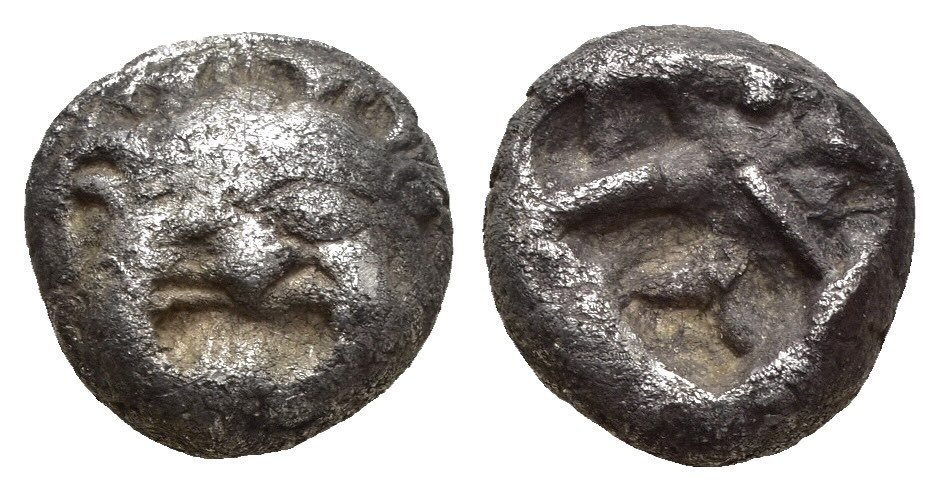
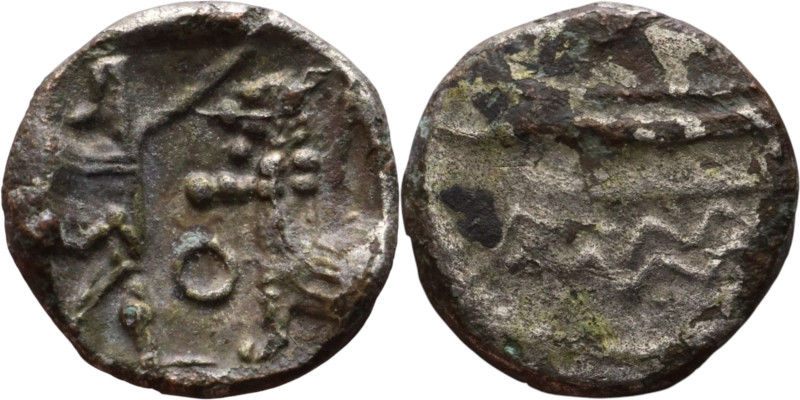
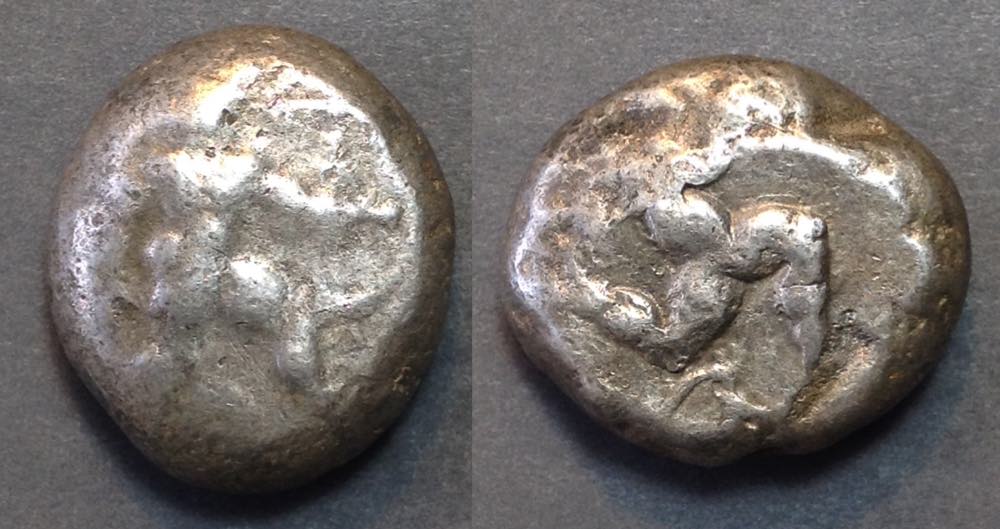
Aspendos, 465-430 BC. Here are formerly-rare staters of the first issue from Aspendos in Pamphylia (in Turkey). These are from a hoard from 2018 or 2019. The hoard has been disbursed and they are not appearing much any more. The coins are all remarkably thick. Silver staters c. 19 mm and c. 10.8 grams.  Did you think you could get a thick stater from c. 465-430 B.C. for under $100?  Archaic! Old! 

c. 465-430 B.C.  The very first issue of Aspendos (Aspendus, Pamphylia, Turkey)
Silver stater.  18 mm. 10.95 grams.
Very thick (5 mm) archaic flan.
Hoplite warrior with spear and shield right
Triskeles of three human legs running right. 

SNG France 3, #1 (the very first type of Aspendos) c. 465-430 BC.
Sear Greek 5381. A hefty chuck of archaic silver. I find it amazing that you can buy an archaic silver stater from well before 400 BC for only [$97] $97 for a stater!

Compare to this auction example:  https://www.romanumismatics.com/189-lot-317-pamphylia-aspendos-ar-stater?auction_id=46&view=lot_detail
or this one:  https://www.romanumismatics.com/189-lot-318-pamphylia-aspendos-ar-stater?auction_id=46&view=lot_detail

I have a web page on this type:  http://augustuscoins.com/ed/interesting/triskeles.html


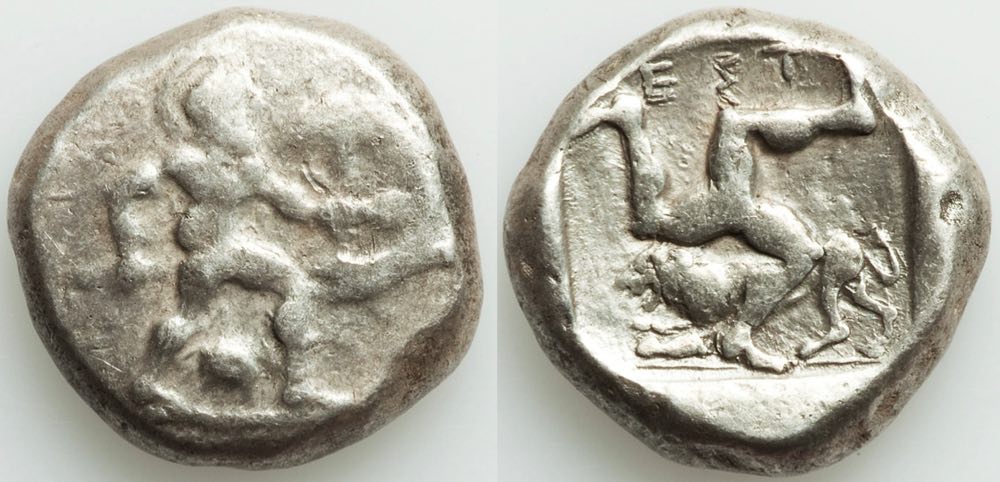
Pamphlyia, Aspendos
465-430 BC
(Later the city has the well-known Slinger and wrestlers type)
Thick silver 20-19 mm. 10.95 grams.
Hoplite warrior right holding spear horizontal and shield in left, turtle between legs
Triskeles (three human legs running) 
lion standing left behind lower leg [What an interesting type!]
EΣT  which abbreviates in Greek the city name in the Pamphylian language
--ESTEFΔIIYI (for "Estwediiys") all well-centered in an incuse square
A very old dumpy thick archaic coin! Very nice triskeles and lion. Much rarer (and more interesting) with the lion. [$355, reduced to $325]


Greek Silver Fractions 

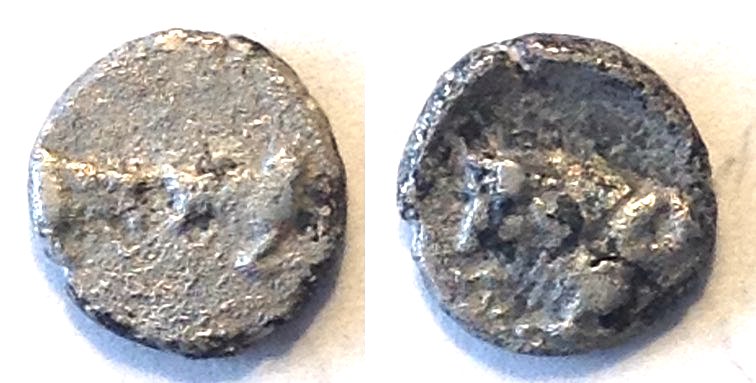
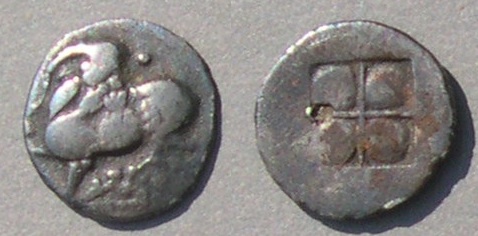
Mygdones or Krestones (Thraco-Macedonian tribes)
Previously attributed to Aegae, Thrace
before 490 BC
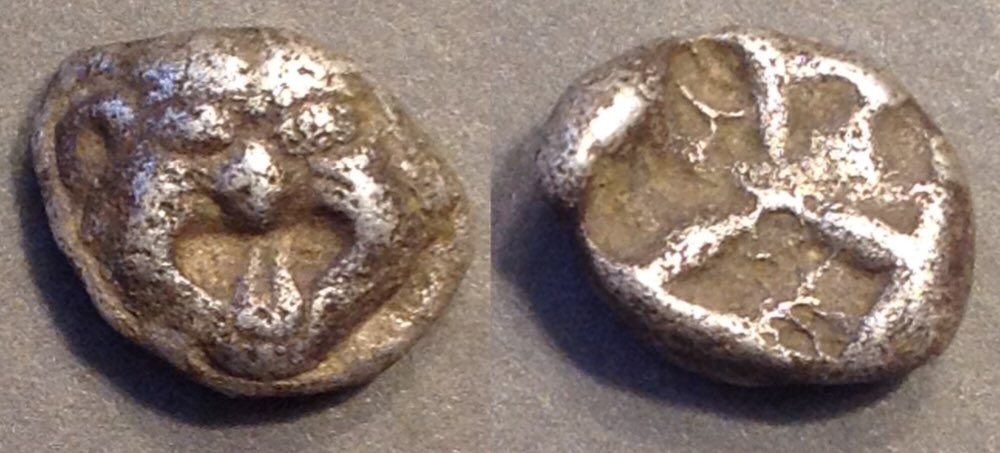
11 mm. 0.84 grams. Diobol.
Goat left, head back
four-part incuse square
New attribution: Hoover HGC 3.1 #368.
Older attributions: SNG ANS 7 Macedonia 1, plate 3, #65.
Kraay, Archaic and Classical, p. 141 [490]
Sear Greek 1293v (has the goat in the other direction)
ex. F. J. Rath list 1/19/1972, lot 290
and with my ticket. Nicely centered.  [$55, reduced to $45]


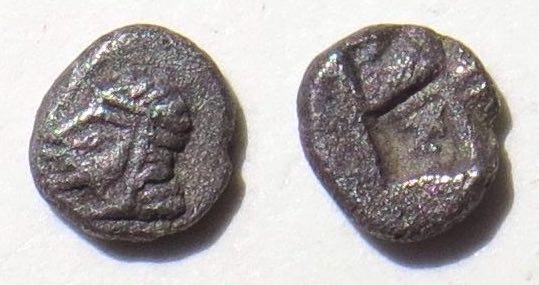
Tiny!  7-6 mm and only 0.38 grams.
Hemiobol.
Kolophon, Ionia
Late 6th C. B.C.  OLD
Archaic head of Apollo left
Four-part incuse square.
Klein --, but 339 is half the weight. SNG Kayhan 342
Sear Greek --. Rosen --, but 386 is half the weight (0.19 grams) 
[$45, reduced to $39, reduced to $32]  (Compare, as always, to vcoins prices)
A small Greek fraction. 
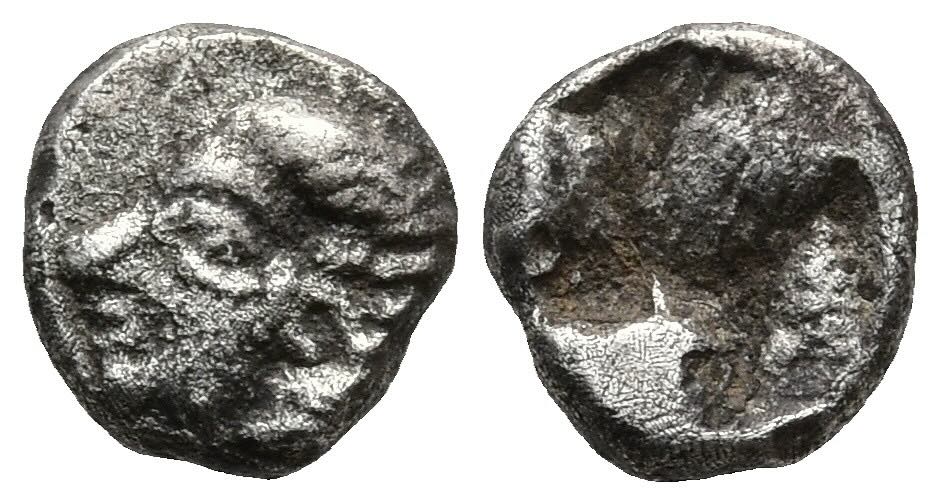
 

Tiny!  5.5 mm maximim. 0.21 grams. Tetartemorion denomination (quarter obol)
Ionia. Kolophon. 
"Late 6th C. B.C." according the SNG Turkey I Kayhan 343, plate 14.
SNG von Aulock I 1810. 
Sear Greek II 4343 variety. 
Archaic head left/millsale pattern incuse
[$29, reduced to $26]  
This might be both the oldest and smallest coin in your collection. 
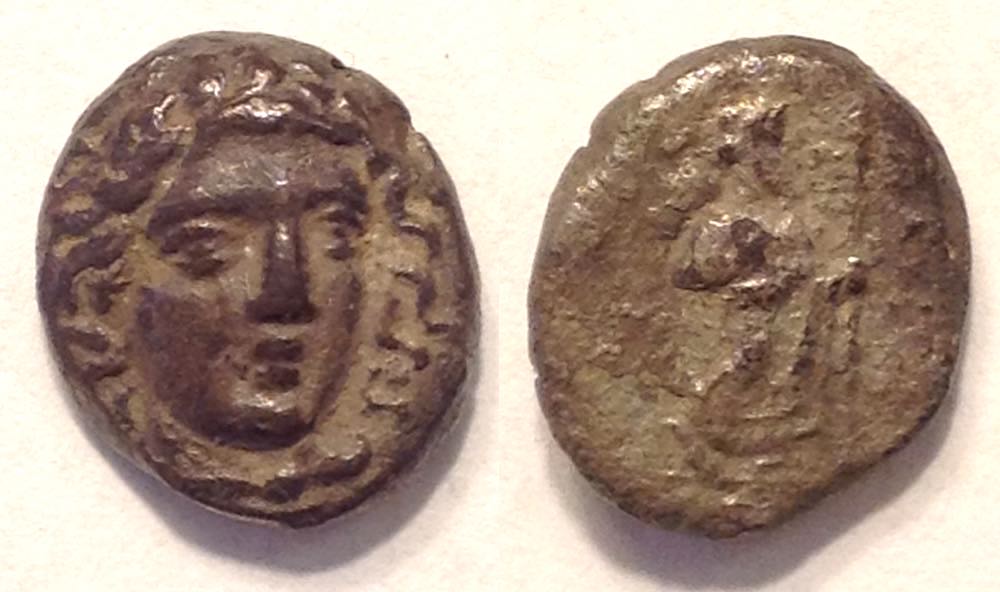

Satrap of Caria. Hidrieus, 351-344 BC.
12-10 mm. Small coin. 1.71 grams. Hemidrachm. 
Mint: Halikarnassos
Apollo head 3/4 facing right
Zeus Labraundos standing right holding labrys (double ax) and spear, to right, downwards letters spelling the satrap's name:  IΔPIEΩΣ (barely visible)

Sear Greek 4961  SNG von Aulock 2369 (This bust is better than von Aulock's). Very nice facing bust. None on vcoins as I write. [$89, reduced to $75]
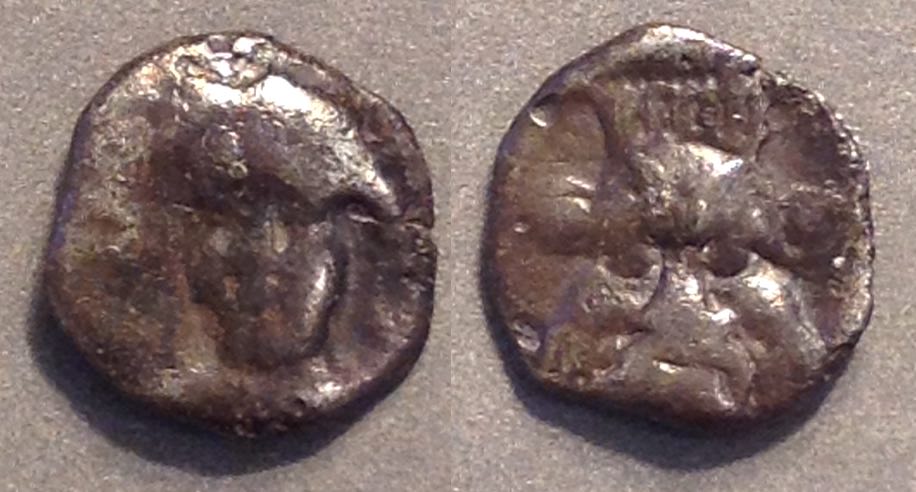
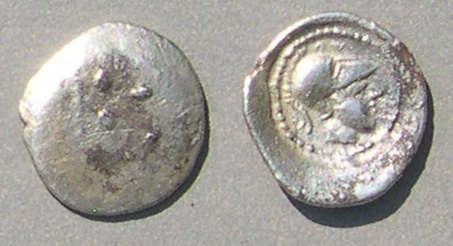
Cilicia, obol.
9 mm. 0.50 grams.
Mint city uncertain, possibly Mallos or Tarsos according to Levante
facing female head, slightly left
Bes facing (a remarkably ugly god)
Wikipedia says, "Ancient Egyptian deity worshipped as a protector of households and, in particular, of mothers, children and childbirth. Bes later came to be regarded as the defender of everything good and the enemy of all that is bad."  
SNG Levante 233. SNG France 2 (Cilicie) 486.
[$39, reduced to $29]
 

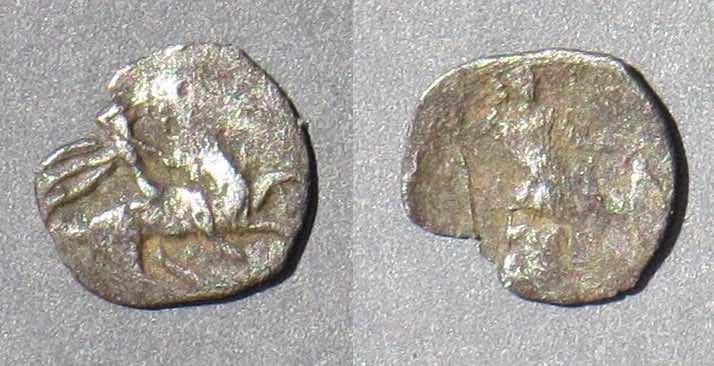
Cilicia,
9-8 mm. 0.18 grams. Very small.
Horseman right with cape flying behind
Athena standing right, vertical scepter in left, left arm resting on shield.
SNG Levante 256 is this type but 0.36 grams. "Possibly 4th C. B.C."
Rare [$19, reduced to $11]

 
Caria, uncertain city before 440 BC [Keckman]
confronted foreparts of two bulls
bull forepart left
7 mm. 0.28 grams.  Small!
SNG Finland Keckman Karia I 914.
SNG Turkey I 968 "Milesian standard tetartemorion"
Sera Greek -- (might fit after 4949)
Three bulls on one coin!  Rough surfaces. [$17, reduced to $13]


Uncertain Lycian Dynast
10 mm. Small. 0.56 grams.
ex Hirsch auction 205, 22-25 Sept. 1999, lot 408
PR 102 DM. "RRRR" "480-440 BC"
Very weak lion's scalp facing(?)
head in crested Corinthian helmet right
[$44, reduced to $37] Illustrated auction pedigree to 1999. In the US only I'll include the Hirsch auction-sale catalog which illustrates this coin and has over 1000 ancient coins and some antiquities]


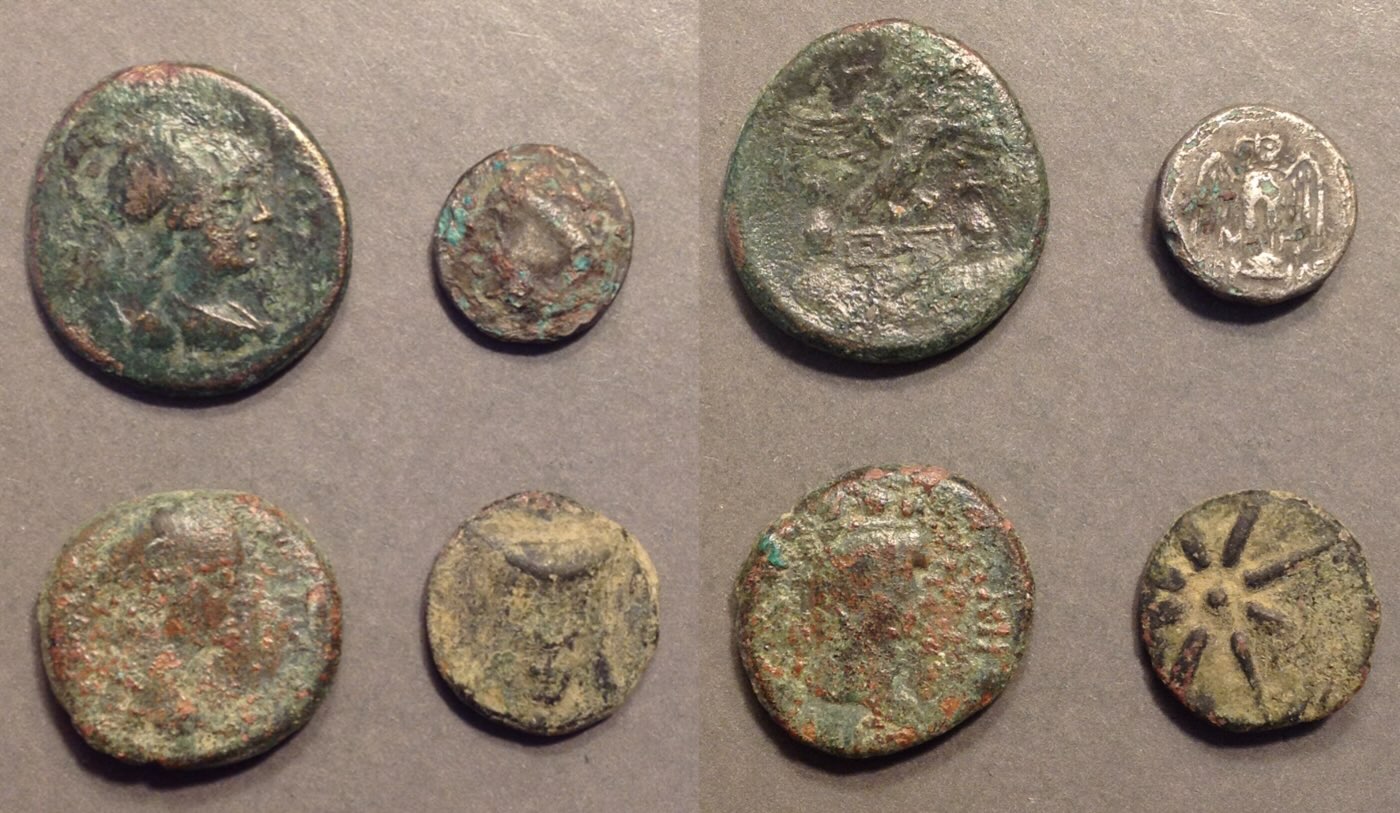
Greek AE:

A rarity. Very few coins of this king are ever offered:

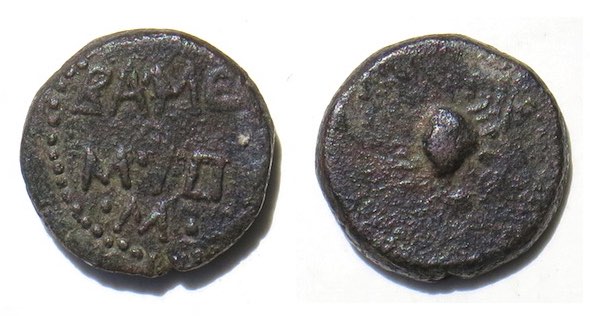
King Mithrades III of Commagene
20 BC - 12 AD (contemporary of Augustus)
18 mm. 6.94 grams.
crab (probably astrological)
BAME
M•TOY
•M•
(BAsileus)ME(glon)
M(ithradates)TOY
M(ithradates)
Alram 249 page 84.
(Sullivan, on Commagne, gives this to Mithradates II, not III)
BMC -- but has discussion under Galatia of the Kingdom and its concern about astrology
MunzZentrum 73 (1992 April 22) had one, lot 1044 "sehr selten".  F. Imhof-Blumer ZfN 1874, page 332.  If you want one of each Greek king, here is one of the most obscure Kings and you won't find a portrait piece! (or, any piece at all except this one) [$145, reduced to $95] Rare. If you collect one of each Greek king, bookmark this page, look around for a while, and come back when you have convinced yourself you won't find another one. 


Jewish:  

[sold]


Oriental Greek

Parthian

[sold]


Persis, a kingdom in southern Iran at the time of the Parthians
.

See my site for more about it: http://augustuscoins.com/ed/Persis/.
There is an excellent very well-illustrated book on its coins by van't Haaff which is free in pdf form at the CNG site:
https://cngcoins.com/Digital+Publications+Archive.aspx


Persis 


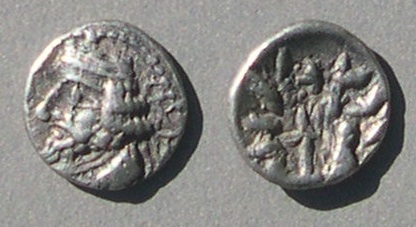
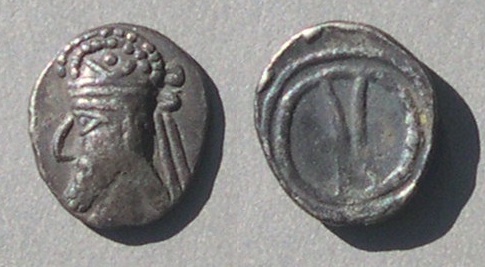
Persis. King Vahsir (son of Darius II)
Obol. 9 mm. 0.60 grams. Small. 
Bust of king left, monogram behind
Fire altar
van't Haaff 584, Alram 584. Sear Greek --
[$39]


Persis. "Prince Y"
Obol. 11-10 mm. 1.05 grams. 
His bust left
diadem
van't Haaff 619.1
Sear Greek Imperial 5956
None on vcoins or MA-Shops as I write. 
Nicely centered and toned [$49]


Sasanian and related types: 

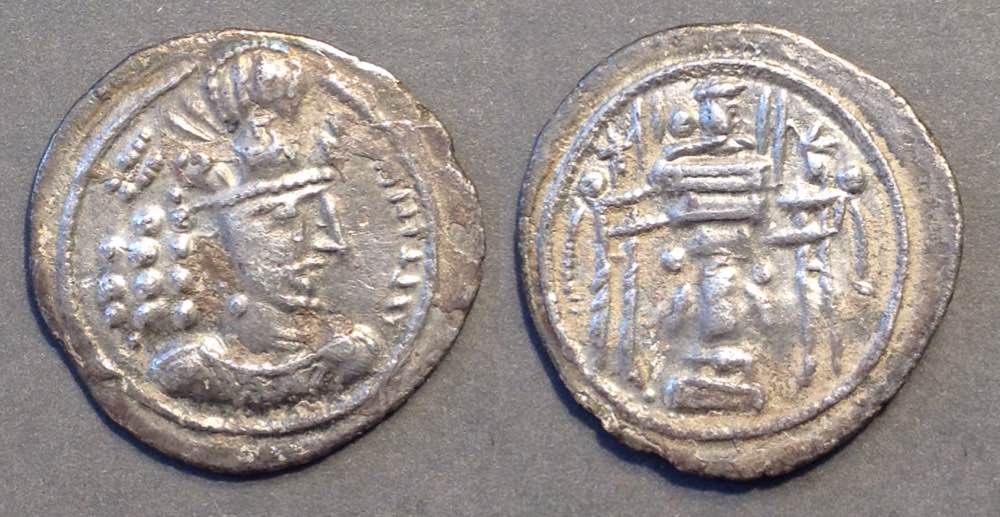
Sasanian. Shapur II. Reigned 309-379. That's long!
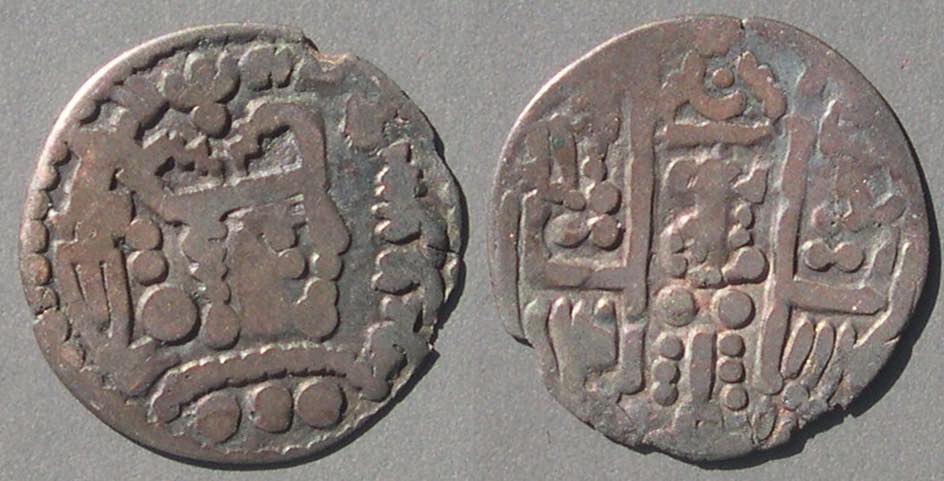
He was in charge when Julian II lost his life while invading Mesopotamia.
23-22 mm. Full size and weight, 4.06 grams.
Note:  His drachms come in two sizes, one is larger and thinner, and the other is this size, which is thicker. 
Crude pseudo-inscription, which is typical of eastern mints. 
Sellwood 32. Gobl 127, plate 8. Amini 393.
[$69]  [As always, compare to the vcoins selection.]


Bukhara, Kingdom of Sogdiana
25 mm. Thin like a Sasanian drachm.
c. 8th C.
Calif al Mahdi
Mitchner 1395 "AH 158-169" AD 770-785
Bokharin style bust right with Bokharan legend in Sogdian script
Bunar Hub k'ay
(Great Lord of Bukhara)
Stylized fire altar and attendents (imitating Sasanian types)
This basic type lasted a long time. Some are mostly silver and later ones mostly copper. This one is toward the coppery end. [$35]
 

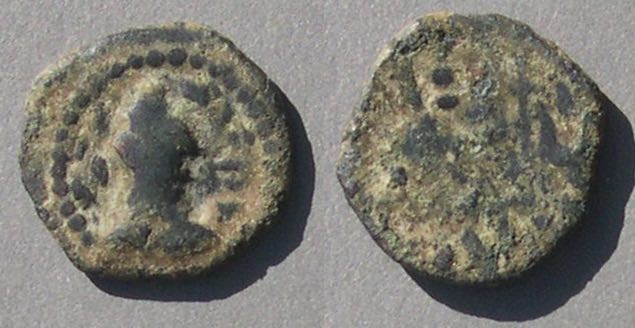
Hephthalite. 1/4 drachm. Some call it a half, but it is both lighter and baser than their drachms.
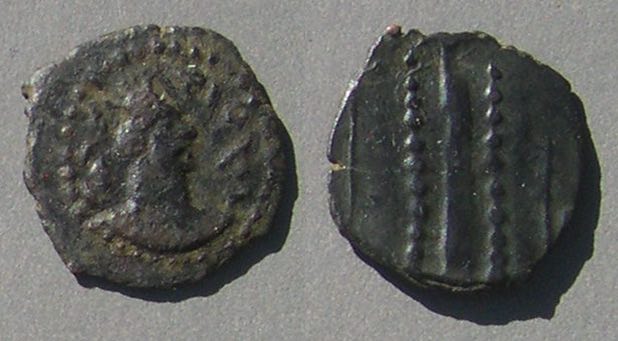
"c. 460-560/576" according to Mitchner ACW page 232
AE16. 1.82 grams. (Not super thin.)
Napki Malik type.
Bust right/a few dots and lines 
Rare. [$17]
Mitchner 1495 


Hephthalite. 1/4 drachm. Some call it a half, but it is both lighter and baser than their drachms.
"c. 460-560/576" according to Mitchner ACW page 232
AE16-15. 1.43 grams. 
Napki Malik type.
Bust right/a few dots and lines 
Rare. Black. Good for type. The reverse, which is degenerate, is far bolder and better than most. The obverse looks like the usual drachm, but this is much smaller. [$24]
Mitchner 1495 


 Indo-Greek
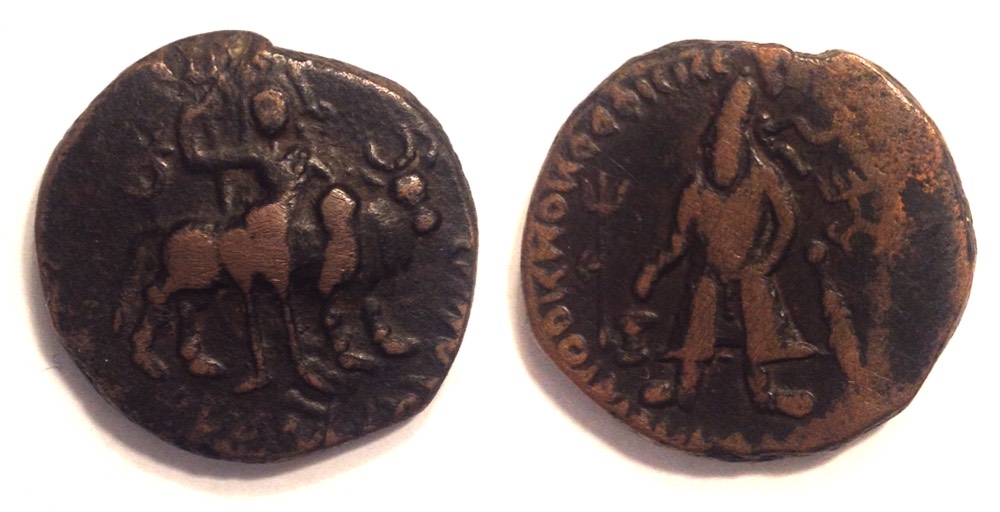
27-26 mm. 16.85 grams. Large and heavy.
Kushan Kadphises Ic. 100-127 AD AD
King
Siva and bull
[$45]


This page above:  Newest first. Then Greek silver,  Greek AE,  Oriental Greek


Next page: Byzantine coinsReturn to the top for links to other pages.