Collecting Constantinian coins
Coins of Constantine The Great (AD 307-337) and his relatives are very common, inexpensive, and fun to collect. This page considers only inexpensive copper coins and ignores gold and silver. It begins with coins of Constantine, continues with coins of his four sons, and then adds in other close relatives including his wife and his mother.
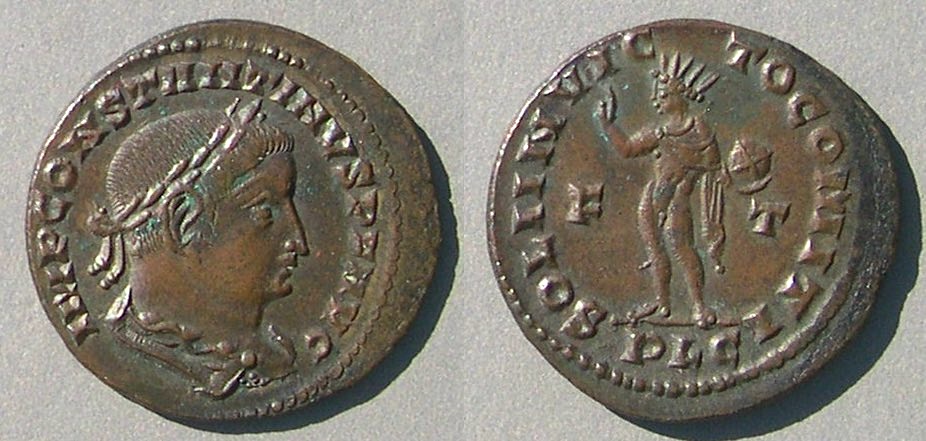 Constantine is known as "The Great" for being the first emperor to support Christianity. Before the famous Battle of the Milvian Bridge at Rome in 312, Constantine was told by the Christian god he would conquer if he inscribed the soldiers' shields with the sign of Christ. He did and won one of the most consequential battles of all time. He initiated the conversion of the empire away from the old classical gods to Christianity.
Constantine presided over the Council of Nicaea in 325 during which he forced the bishops to compose and settle on one statement of Christian belief they could all support (but, not all did). The result was the "Nicaean Creed," still used by many Christian churches today. Nevertheless, very few of his coins refer to Christianity (and those that do are much more expensive).
Many of his coins refer to the old gods including the sun god, Sol, Mars, and Jupiter, as well as Hercules.
The coin to the above right: Constantine. 24-22 mm. SOLI INVICTO COMITI. The sun god Sol standing left, radiate (the sun's rays), with right hand raised in greeting and globe in left. This reverse type with Sol was struck from 309 through 318. This type with the sun god shows Constantine was not fully committed to Christianity, even after his so-called "conversion" in 312. Constantine was the first Christian emperor, but that does not mean his coin types were Christian types.
Reference: RIC VI Lyons 309. (References are given at the end.)
Constantine founded Constantinople ("Constantine's city," now named Istanbul in Turkey) in 326 and dedicated it in 330. It became the capitol of the Roman empire for over a thousand years. There are very many attractive and inexpensive coins struck to commemorate its foundation.
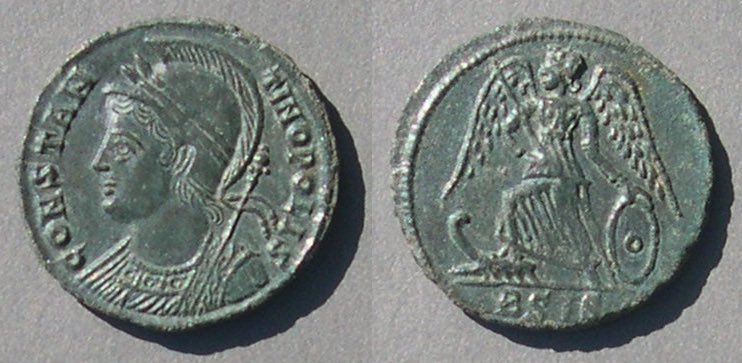 CONSTANTINOPOLIS, an anonomous type not mentioning an emperor.
18 mm. 2.27 grams.
The personification of Constantinople, facing left, helmeted and holding a scepter.
Victory standing left on the (tiny) prow of a galley (see the oars?)
BSIS for B = second workshop, and SIS for the mint Siscia.
RIC VI Siscia 224, struck "330-333".
Sear IV 16468.
This type is very common and available for maybe $25.
This site has a page on the types associated with the foundation of Constantinople.
A friend of mine collects nothing but coins of Constantine. There are many websites displaying coins of Constantine (for example, this one). His coins refer to classical gods such as Mars and Jupiter, particular victories, the army, vows, arrivals, and a host of other topics. In 316 when Constantine was emperor in the west, Licinius was emperor in the east and minted coins with Jupiter as the reverse type. As co-ruler, Constantine was included in issues from mints of Licinius, although he didn't issue coins with Jupiter for himself.
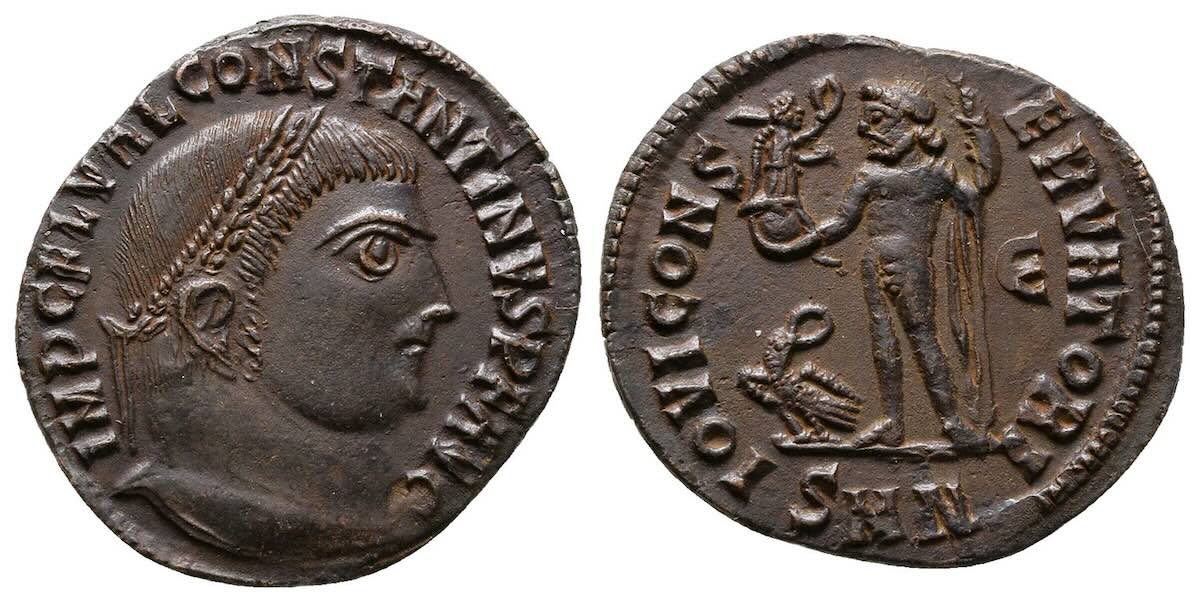 Constantine
21-18 mm. 2.56 grams.
IMP C FL VAL CONSTANTINVS PF AVG
Imperator Caesar Flavius Valerius ...
IOVI CONSERVATORI
Iove = Jupiter, king of the gods.
Jupiter standing left, holding Victory on globe, Victory crowning him with wreath, eagle with wreath at feet left.
SMN (Sacra Moneta Nicomedia)
RIC VII Nicomedia 12 Struck "316". RIC lists this exact variety as "r1" which means "rare," but there are so many similar varieties that it is fair to say this type is very common. This particular coin, which is in very high grade, cost me $30 in 2024.
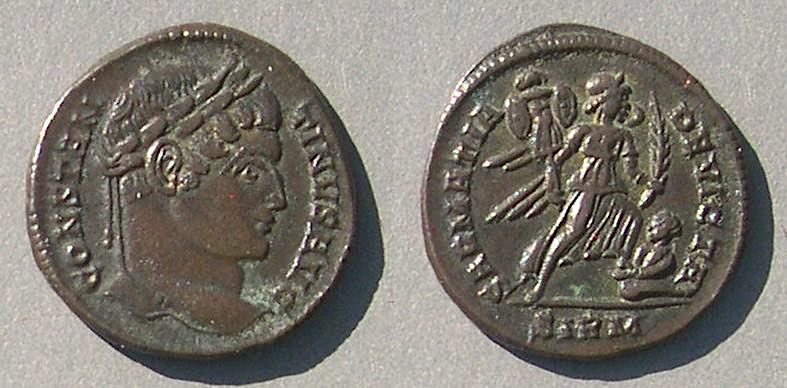 Constantine
18 mm.
CONSTANTINVS AVG
Head right, laureate
SARMATIA DEVICTA
Winged Victory advancing right holding trophy of arms and a palm branch (signifying peace), captive at feet
SIRM in exergue.
RIC VII Sirmium 48, struck "324-5".
This type celebrates his victory in the Sarmatian war on the Danube frontier in 322. The same mint at the same time issued this same design with legend ALAMANNIA DEVICTA for Crispus and Constantine II. Many earlier Roman coins celebrate and mention particular victories, but these two types are the last to mention particular victories.
Constantine's Four Sons. A type set of Roman emperors would include coins of each of his four sons: Crispus, Constantine II, Constantius II, and Constans. Each was elevated to the rank of Caesar and all but Crispus became Augusti in 337.
Crispus. Crispus was Constantine's first son, by his first wife Minervina. He was made admiral of the fleet and had navel success in the second civil war between Constantine and Licinius in 324. Crispus was executed in 326 by his father Constantine. Apparently he was falsely accused of crimes by Fausta, his stepmother, second wife of Constantine, who naturally favored her own sons and wanted the eldest, Crispus, out of the way. When Constantine (too late) realized he had been deceived, he executed Fausta too. Nevertheless, Fausta's sons inherited the empire when Constantine died in 337.
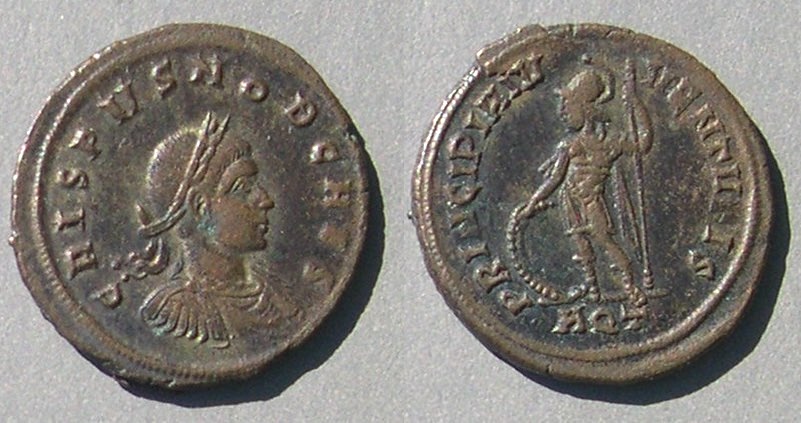 Crispus, Caesar 317-326.
21-20 mm. 3.33 grams.
CRISPVS NOB CAES
Bust right, laureate, draped, and cuirassed.
PRINCIPIA IVVENTVTIS
(Prince of youth)
Emperor standing left resting right hand on shield and holding long vertical scepter with his right hand.
RIC VII Aquileia 9 struck in 317.
Crispus was never Augustus. All the types of Crispus are listed here.
Constantine II. To cement relations between co-rulers, Constantine had to divorce Minevina and marry Fausta, the daughter of the western Augustus Maximian. They had three sons. Constantine II was the eldest, born in 316. When Crispus and Licinius II were made Caesars in 317, so was Constantine II in spite of being only one year old. His first coins make him look much older, but at least they portray a boy and not a man. When Constantine died in 337, Constantine II was about 21 and inherited the western third of the empire. Not content with that, in 340 Constantine II invaded the central region ruled by Constans and was killed in an ambush.
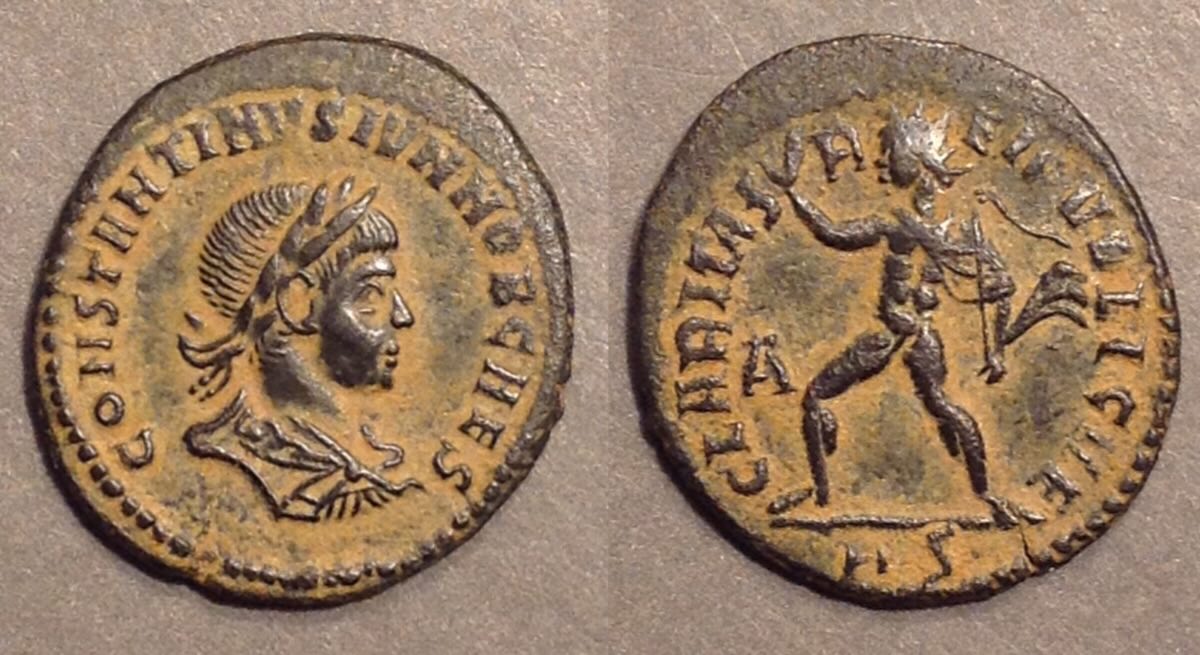 Constantine II, Caesar 317-337 and Augustus 337-340.
20-19 mm. 2.67 grams.
His first issue, with a reverse especially type for him.
CONSTANTINVS IVN NOB CAES
(Constantine Junior Noble Caesar)
Bust right, laureate, draped, and cuirassed.
CLARITAS REIPVBLIVAE
The sun god Sol advancing left with right hand raised and left holding a whip, cloak flying behind.
RS in exergue
RIC VII Rome 84, struck 317.
Sear V 17114
All the types of Constantine II are listed here.
Constantius II. Constantius II was born in 317, made Caesar in 324, and became Augustus after Constantine's death in 337. He ruled until 361 when he died of natural causes, aged 44.
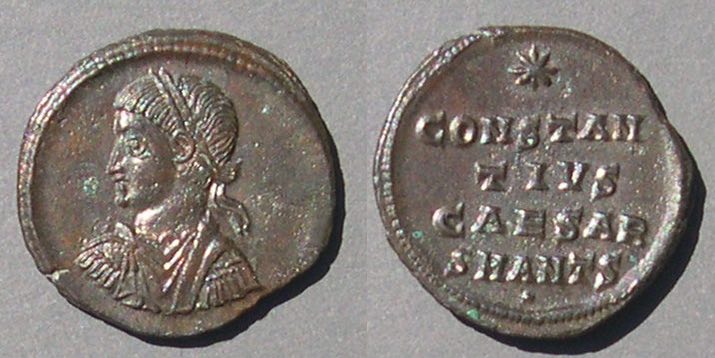 Constantius II, as Caesar. Caesar 324-337 and Augustus 337-361.
18 mm.
No obverse legend. The term for that is "anepigraphic."
The reverse has no design other than its legend
✳
CONSTAN
TIVS
CAESAR
SMANTS (Sacra Moneta Antioch, officina S)
•
RIC VII Antioch 60s. Struck 324-5.
Anepigraphic obverses were struck for six members of the family at this time: Constantine, Constantine II, Constantius II, Crispus, Fausta, and Helena. That would make a nice mini-theme collection. The two women are hard to find and expensive.
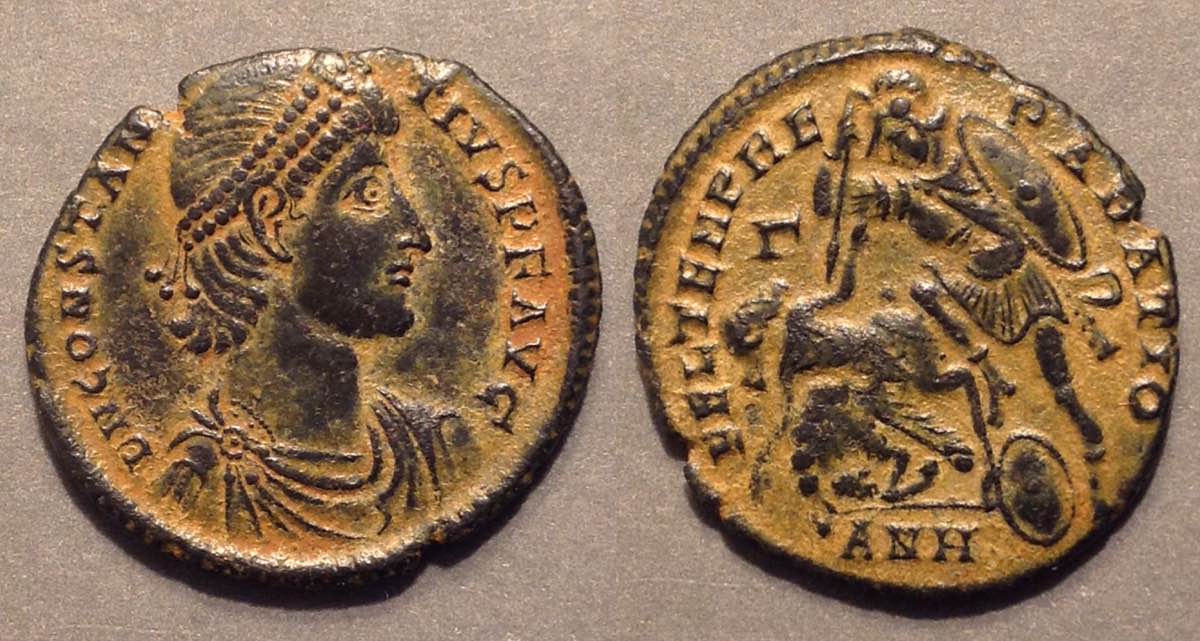 Constantius II, as Augustus, after the coin reform of 348 when FEL TEMP REPARATIO types were introduced.
FEL TEMP REPARATIO = "Happy times are here again."
23-22 mm. 4.77 grams.
DN CONSTANTIVS PF AVG
Bust right, pearl-diademed, draped, and cuirassed
FEL TEMP REPARATIO
The extremely common "soldier spearing fallen horseman" type in which a very large Roman soldier spears downward into a smaller barbarian horseman reaching back while mounted on a small falling horse, with his shield on the gound to the right.
ANH in exergue for Antioch, officina H = 8. Γ in upper left field.
RIC VIII Antioch 132.
This coin is worth maybe $30-$40 in 2026.
All the types of Constantius II are listed here.
Constans. Constans was born in 320 and made Caesar in 333. In 337 when Constantine died he inherited the central region of the empire and became Augustus. In 340 Constans inherited the west when Constantine II was killed invading the territory of Constans. Constans was killed in 350 during the usurpation of Magnentius in the West.
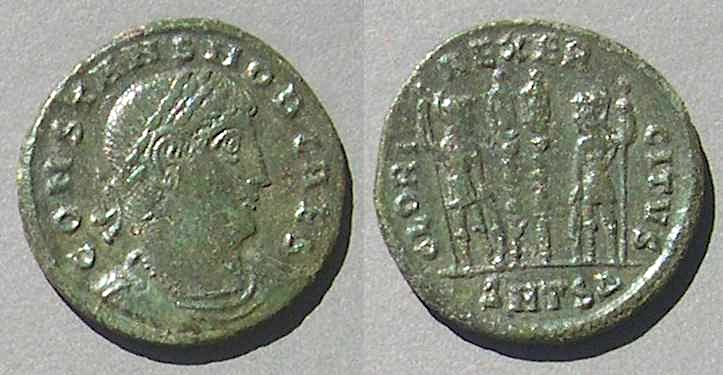 Constans, as Caesar. Caesar 333-337 and Augustus 337-350.
18 mm. 2.56 grams.
CONSTANS NOB CAES
Bust right, laureate, draped, and cuirassed
GLORIA EXERCITVS (Glory of the Army)
Two soldiers and two standards
SMTSΔ (Sacra Moneta Thessalonica officina 4)
RIC VII Thessaloncia 201, struck 335-6.
Constans does not have a wide variety of types as Caesar, unlike his brothers who were Caesars when there were numerous reverse types before 330. After 330 each brother had only two reverse types as Caesar and they were very similar; one was this type with legend GLORIA EXERCITVS two soldiers and two standards and the second had the same legend and design but only one standard and it was slightly smaller. It is worth only $15-$30. Because Constans did not become Caesar until 333, he had only those two reverse types. But, he has interesting types as Augustus.
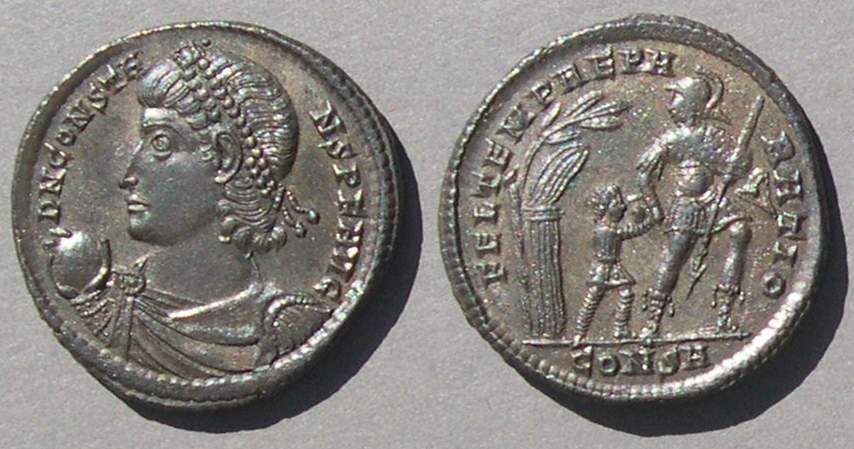 Constans, as Augustus, after the coin reform of 348 when FEL TEMP REPARATIO types were introduced.
22 mm. 4.71 grams.
DN CONSTANS PF AVG
Bust left, holding globe. Pearl-diademed, draped, and cuirassed.
FEL TEMP REPARATIO
Large soldier with reversed spear leading small figure from "hut" with a tree arching over it behind.
RIC VIII Constantinople 86.
Sear V 18697.
The meaning of this type has been debated without a consenus emerging. I see it as the Romans helping barbarians (see the trousers?) emerge from primitive habitation into the Roman world. Of interest is that each mint has its own, distinctive, type of tree. The type is very common so getting one from each mint is a a possible collecting mini-theme.
A coin in spectacular condition like the one above might cost over $100, but very similar coins in pleasing condition might be only $20-$40.
All the types of Constans are here.
Comment on the definition of "types". Reverse "types" are defined by the legend and design, not including mintmarks and field marks, so each reverse "type" can have numerous "varieties." Also, each ruler can have several portrait types facing right or left and different obverse legends. So, what is called one reverse "type" on this page may correspond to many different types of interest to specialist collector who cares about different mints and different portrait types.
Comment on denominations. Ancient literature rarely mentions coin denominations by name, and when it does, it is usually unclear which types they are referring to. So, as an admission of our ignorance, denominations of the Constantinian period are often described by size using "AEx" where AE1 is over 25 mm, AE2 is 25-22 mm, AE3 is 21-17 mm (the size of most Constantinian coins), and AE4 is 16 mm and smaller. For comparison, a US dime is 18 mm and a US nickle is 21 mm.
The portrait series could add in coins of his wife, Fausta, his mother, Helena, and his father, Constantius I. It might also include his father-in-law, Maximian.
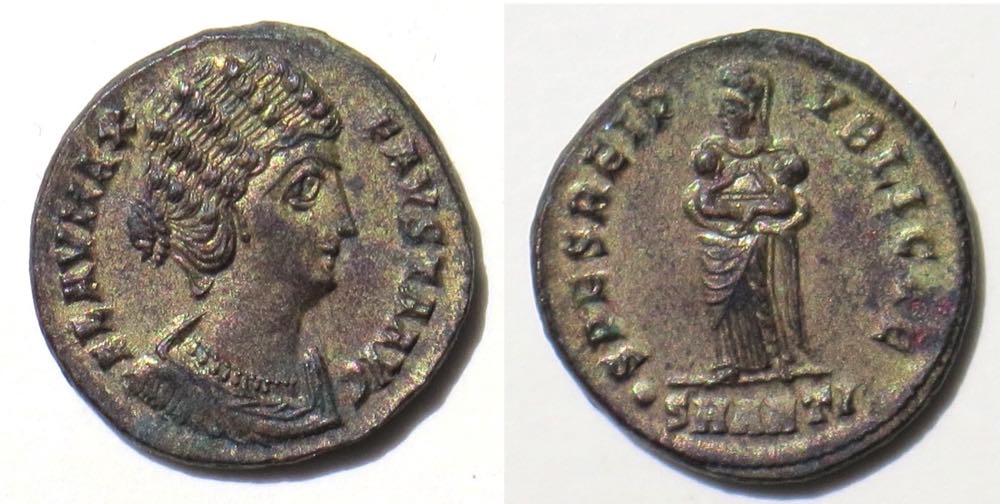 Fausta, wife of Constantine 307-326
19 mm. 3.52 grams.
FLAV MAX FAVSTA AVG
SPES REIPVBLICAE
Empress holding two children (Constantine II and Constantius II)
• SMANTI
RIC Antioch 77v (because of the dot to the left of the mintmark)
Struck 326.
Helena, Constantine's mother and first wife of Constantius. She died c. 328 and had coins struck for her c. 318-340. She is famous for being a devout Christian who went to the Holy Land and identified many important Christian sites and artifacts, including the "True Cross" of Christ's crucifixion. She is a saint of the Eastern Orthodox church.
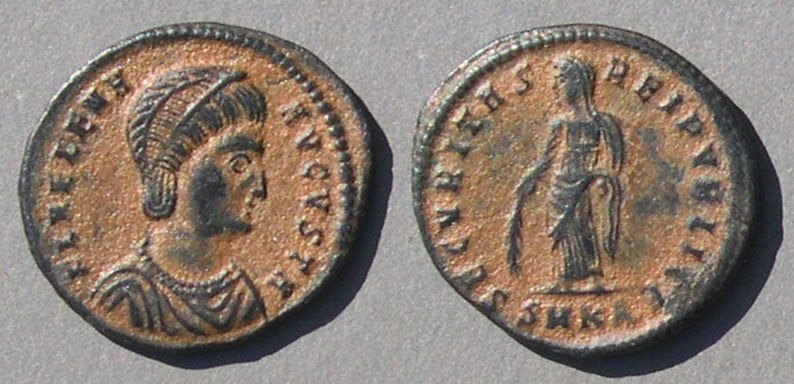 Helena, mother of Constantine.
20 mm. 2.63 grams.
FL HELENA AVGVSTA
Her bust right, with elaborate hairstyle, drapery, and a necklace.
SECVRITAS REIPVBLICE
Securitas standing, lowering branch, raising robe with left.
SMKA
RIC Cyzicus 28, struck 324-5.
Sear IV 16623
Constantius I. Constantius I was one of the original tetrarchs. He was Caesar from 293 under Diocletian and Maximian, and Augustus from 305 when they abdicated. When he died in of natural causes in 306 his troops elevated his son Constantine. Constantius was originally married to Helena, mother of Constantine, but had to marry Theodora (step-daughter of the Augustus Maximian) to cement relations among the tetrarchy.
Constantine was with Constantius in York, England, when he died. The army immediately proclaimed Constantine emperor. There was jockeying about what his precise title should be. Constantine minted coins with the title Caesar 306-7 and then Augustus, but Galerius did not want him to take the title Augustus and gave him (without Constantine's consent) the new title "FIL AVGG" (son of the Augusti) which only appears on coins from mints under the control of Galerius. I have a long page on the events associated with the title FIL AVGG.
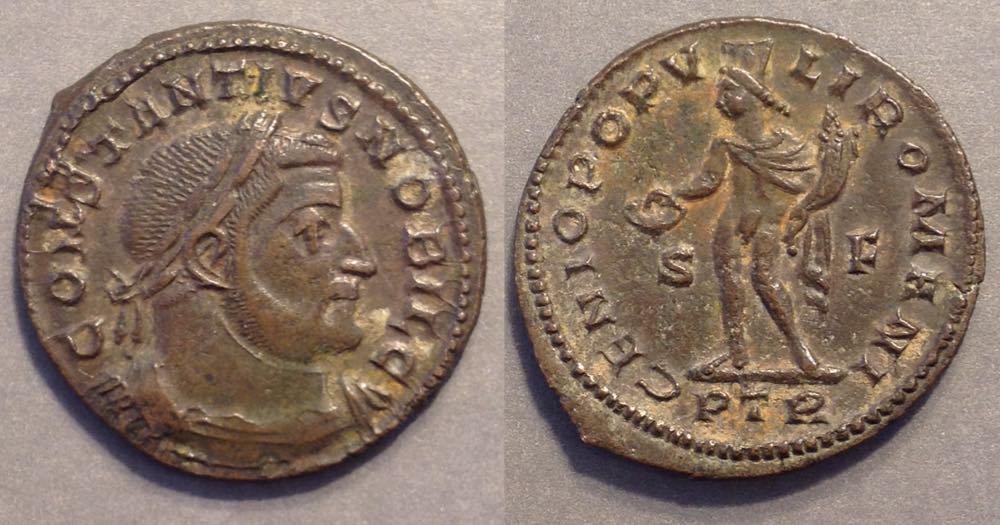 Constantius, father of Constantine. Caesar 293 - 305 and Augustus 305-306.
27 mm. 9.35 grams. A "follis" struck c. 303-305 when he was Caesar.
CONSTANTIVS NOBIL CAES
Bust right, laureate and cuirassed
GENIO POPVLI ROMANI ("Spirit of the people of Rome")
Genius (Spirit) standing left holding out patera in right, cradling cornucopia with left, and naked but for a cloak draped over his left shoulder.
S F (denotes a particular coin issue, but the meaning of the letters is uncertain)
PTR (Prima [first workshop] Trier)
RIC VI Trier 594a "c. 303 - 1 May 305" (when Diocletian and Maximian abdicated and Constantius and Galerius were promoted to Augusti).
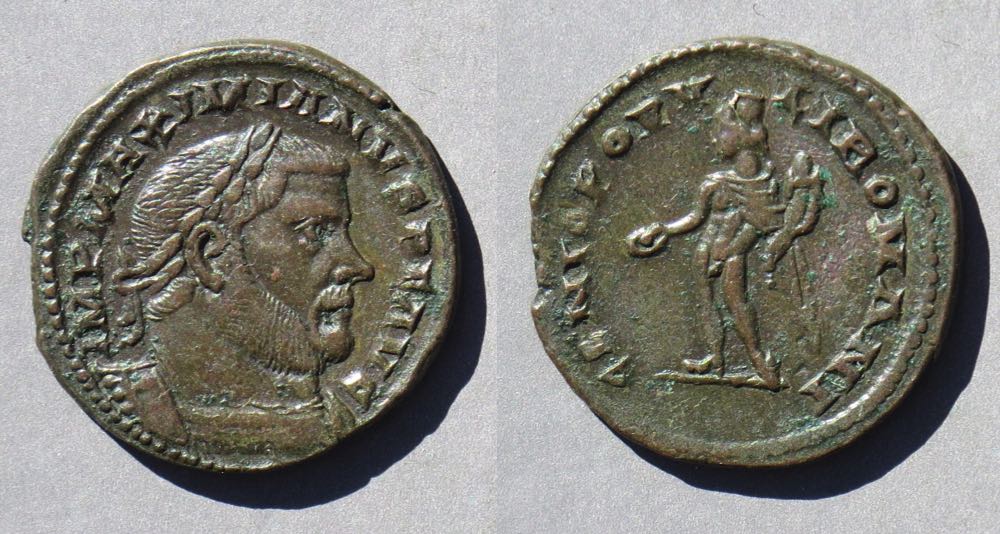 Maximian, father of Fausta, therefore Constantine's father-in-law.
Augustus 286-305. In 305 he, under pressure from Diocletian, abdicated and took the status of "senior," but retired, emperor. He had two comebacks referred to as his second and third reigns. They are discussed on a page about the coins of the abdication of Diocletian and Maximian.
This coin is also a common large follis (28 mm. 9.89 grams) with some extra interest because it was minted in London and because the portrait is especially fine.
IMP MAXIMIANVS PF AVG
(Imperator Maximian Pius Felix Augustus)
Bust right, laureate and cuirassed
GENIO POPVLI ROMANI with Genius as above, but no mintmark, which is attributed to London.
RIC VI London 23b "c. 303 onward"
Sear IV 13237
Maximian and Constantius were members of the original tetrarchy. Several pages on this site discuss coins of the tetrarchy.
Other Relatives on Coins. In 335 Constantine began planning a massive invasion of the Sasanian empire (Persia). In anticipation he elevated two nephews, Delmatius and Hanniballian. Delmatius was to be Caesar in Thrace, Macedonia, and Achaia. Hanniballian was to become the ruler of Mesopotamia after the conquest. However, Constantine died in 337 and the conquest didn't even get started. Each nephew was on coins from 335 to 337, when they were executed in "the summer of blood" in which Constantius II and his brothers consolidated power by executing their relatives.
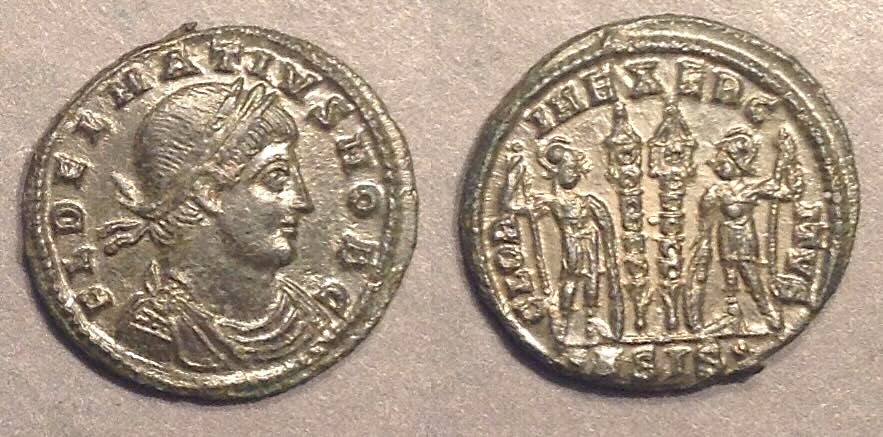 Delmatius, 335-337.
19 mm. 2.40 grams.
FL DELMATIVS NOB C
Bust right, laureate, draped, and cuirassed.
GLORIA EXERCITVS (Glory of the Army)
Two soldiers and two standards.
RIC VII Siscia 239.
Sear IV 16878.
Delmatius has only two types in his name. The other is the one-standard version. The two-standard type is less common because it was discontinued shortly after he was elevated and the one-standard version was struck for longer.
To find Delmatius (with an E) on Wikipedia you will be redirected to Dalmatius (with an A). Nevertheless, his name is correctly spelled with an E, as proven by the fact that the mints all spelled it with E except for two that began with A and switched to E. In October 2026 the Wikipedia entry (still spelled with A) was modified to note the proper spelling.
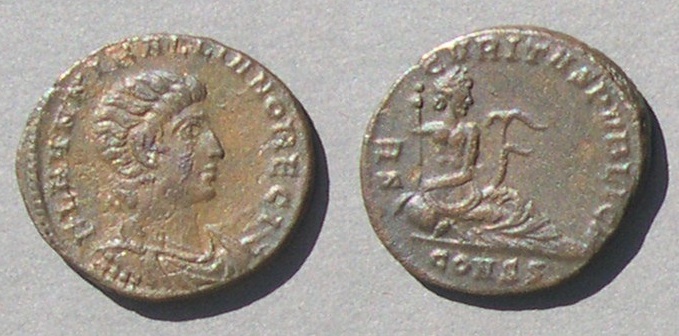 Hanniballianus, 335-337, as Rex.
17-15 mm. 1.71 grams.
FL HANNIBALLIANO REGI (The only appearance of "king" on Roman coins)
Bust right, bare-headed, draped, and cuirassed.
SECVRITA PVBLICA
The river-god Euphrates reclining right, holding scepter, with urn at his right hip spilling water (just above the exergual line), reed behind.
CONSS
RIC VII Constantinople 147. RIC says it is very rare, but many have appeared since RIC VII was written.
Sear IV 16905.
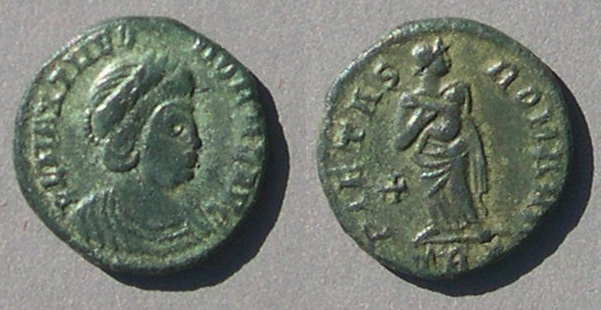 Theodora, second wife of Constantius and step-daughter of Maximian. She had six children with Constantius and was the grandmother of Delmatius, Hanniballian, and emperor Julian II.
14 mm. 1.96 grams.
FL MAX THEODORA AVG
Bust right, mantle and necklace, hair elaborately dressed
PIETAS ROMANA
Pietas standing right holding child in arms
TRS
RIC VIII Trier 43. Struck 337-340 (or 335 according to Callu, SNR 1972-1977, page 196).
Scarce. The Christian cross in the left field is important and increases the coin's value.
Sear V 17499.
Still more Relatives on Coins. Constantius Gallus (351-354) and Julian (355-363) were grandsons of Constantius and Theodora. In 337 both were too young to be a threat to Constantius II who arranged for the other relatives to be killed. In 350, Magnentius revolted in the west and killed Constans. Constantius II needed to move west to confront the usurper. So, he appointed Gallus Caesar in the East, who then took up residence in Antioch. In 353 Magnentius was defeated in battle by Constantius II and committed suicide. Meanwhile, Gallus was a harsh ruler who alienated his subjects. When convincing proof of this was presented to Constantius II, he deceptively asked Gallus to come to him with the expectation of promotion. On the way Gallus was put to death in 354.
Julian II was the younger half-brother of Gallus. After Gallus was executed in 354 Julian was promoted to Caesar in the West in 355. Constantius II then ruled the East. Julian had no love for Constantius II, who had executed Julian's father. Also, Julian was a firm pagan who supported the old gods while Constantius II was a Christian. In 360 Julian's troops in Paris proclaimed him Augustus and the civil war was on. However, Constantius II died in 361 of natural causes before major battles occurred. Constantius II named Julian as his successor, avoiding further civil war. Julian became sole emperor. He invaded Persia and after initial successes died in battle in 363. A general, Jovian, was selected emperor and withdrew the troops after making concessions to the Persians.
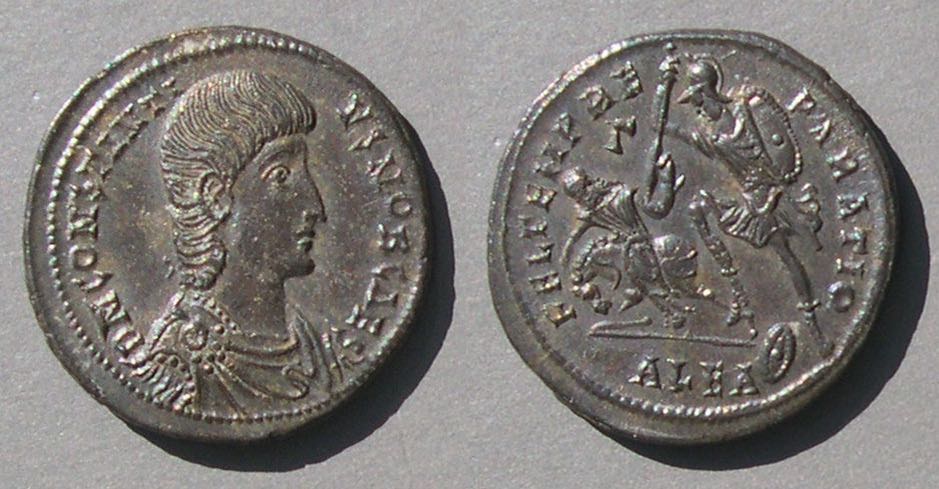 Constantius Gallus, Caesar 351-354.
24-23 mm. 6.14 grams.
DN CONSTANTIVS NOB CAES
Bust right, bare-headed and cuirassed.
FEL TEMP REPARATIO
Soldier spearing fallen horseman.
RIC VIII Alexandria 74.
Constantius Gallus was made Caesar in 351, years after the "FEL TEMP REPARATIO" coin reform of 348. All his types are either from that reform or types issued by Vetranio in 350.
Gallus is distinguished from Constantius II by being bare-headed and by being Caesar.
All the reverse types of Constantius Gallus are here.
Julian was made Caesar in 355 by which time the coin types of the 348 "FEL TEMP REPARATIO" coin reform were either discontinued or much reduced in size. Julian's soldier-spearing-fallen-horseman coins are only 17 mm in diameter in contrast to those issued in 348 which were 24-23 mm. As Augustus he introduced a new, larger denomination we call "AE1."
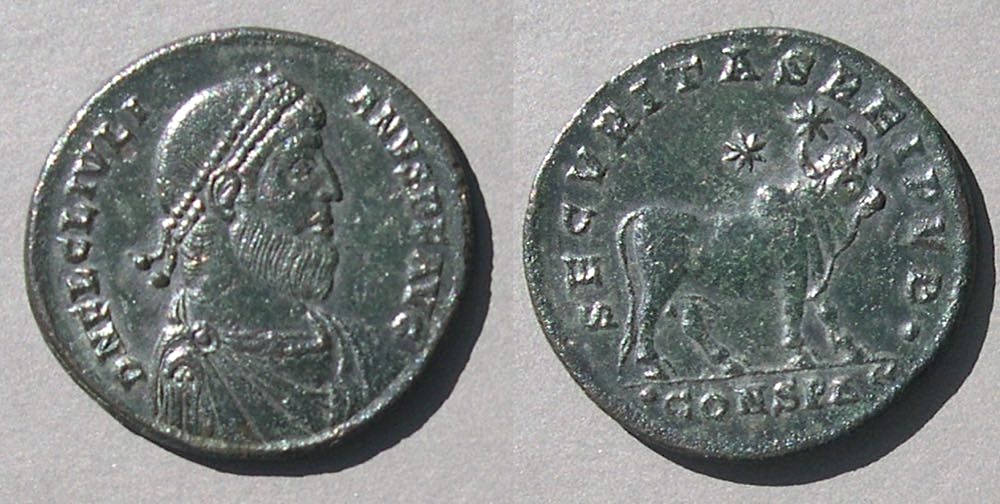 Julian II, Caesar 355-360 and Augustus 360-363.
28 mm. 8.57 grams.
DN FL CL IVLIANVS PF AVG
Dominus Nostrum (our lord) Flavius Claudius Julian Pius Felix Augustus
SECVRITAS REIPVB •
Bull standing right, two stars above.
• CONSPΔ
RIC Constantinople 167, struck "3 November 361 to 26 June 363."
Julian advertised that he was pagan with his long philosopher's beard. (As you can see from the coins, Christians had coins without beards.) Also, bulls play an important role in pagan religions. The precise identity and meaning of the this bull on the reverse has been hotly debated for a century. You can have lots of fun looking up the arguments. One of the joys of ancient-coin collecting is that not everything is known.
All the reverse types of Julian II are here.
Coins of Gallus and Julian II are common, but not as common as coins of Constantine and his sons.
In 365 Procopius, possibly a maternal cousin of Julian II, revolted against Valens. He lasted only seven months. His coins used to be rare, but many have come on the market in the last decade and now they are only scarce. However, his relation to Constantine is so distant he is usually not thought of as belonging to the dynasty. Nepotian, who was ruler at Rome for 28 days in 350, was another nephew of Constantine. Don't expect to acquire coins of Nepotian because his coins are very rare. Even rarer are coins of Constantia, daughter of Maximian and Theodora, wife of Licinius, and mother of Licinius II. Her coins are almost never offered.
Conclusion. If you have read this far you have certainly thought of various possible collecting themes. But, I do not encourage you to pick one. I encourage you to collect what interests you at the moment and expand your collection however you like as your knowledge increases. Collecting is not a task. It is an enjoyable hobby that can last a lifetime. I know; I've been at it 54 years!
Links to related pages about coins of
Crispus
Constantine II
Constantius II
Constans
Constantius Gallus
Julian II
How Constantine and Maximinus II got the title FIL AVG
The First Tetrarchy (293-305)
More pages about the tetrarchies
The End
References:
RIC [Roman Imperial Coinage] volumes VI (to 312), VII (312-337), and VIII (337-364).
There are many biographies of Constantine. Academic libraries may have several. Michael Grant was a numismatist, so his, Constantine The Great, is might be one to pick.
Of course, you can find Constantine and the other Romans on Wikipedia.
Collectors have websites on Constantine:
Victor Clark: https://constantinethegreatcoins.com/index.html
Glen Simonelli: https://feltemp.com/Constantine_1.html
Go to the main Table of Contents page of this whole educational site.
Go to a page for ancient-coin-collecting beginners.
Go to a page which lists reputable ancient-coin dealers from whom you can buy coins.
Go to my own sale site with inexpensive ancient coins.