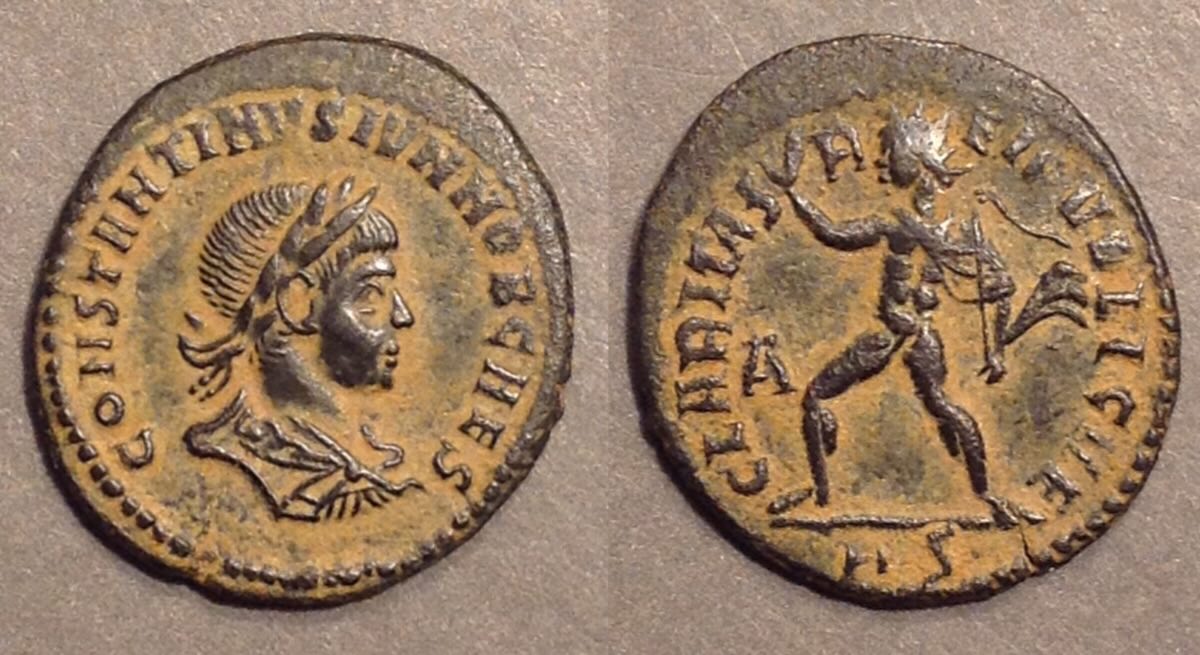
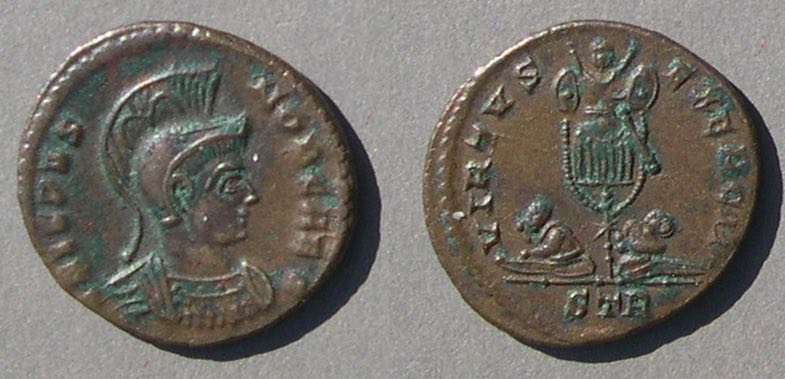
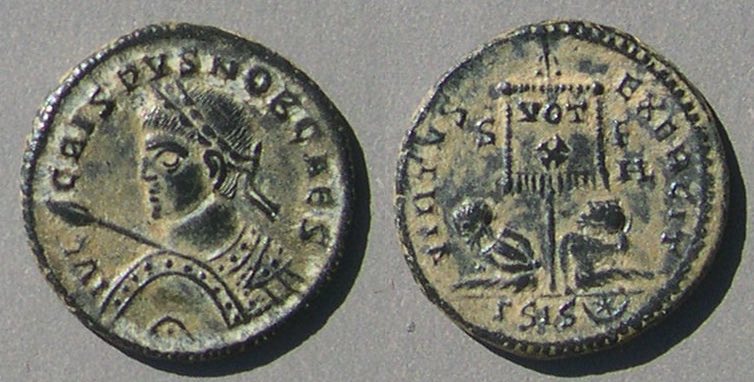
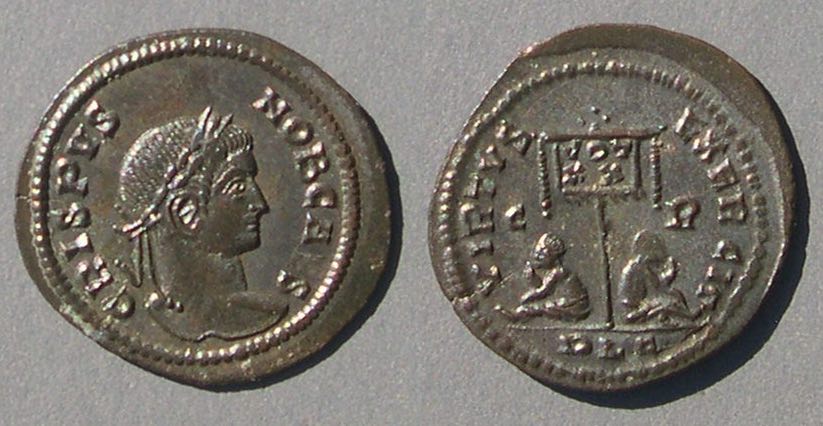
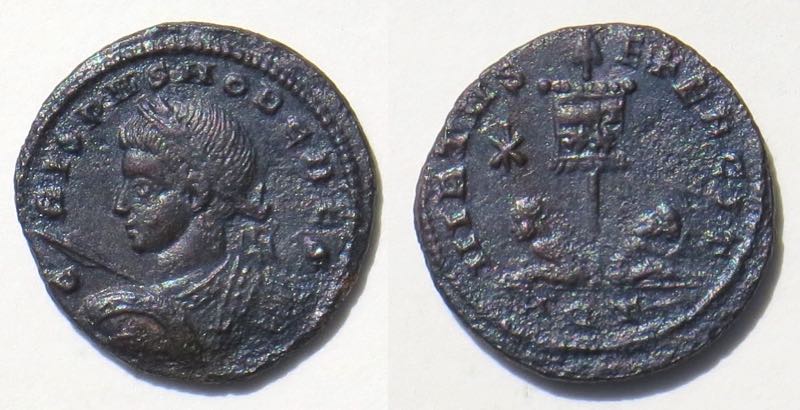
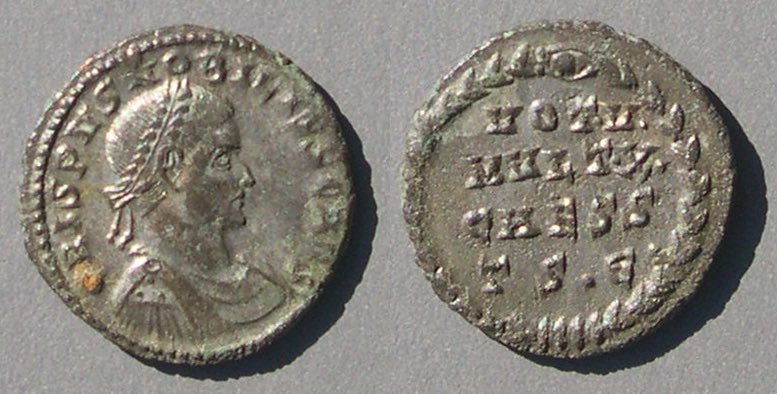
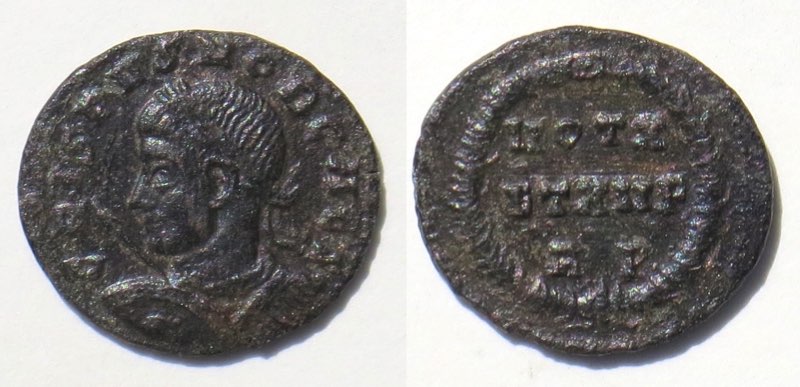
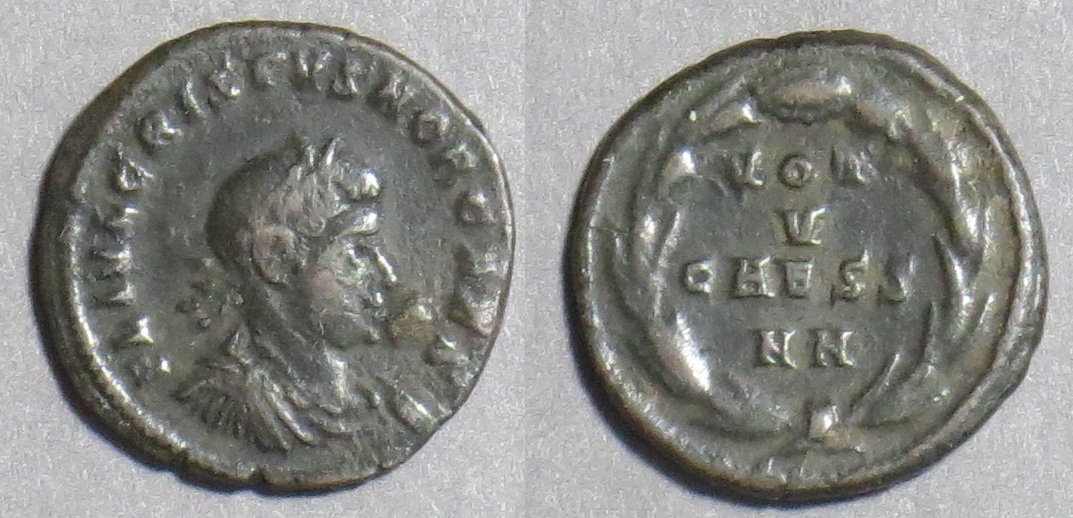
Coins of Crispus, son of Constantine the Great and Roman Caesar 317-326
   All reverse types of his bronze coins.
   
(Skip down to the images of each type. There are similar pages on coins of Licinius and Licinius II, Constantine II, Constantius II, and Constans.)

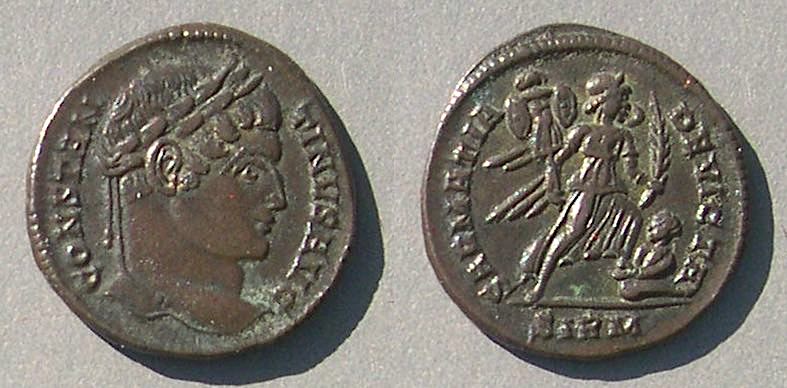
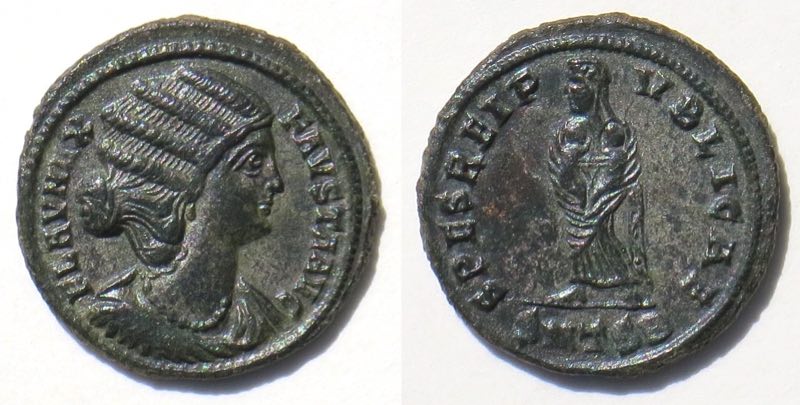
Crispus, born in 300 or 303, was the son of Constantine and Minervina. In 307 Constantine married Fausta, daughter of emperor Maximian, for dynastic reasons. Constantine had three sons with Fausta (Constantine II in 316, Constantius II in 317, and Constans in 320). Fausta (the second coin image) natually favored her own sons over Crispus. The story is that she contrived charges against Crispus that were serious enough that Constantine had Crispus executed in 326. Shortly thereafter, when he realized that the charges had been false, he had Fausta executed. Nevertheless, her sons inherited the empire when Constantine died in 337. 


In late 316, Constantine (the western emperor) and Licinius (the eastern emperor) agreed to elevate their sons to the rank of Caesar. Coins were then issued for Crispus, Constantine II, and Licinius II. (Constantine's sons Constantius II and Constans were made Caesars in 324 and 333.) Almost all the bronze coins of Crispus are AE3s--coins which are usually 18-19 mm in diameter but occasionally up to 21 mm in diameter. All the AE3 types are listed in Table 1. All the types not in Table 1 are of extremely rare small denominations which played almost no role in the monetary system. They are listed in Table 2 far below.

References are to Roman Bronze Coins from Paganism to Christianity, 294-364, by Victor "Tory" Failmezger (2002), Roman Coins and Their Values, volume IV, by David Sear (2011), and Roman Imperial Coinage, volume VII by Patrick Bruun (1966). 
 
Table 1: Crispus as Caesar, 317-326
(Reverse types of AE3s in alphabetical order)
Failmezger # (image link)       Legend and design Notes. S = scarce. R = rare. R2 = very rare. C = common
F341

ALAMANNIA DEVICTA, Victory right holding trophy and palm, captive to right

S. Only Sirmium.

F299

BEATA TRAQVILLITAS, Altar with globe, VOT IS XX

C2. Spelled BEATA or BEATAE or BEAT. VOTIS or VOT

F300*

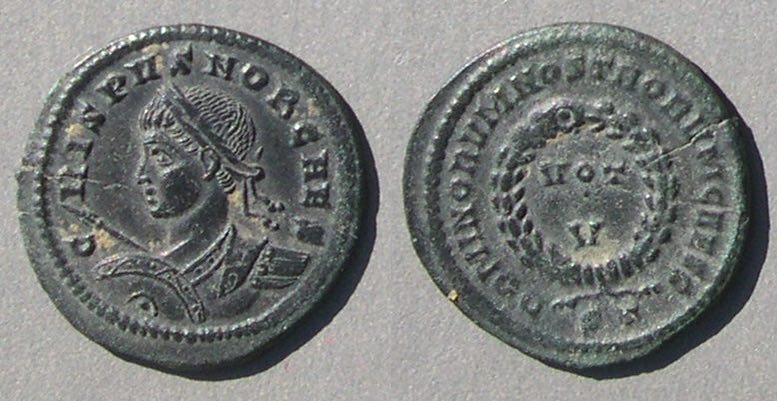
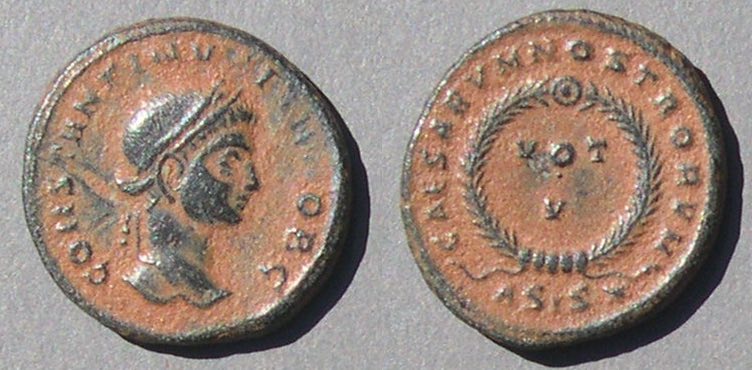
CAESARVM NOSTRORVM around VOT/V in wreath

 
F301*

CAESARVM NOSTRORVM around large V, no wreath

R2. Only Thessalonica. RIC Thess 85, 90, 91. Pages 508-9. 

F302

CAESARVM NOSTRORVM around large VO/TIS/V (no wreath)

R2.. RIC Thess 91, page 509.

F303

CAESARVM NOSTRORVM around VOT/X in wreath

 
F271

CLARITAS REIPVBLICAE, Sol standing left raising right hand and holding globe in left.

Only Trier. S. Only for Constantine II at mints other than Trier, except RIC Aquileia 14 and RIC Siscia 35 are r5 for Constantine. 

F273*

CLARITAS REIPVBLICAE, Sol standing left rising right hand and holding whip in left. 

Only Trier 
F336

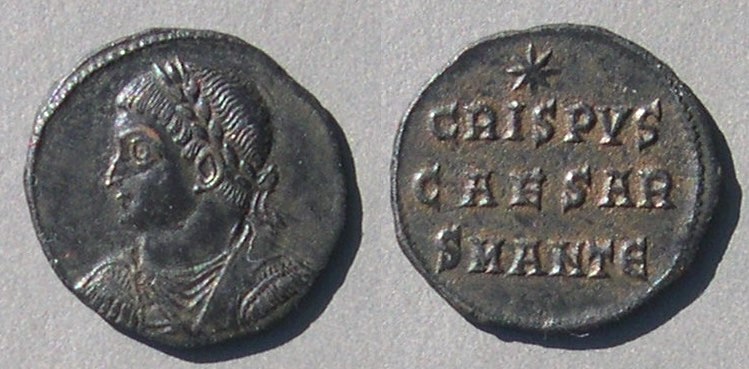
CRISPVS/CAESAR/SMANT or other mintmark

Rare. The great majority are from Antioch.

F347*

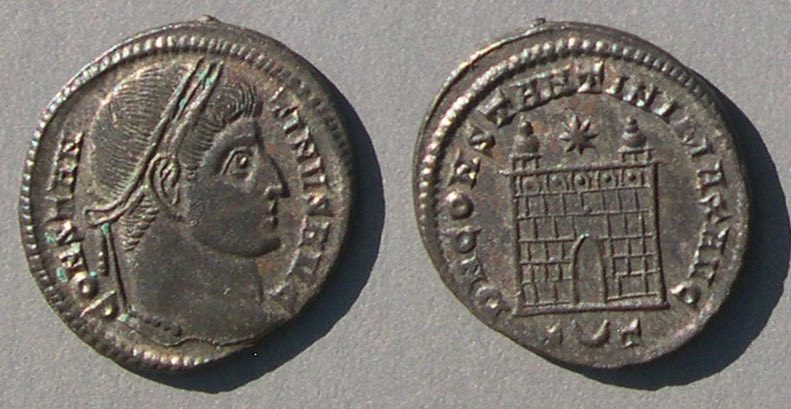
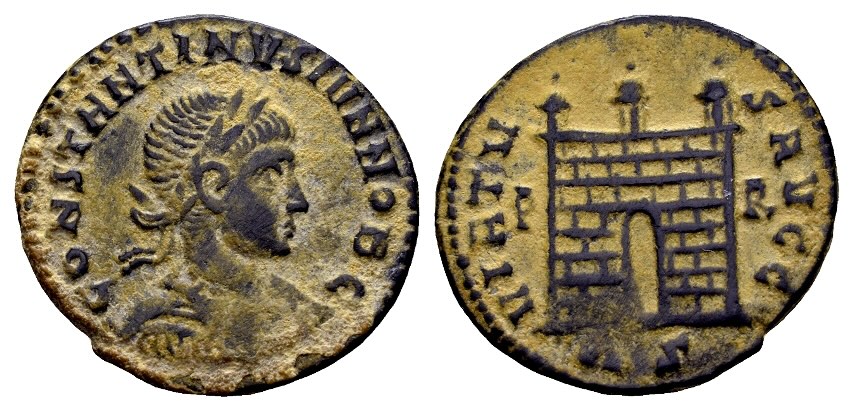
DN CONSTANTINI MAX AVG, campgate

Only Ticinum. The legend would be PROVIDENTIA CAESS elsewhere. This legend is primarily for Constantine. 

F309*

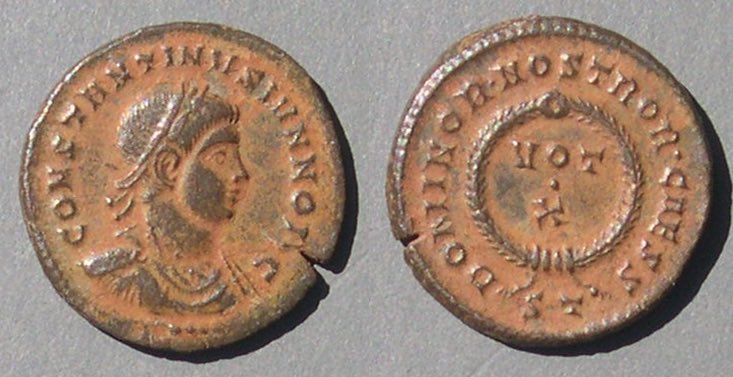
DOMINOR NOSTROR CAESS around VOT/V in wreath

F312 is similar with a less abbreviation. 
F310*

DOMINOR NOSTROR CAESS around VOT/X in wreath

 
F311*

DOMINOR NOSTROR CAESS around VOT/XX in wreath


F312 DOMINORVM NOSTRORVM CAESS around VOT/V in wreath (only Ticinum) F309 is similar with a more abbreviation. 
F278

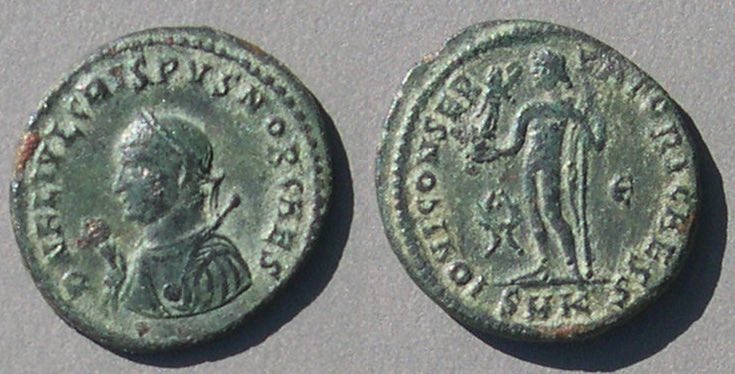
IOVI CONSERVATORI CAESS, Jupiter holding Victory

 
F279

IOVI CONSERVATORI, XIIΓ in r. field. Jupiter standing l. holding Victory, eagle left, captive right.

C2. XIIΓ is for “12 1/2”, the denomination, which is radiate for Constantine and Licinius, laureate for Crispus and Constantine II, and helmeted for Licinius II.

F280*

PAX PERPETVA, Pax leans on column 

Only Rome.
F281 

PRINCIPIA IVVENTVTIS, Emperor standing left, helmeted, with left hand resting on shield and scepter

Failmezger does not distinguish emperor "standing left" from "advancing right." 
F281 

PRINCIPIA IVVENTVTIS, Emperor advancing right with spear and shield

 Failmezger does not distinguish emperor "standing left" from "advancing right." 
F283

PROVIDENTIAE CAESS, Jupiter standing left holding Victory on globe and scepter

 
F282, 354

PROVIDENTIAE CAESS, campgate

 
F315

ROMAE AETERNAE, Roma seated right inscribing shield X/V

 
F285*

SARMATIA DEVICTA, Victory left with captive to right

R2. Only Trier. Two r5 busts at Trier. This type really belongs to Constantine. 

F284*

SAECVLI FELICITAS AVG, shield on cippus

R2
F286

SOLI INVICTO COMITI, Sol standing

Sol stands in several poses.
F316-8

VICT LAETAE PRINC PERP, two Victories holding shield inscribed VOT/PR

Lyon has two captives in mintmark, Arles has one. Other mints have none.

F287

VICTORIA CAESS NN, Victory advancing left holding wreath and palm

Only Thessalonica. S.
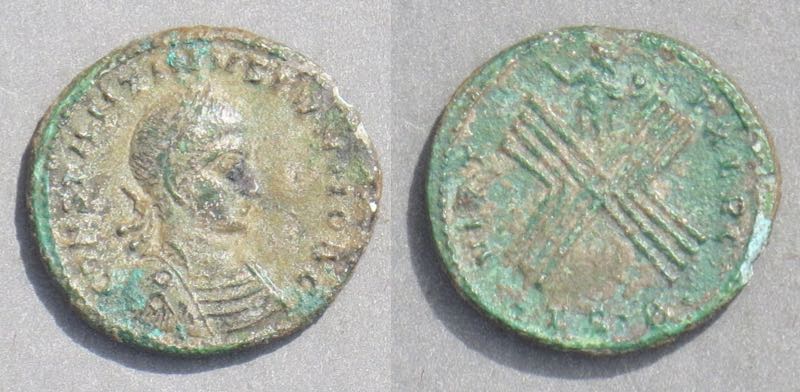
F288

VIRT EXERCIT, plan of camp like quadruple X 

Only Thessalonica. R2. RIC Thess 69, p. 507.

F289-290, 361-2*

VIRTVS AVGG, campgate

Failmezger distinguishes the number of towers--2, 3, or 4. This page doesn't.

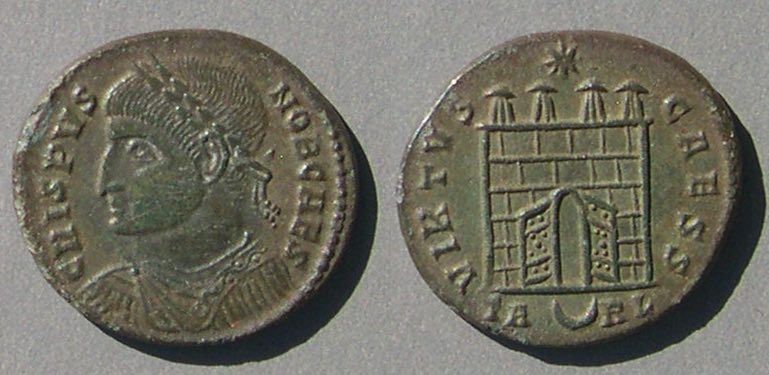
F361-2

VIRTVS CAESS, campgate

Only Arles. S. Failmezger distinguishes the number of towers. This page doesn't.
F291

VIRTVS EXERCIT, trophy between two captives

 
F319

VIRTVS EXERCIT, VOT/X on standard between two captives

 
F320

VIRTVS EXERCIT, VOT/XX on standard between two captives

 
F321

VOT V/MVLT X/CAES/TSE in wreath 

Only Thessalonica. S.
F322

VOT X/ET XV F/PR in wreath 

Only Rome. R2. RIC Rome 208, page 318.
F342*

VOT/XV/FEL/XX in wreath 

Only Rome. R. RIC Rome 216, 222,  page 318f.


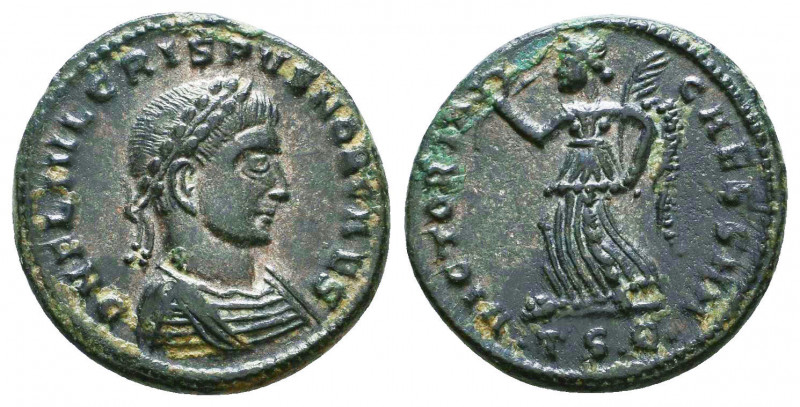
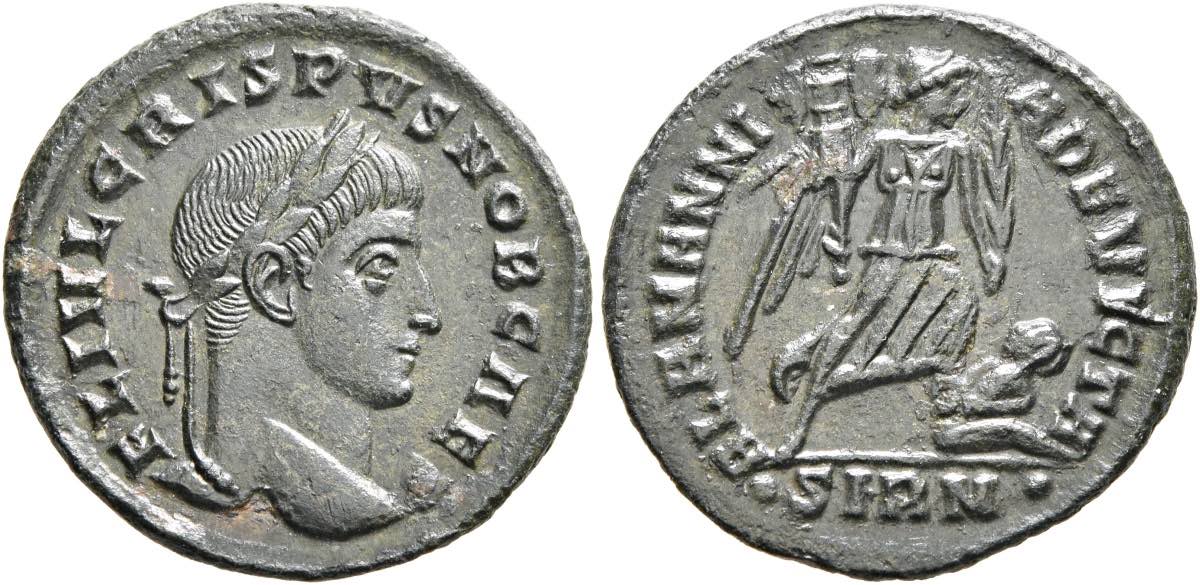
F341. ALAMANNIA DEVICTA


ALAMANNIA DEVICTA
Victory right holding trophy and palm, captive to right

This example: • SIRM • in exergue
18.7 mm. 2.77 grams.
RIC Sirmium 49.
Sear IV 16723


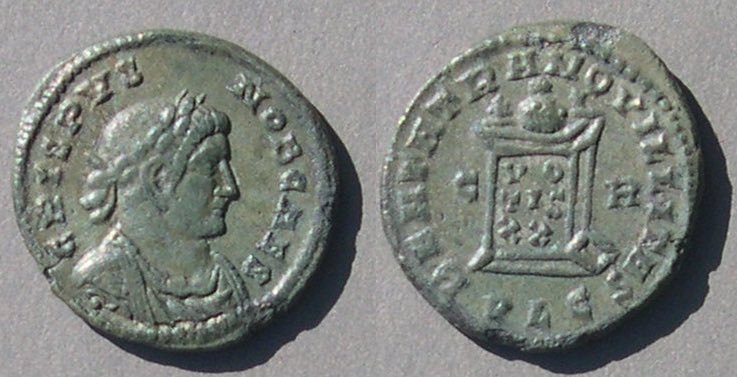
F299. BEATA TRANQVILLITAS
 
BEATA TRANQVILLITAS

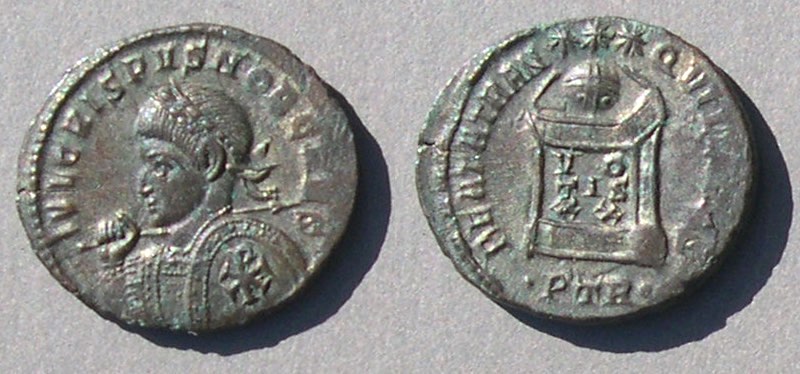
VO/TIS/XX on altar surmounted by globe

This example: 18 mm. 2.93 grams.
C  R either side of altar
PLC
RIC Lyons 132.
Sear IV 16734

This reverse come with many different obverse busts. Dieter Alten and Carl-Friedrich Zshueke wrote a book Die Römische Münzserie: BEATA TRANQVILLITAS in der Prägestätte Trier 321-323 (1987) lisitng and illustrating 255(!) varieties just from Trier for Crispus. 


This variety is the most desirable for having an important early Christian symbol on the obverse which proves that the "sign" Constantine had his soldiers put on their shields at the decisive Battle of the Milvian Bridge was a chi-rho and not a cross.
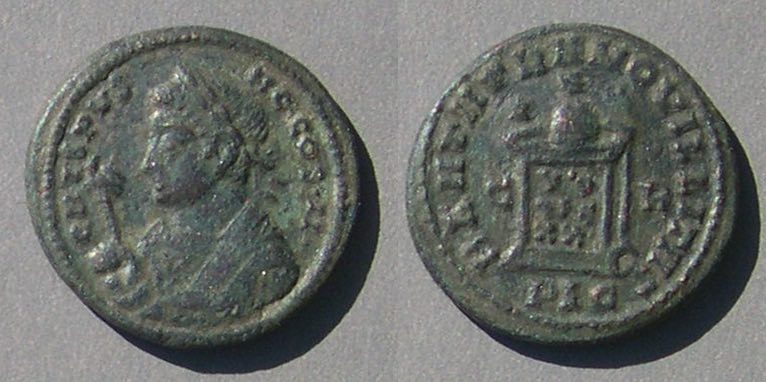
It is very rare.

This example. 19-17 mm. 3.12 grams.
RIC does not give this variety with a chi-rho its own number. It is included in the common RIC Trier 372.

This example was found Sunday, 24 September, 2000 at Langtoft near East Riding in Yorkshire. Langtoft Hoard number 2, coin 136.


This very rare variety is desirable for having an unusual obvesrse legend 
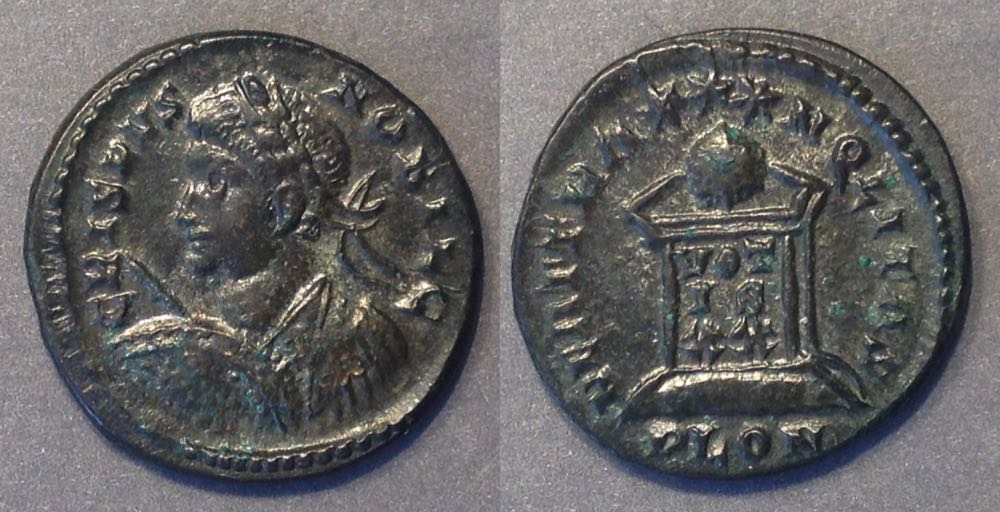
CRISPVS N C COS II
referencing his second consulship, which dates it to 321.

19 mm. 3.09 grans.
RIC Lugdundum 138 "r4", page 131.
Sear IV 16735


This example from London has the legend misspelled:
BEAT TRANQLITAS  [missing "VIL"]

19 mm. 3.19 grams.
RIC London 279
Sear IV 16734
 

F300. CAESARVM NOSTRORVM around VOT/V in wreath

      [no photo]

F301. CAESARVM NOSTRORVM around large V, no wreath

     [no photo]

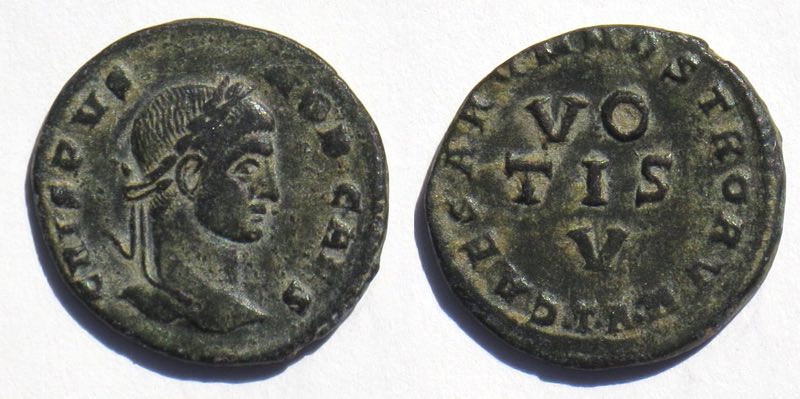
F302. CAESARVM NOSTRORVM around large VO/TIS/V (no wreath)

CAESARVM NOSTRORVM 
around large
VO/TIS/V (no wreath)

This example: 19-18 mm. 2.55 grams.
• T • A
RIC Arles 210, page 257. "r4" (This officina only)
Sear IV 16742


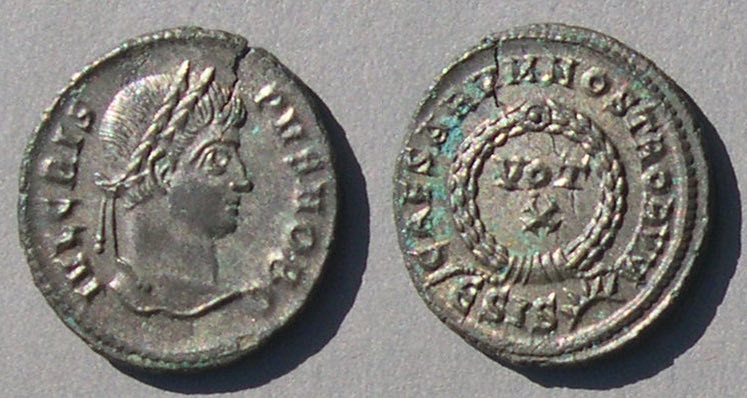
F303. CAESARVM NOSTRORVM around VOT/X in wreath

CAESARVM NOSTRORVM
around VOT/X in wreath

This example: 20 mm. 3.19 grams.
RIC Siscia 181, page 446
Sear IV 16773

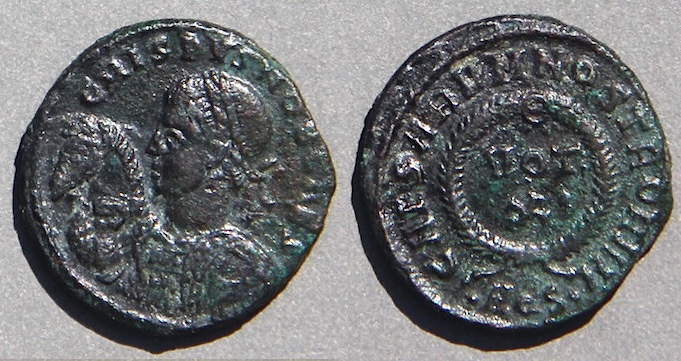
There are many obverse bust varieties of this reverse type. See the next coin for one.


CAESARVM NOSTRORVM
around VOT/X in wreath

This example is highly desirable because of the horse's head on the obverse.
RIC Aquileia 98, page 404, "r3" with only this one variety. Struck "321".


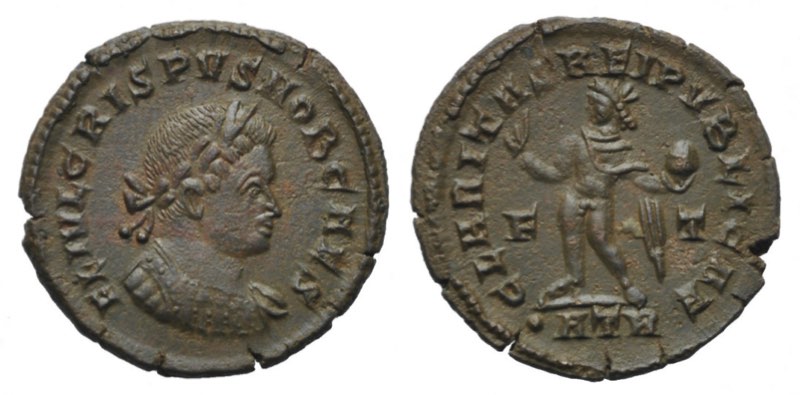
F271. CLARITAS REIPVBLICAE, Sol standing left raising right hand and holding globe in left. (only Trier)

CLARITAS REIPVBLICAE
Sol standing left rising right hand and holding globe in left.
(only Trier)

This example: 21 mm (larger than many AE3s). 3.36 grams.
Struck 317-318, an early issue. 
RIC Trier 177, page 177 "r3"
Sear IV 16679
 
F273. CLARITAS REIPVBLICAE, Sol standing left rising right hand and holding whip in left. 

     [no image] 


F336. CRISPVS/CAESAR/SMANT, or other mintmark

CRISPVS/CAESAR/SMANTŠ„
Anepigraphic obverse

In this well-known anepigraphic series, coins of Crispus, Fausta, and Helena are the rarest. All of them are far more common from Antioch than from all the other mints put together.

This example:  18 mm. 1.99 grams.
RIC Antioch 53, page 186. "r4" (but many have appeared since RIC was written)
Sear IV 16781


F347. DN CONSTANTINI MAX AVG, campgate (only Ticinum)

     [no photo]

F309. DOMINOR NOSTROR CAESS around VOT/V in wreath

     [no photo]

F310.  DOMINOR NOSTROR CAESS around VOT/X in wreath

     [no photo]


F311.  DOMINOR NOSTROR CAESS around VOT/XX in wreath 

     [no photo]


F312. DOMINORVM NOSTRORVM CAESS around VOT/V in wreath

 DOMINORVM NOSTRORVM CAESS
around VOT/V in wreath

This example: 20 mm. 2.28 grams.
RIC Ticinum 150 "320-321" "r4" page 380.
Sear IV 16789


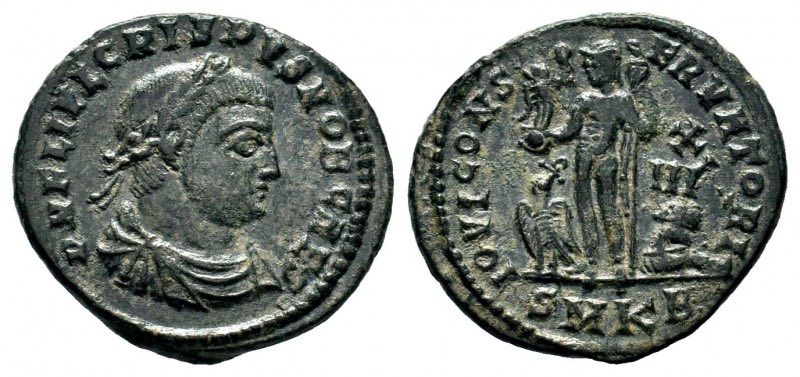
F278. IOVI CONSERVATORI CAESS, Jupiter holding Victory

IOVI CONSERVATORI CAESS
Jupiter holding Victory

This example: 18 mm. 2.51 grams.
RIC Cyzicus 10, page 644. "317-320"
Sear IV 16688


F279. IOVI CONSERVATORI, XIIΓ in right field, Jupiter standing left holding Victory, eagle left, captive right.

IOVI CONSERVATORI
XIIΓ in r. field.
Jupiter standing left holding Victory, eagle left, captive right.

XIIΓ is for “12 1/2”, the denomination, which is radiate for Constantine and Licinius, laureate for Crispus and Constantine II, and helmeted for Licinius II.

This example: 20-19 mm. 2.97 grams.
RIC Cyzicus 17, page 645.
Sear IV 16685


F280. PAX PERPETVA, Pax leans on column (only Rome)

     [no photo]

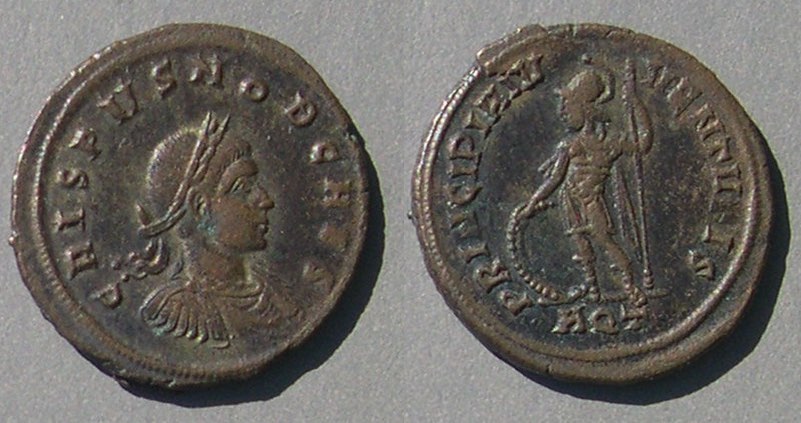
F281. PRINCIPIA IVVENTVTIS, Emp. standing left, helmeted, with r. on shield and left holding scepter

PRINCIPIA IVVENTVTIS
Emperor standing left, helmeted, with r. on shield and left holding scepter

This example: 21-20 mm. 3.33 grams.
RIC Aquileia 9, page 393
Sear IV 16709


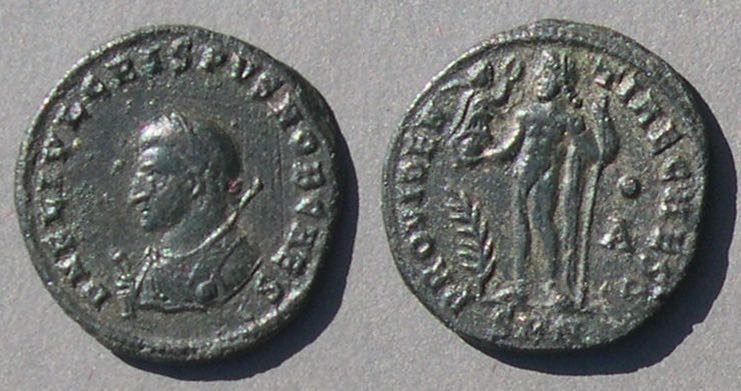
F283. PROVIDENTIAE CAESS, Jupiter stg. left holding Victory on globe and scepter

PROVIDENTIAE CAESS
Jupiter standing left holding Victory on globe in right and scepter in left

This example: 19 mm. 2.53 grams.
RIC Nicomedia 31, page 604
Sear IV 16715


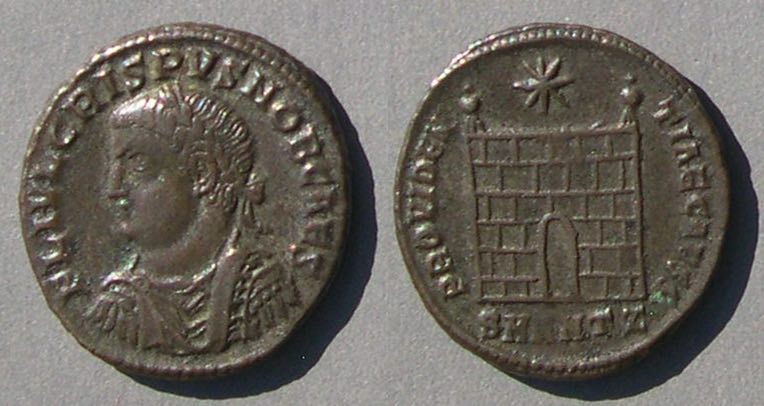
F282. PROVIDENTIAE CAESS, camp gate

PROVIDENTIAE CAESS,
camp gate

This example: 20-19 mm. 3.73 grams.
RIC Antioch 64z, page 688.
Sear IV 16811


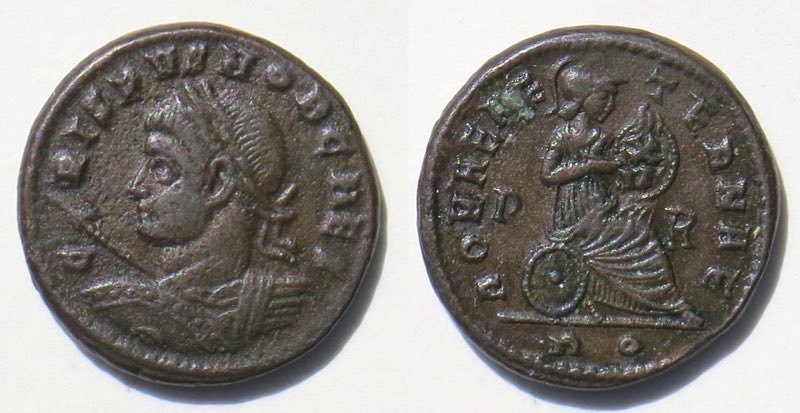
F315. ROMAE AETERNAE, Roma seated right inscribing shield X/V. 

ROMAE AETERNAE
Roma seated right inscribing shield X/V

This example: 19 mm. 3.91 grams.
RIC Rome 152, page 315. "318-319"
Sear IV 16814


F284. SARMATIA DEVICTA, Victory left with captive to right

     [no photo]

F284.  SAECVLI FELICITAS AVG, shield on cippus

      [no photo]


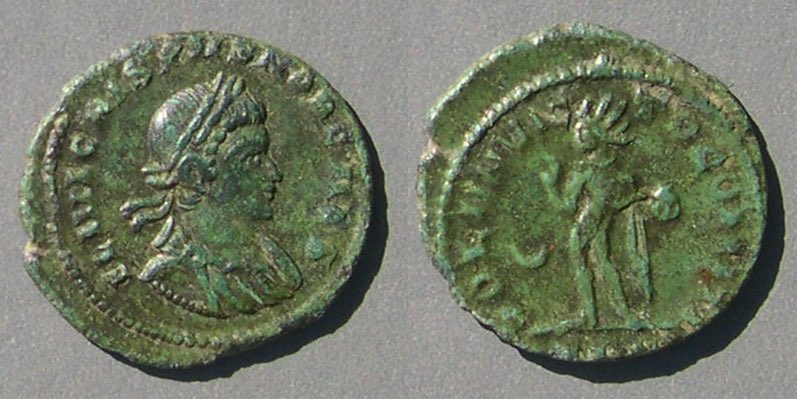
F286.  SOLI INVICTO COMITI, Sol standing

SOLI INVICTO COMITI
Sol standing

This example: 20-19 mm. 2.49 grams.
RIC London 142, page 105.
Sear IV 16720


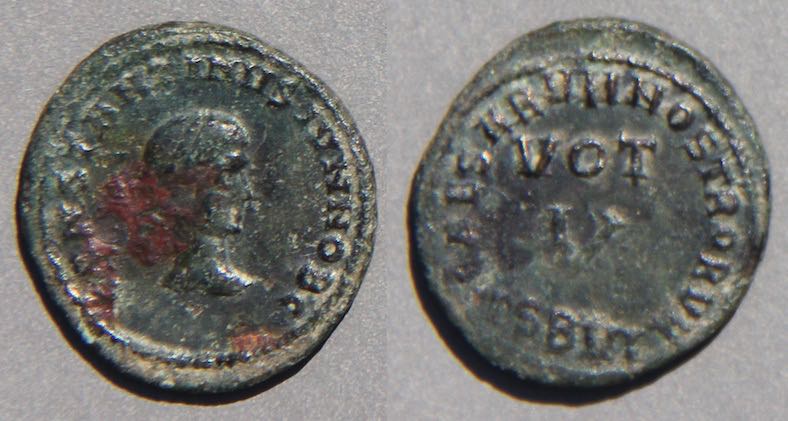
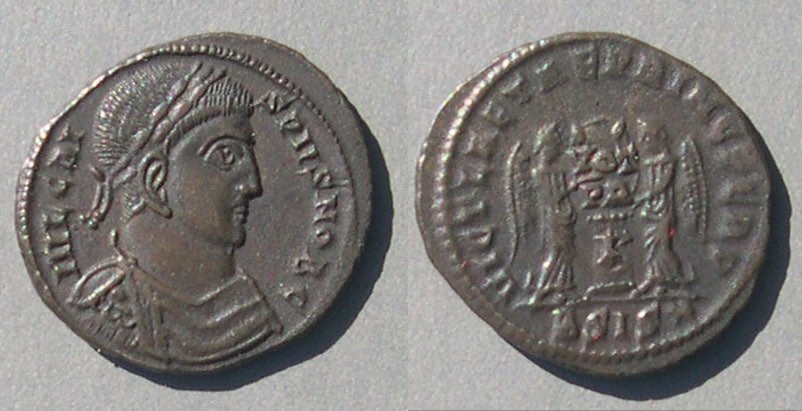
F316-8.  VICT LAETAE PRINC PERP, two Victories holding shield inscribed VOT/PR


VICT LAETAE PRINC PERP
two Victories holding shield inscribed VOT/PR
on cippus

This example: 20 mm. 3.37 grams.
RIC Siscia 97, "r3" but many similar varieties. page 436.
Sear IV 16818
 

Failmezger distinguishes varieties in which Lyon has two captives in the mintmark and Arles has one.


 F287. VICTORIA CAESS NN, Victory advancing left holding wreath and palm


VICTORIA CAESS NN
Victory advancing left holding wreath and palm

Only from Thessalonica

This example: 18 mm. 3.35 grams.
RIC Thessalonica 62, page 506.
Sear IV 16819


VIRT EXERCIT, plan of camp like triple X (only Thessalonica)

     [no image]

F289. VIRTVS AVGG, campgate

     [no photo]
 
F261. VIRTVS CAESS, campgate

VIRTVS CAESS
campgate

This example: 19 mm. 3.43 grams.
RIC Arles 292, "r1" only one officina, with Arles 293 also r5, only this mint.
Struck "325-326"
Sear IV 16833
 

F291. VIRTVS EXERCIT, trophy between two captives

VIRTVS EXERCIT,
trophy between two captives

This example: 19-18 mm. 2.65 grams.
RIC Trier 261, page 187
Sear IV 16835


F319. VIRTVS EXERCIT, VOT/X on standard between two captives

VIRTVS EXERCIT
VOT/X on standard between two captives

This example: 19 mm. 2.90 grams.
RIC Siscia 130, page 440
Sear IV 16841


F320. VIRTVS EXERCIT, VOT/XX on standard between two captives

VIRTVS EXERCIT,
VOT/XX on standard between two captives

This example: 21 mm. 2.28 grams.
RIC Lyons 121 "r4" page 130, struck "321"
Sear IV 16848

An interesting variety is next.


(again)
VIRTVS EXERCIT
VOT/XX on standard between two captives

This example: 18 mm. 2.48 grams.
RIC Aquileia 61 "r4", p. 401, struck "320"
Sear IV 16853

This variety has a symbol to the left of the standard that might be an iota-chi
which might stand for
Ihsus Xristus
and, if so, it would be a very early Christian reference.


F321.  VOT V/MVLT X/CAES/TSE in wreath (only Thessalonica)

VOT V/MVLT X/CAES/TSE
in wreath
(only Thessalonica)

This example: 19 mm. 3.11 grams.
RIC Thessalonica 38 "r3", page 504, struck "318-9"
Sear IV 16859


F322. VOT X/ET XV F/PR in wreath

VOT X/ET XV F/PR
in wreath

This example: 19-17 mm. 2.33 grams.
RIC Rome 216v (only officina S is listed, r5, and this one is P)
Sear 16861


F342. VOT/XV/FEL/XX in wreath (only Rome)

     [no photo]
 

Rare denominations listed in Die Bronze-Teilstück-Prägungen der römischen Münzstätte Trier by Carl-Friedrich Zschucke (1989). 65 pages including 173 small coins photographed. 

F327. VOT/V/CAESS/NN

VOT/V/CAESS/NN
16 mm. 2.22 grams.
A "fraction" which Zschucke thought was a "1/4". 

RIC Trier 339 "r5" only one variety, page 193 "321-2"
Sear IV 16864 "billon half centenionalis(?)"
Zschucke 14, 18, struck for July 25, 320.


Table 2: Crispus, 317-326. Unusual fractional denominations
Failmezger #
(image link)
      Legend and design Notes. S = scarce.
R = rare. R2 = very rare.
F293

PRINCIPIA IVVENTVTIS

"1/2"  R2
F295

VBERTAS SAECVLI, three Moneta standing

"1/4"  R2
F296

VBERTAS SAECVLI, Vbertas standing

"1/4"  R2
F327

VOT/V/CAESS/NN in wreath 

"1/4"  R2
F328

VOT/V/MVLT/X

"1/4"  R2

 
        The end
 

Go to a similar page on coins of Licinius and Licinius IIConstantine II, Constantius II, or Constans.

Go to the main Table of Contents of this whole educational site.