Top coins from the whole site. Go to the main pages which repeat these and also have other ancient coins.
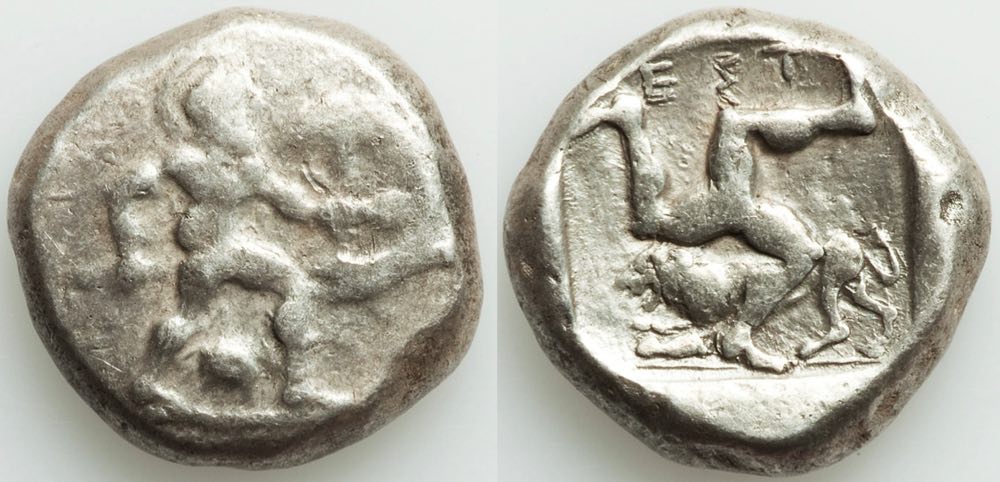 Pamphlyia, Aspendos
465-430 BC
(Later the city has the well-known Slinger and wrestlers type)
Thick silver 20-19 mm. 10.95 grams.
Hoplite warrior right holding spear horizontal and shield in left, turtle between legs
Triskeles (three human legs running)
lion standing left behind lower leg [What an interesting type!]
EΣT which abbreviates in Greek the city name in the Pamphylian language--ESTEFΔIIYI (for "Estwediiys") all well-centered in an incuse square
A very old dumpy thick archaic coin! Very nice triskeles and lion. Much rarer (and more interesting) with the lion. [$345 SOLD]
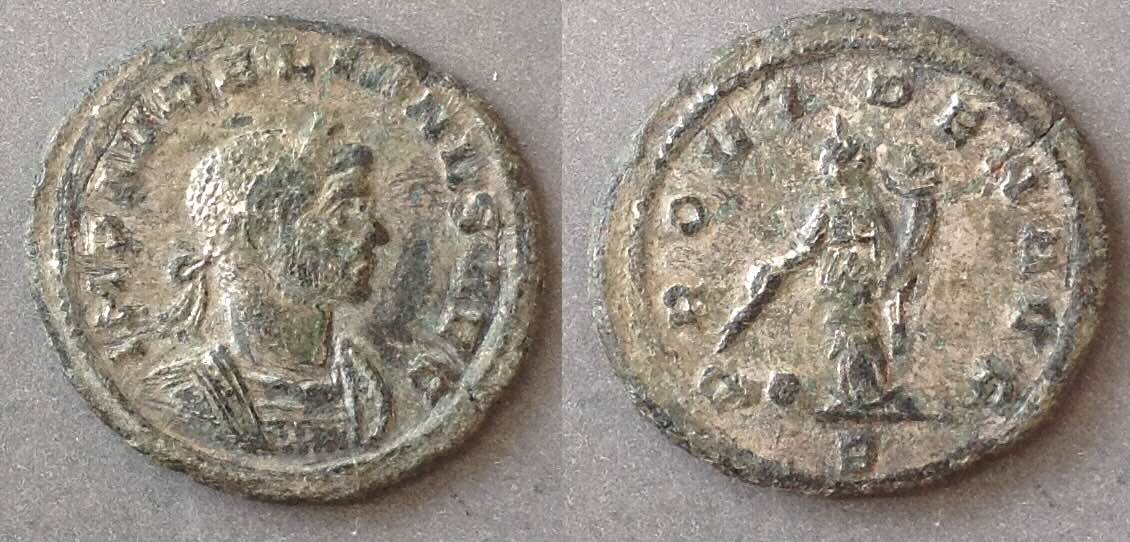 Aurelian, 270-275
Very rare type of the denarius denomination.
19 mm. 2.41 grams.
Everone knows that most coins of Aurelian are radiate and he has a type as a laureate denarius: VICTORIA AVG. That type is scarce compared to his antoniniani or aureliani. Did you know he had other, far rarer, types of denarii too?
This one is highly unusual. Lots of silvering.
RIC 69. Estiot 248, 249 on page 166. "11th issue, beginning 275 - Sept. 275." page 304, Rome mint. Part of his reformed coinage.
ex Numismatica Zagreb March 7, 2005, at $112. I bet I see 50 of his common denarius VICTORIA AVG for every denarius that is not VICTORIA AVG.
A rarity. [$165 SOLD]
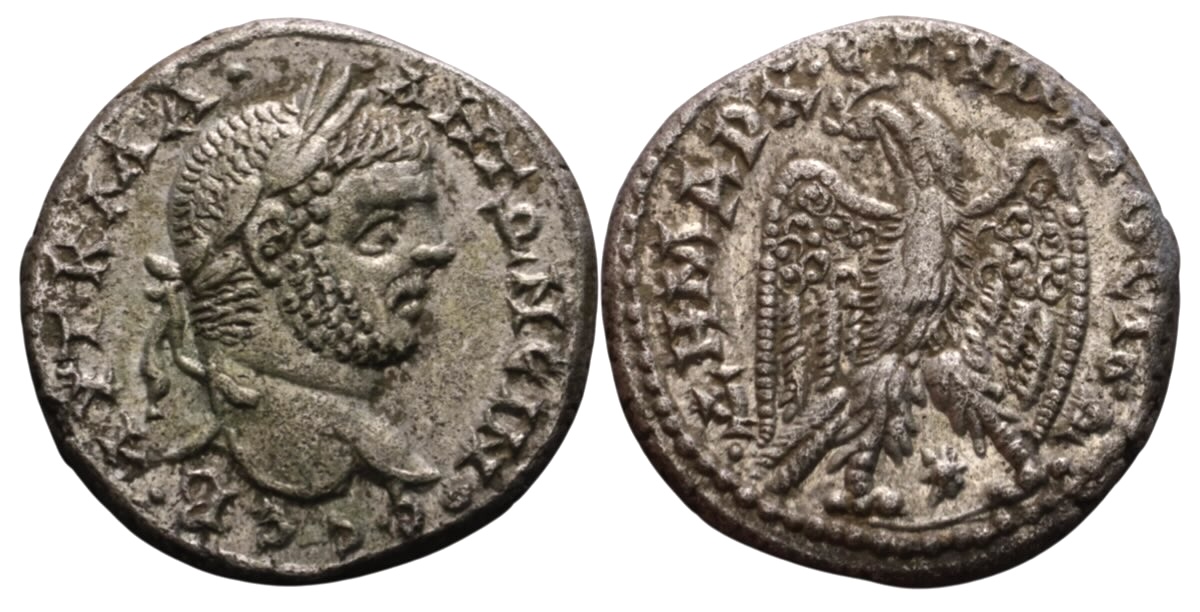 Bold Caracalla tetradrachm of Laodicia ad Mare
Struck 215-217.
Syrian tetradrachm.
26 mm. 14.12 grams.
Prier 1179
AVT K M A ANTΩN Є INOC CEB
ΔMHAPX Z YΠATOC TO Δ
A strong portrait of Caracalla on a (debased) silver coin.
[$125]
Very rare short-lived denomination: 10 to 1 as opposed to the usual 20 to 1:
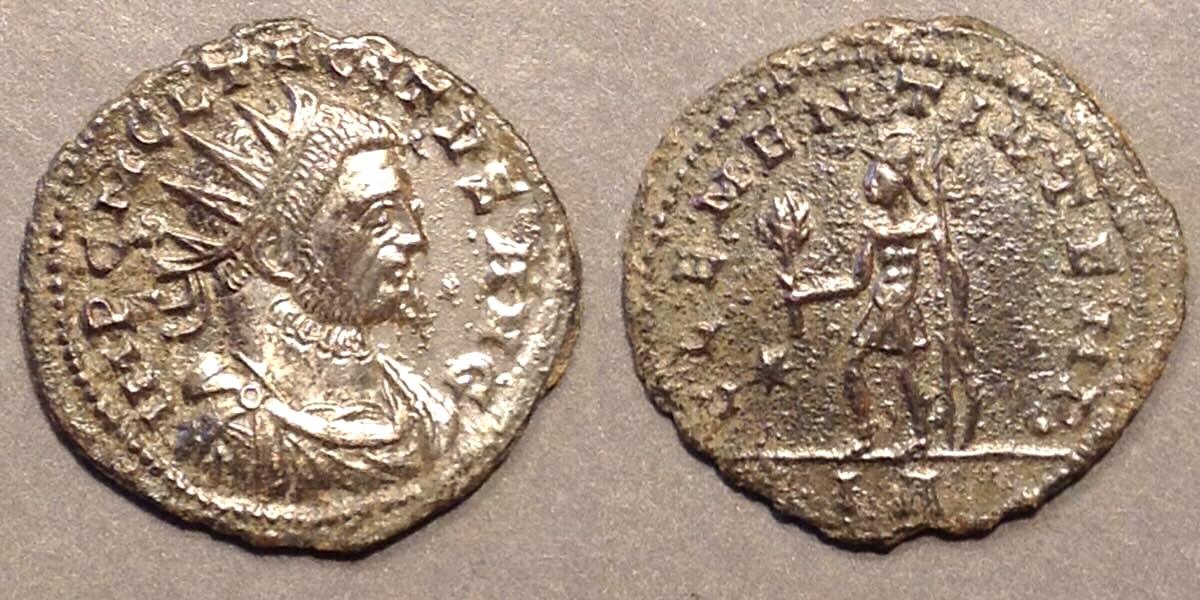 Tacitus, 275-276.
23.4-21.8 mm. 3.805 grams. Original silvering on the portrait.
Tripolis mint.
RIC#214, IA variety, Plate X.154
"double antoninianus"
Estiot, emission 2, Jan.- June 276
Plate 64, 1846.
Mars stg. or walking l, holding olive branch and spear and shield. "R"
* in field left, IA in exergue
IA coins are slightly larger in diameter than KA coins.
The "IA" type is extremely rare. The "KA" type is scarce to rare. Callu et al. showed that the "XI" type of Antioch and the "IA" (Greek for "XI") type of Tripolis had about twice the silver content of the usual "XXI" and "KA" (Greek for "XXI") types, conclusively proving that "20 - 1" had to mean either "twenty of these coins make one [of some higher standard]" or "twenty parts base metal to one of silver." The latter interpretation has come to be accepted. Esty, et al. did further work on the alloy of these coins of Tacitus and again showed that the silver content of the "XI" and "IA" coins was about twice the silver content of the regular coins and consistent with the "ten parts base metal to one part silver" hypothesis [here is a pdf of my article on the alloy]. The conclusion is that Tacitus instituted a short-lived and ill-fated coin reform shortly after they initial reform of Aurelian in 274. Very few of these coins with higher silver content are extant. This "XI" = "IA" denomination is extremely rare.
CNGs one of the type at $190+20% = $228: https://www.acsearch.info/search.html?id=14692725
CNG at $250+20% = $300: https://www.acsearch.info/search.html?id=13564436
The one is far nicer than either CNG coin. [$190 SOLD] Please compare!
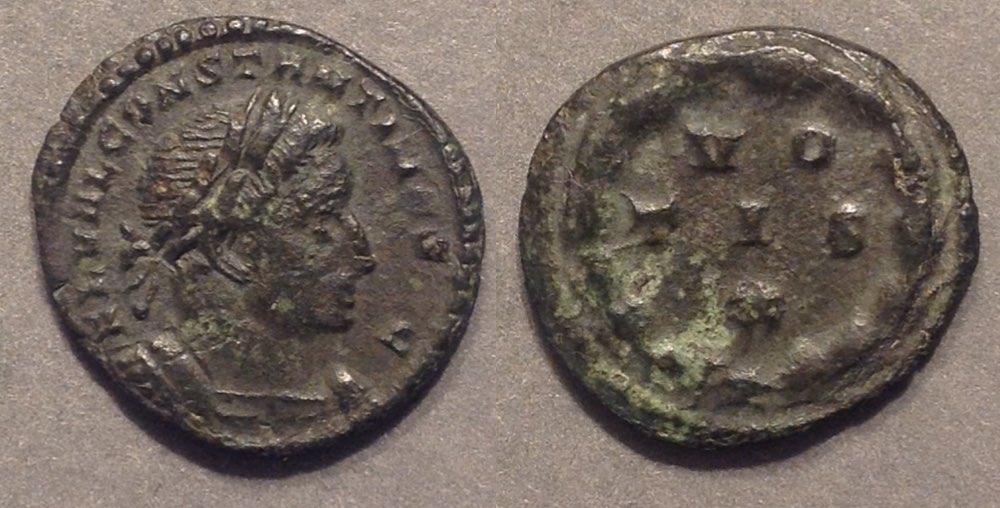 Constantine, 306-307-337.
Rare 17-15 mm fraction. 2.14 grams. Small. (Photo larger in proportion than the others.)
Rare denomination!
Struck as Caesar Summer 307.
For some unclear reason Trier struck low-denomination coins hardly struck elsewhere.
FL VAL CONSTANTINVS N C
VO/TIS/X
Zschucke 7.13b, plate p. 48.
RIC VI Trier 750 "R" page 214.
Failmezger 218 "R"
ex Gert Boersema on vcoins, April 7, 2008, at $243.
Not your usual Constantine, on the contray, this is a rare, smaller, denomination [$259 (+ $8 shipping)]
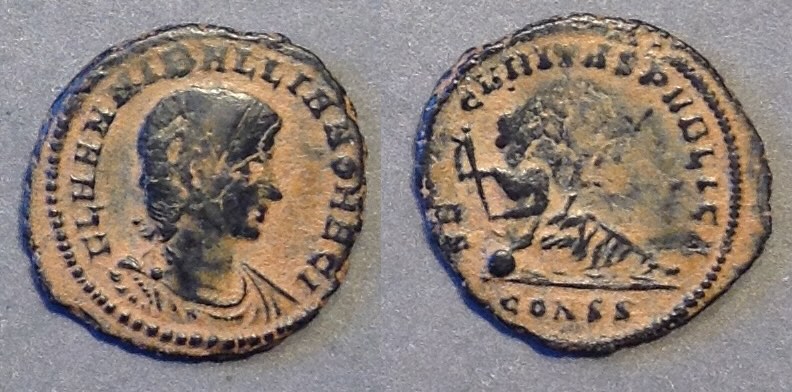 Hanniballianus SOLD
335-337. 16.5 mm. A small coin, but full flan--better flan than almost all of the type.
Very nicely repatinted.
He was chosen by Constantine to become ruler of the part of Mesopotamia that Constantine expected to conquer in his (aborted by Constantine's death in 337) campaign prepared in 335. Note the title "REGI"-- the only use of "King" on a Roman imperial coin. The river god on the reverse refers to the Euphrates which would have been the route of invasion. Hanniballianus was killed in the purge by Constantius II and his brothers in 337 in the "Summer of Blood" after Constantine's death.
The importance of this particular example is that it is legible--all of it.
FL (Flavius) HANNIBALLIANO REGI
SECVRITAS PUBLICA
CONSS (Constantinople) RIC VII Constantinople 147 "r2" (very rare) but many have been found since then.
Compare to this recent CNG coin:
https://auctions.cngcoins.com/lots/view/4-GYPG2S/hanniballianus-rex-regum-ad-335-337-follis-145mm-141-g-6h-constantinople-mint-6th-officina-struck-ad-336-337-vf at $250+20% = $300. I much prefer this one. [$185 (+ $6 shipping)] The CNG coin is crowded at 14.5 mm, where this one is 16.5 mm max.