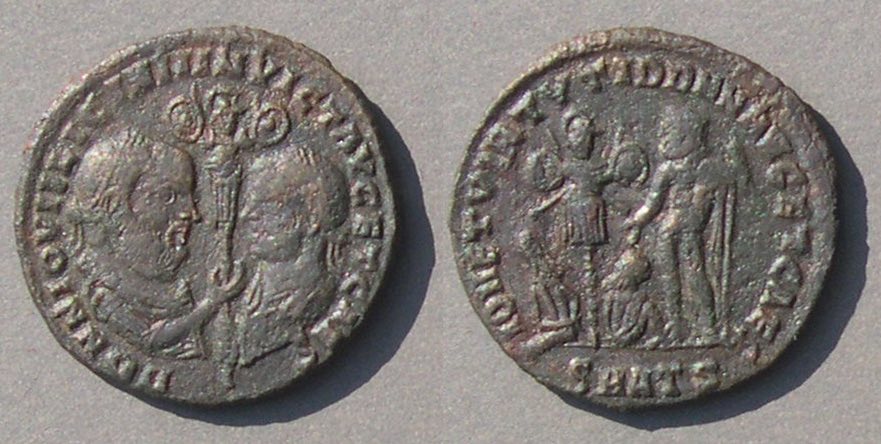
 Coins of the Roman Emperor Licinius (308-324 AD) and his son Licinius II (317-324 AD)
All their reverse types of bronze coins.
Images: Skip down to Licinius: DN, GENIO, IOVI, LICINI, ROMAE, VICTORIA, VOT. Licinius II: CAESARVM, IOVI, PROVIDENTIAE, VICTORIA, VOT.
Contents:
1) Tables listing reverse types, linked to images.
For Licinius, for Licinius II, and double effigy.
2) Some history (next).
3) Images of coins with those reverse types.
4) Comments on how I distinguish between between "types" and "varieties".
(There are similar pages for coins of Roman emperors Crispus, Constantine II, Constans and Constantius II.)
Coin at the upper right: Licinius and Licinius II, vis-a-vis. For more about it, see below. (Skip down to the tables. Skip further down to the images.)
What's new? 2026, March 5. This page is only a draft and far from ready. Much remains to be filled in.
History. Licinius became emperor in 308 in a unique manner--he was apponted at a conference!
By 308 the orderly tetrarchal system (four rulers, two Augusti and two Caesars) instituted by Diocletian in 293 had broken down. The East was still as intended with Galerius as Augustus and Maximinus II (Daia/Daza) as Caesar, but the West had three rulers all claming the title Augustus: Constantine, Maximian, and Maxentius. To straighten this out, Galerius called the famous Conference at Carnuntum (a military city on the Danube 30 miles east of modern Vienna). The retired Diocletian attended as an elder statesman. The four main decisions were: 1) Constantine was to be demoted to western Caesar, 2) Maximian was to retire again, 3) Maxentius was declared a "public enemy," and 4) Licinius, a new man, was to become western Augustus (without ever having been Caesar).
None of the decisions actually came to pass. Constantine continued to use the title Augustus. Maximian continued to seek power. Maxentius continued as Augustus at Rome. Licinius never made it to the West, but he did assume power in the middle--the former territory of Severus II, minus Rome and the other territory held by Maxentius. The early mints of Licinius included Siscia and Thessalonica.
By 314 Constantine was sole ruler in the West (Some of that story is here) and Licinius was sole ruler in the East. Galerius, the eastern Augustus, had died in 311 from disease and Maximinus II took his territory and attempted to expand into the territory of Licinius, but in 313 Licinius defeated Maximinus II in battle and inherited the entire East. Because most of his coins are later issues that mention IOVI CONSERVATORI, collectors might think of Licinius as a Jovian, eastern, emperor. Nevertheless, technically he began as the western emperor.
After an inconclusive war between Constantine and Licinus in 316, they reconciled and coined for each other. In 317 their three children, Licinius II, Crispus, and Constantine II, were made Caesars and each of their coin types was minted in all three of their names. A second war in 324 resulted in the victory of Constantine and the deaths of Licinius and Licinius II. Constantine became sole Augustus for the entire empire with his sons as Caesars.
Collecting. Roman-coin collectors usually begin by collecting portraits of the emperors. The five centuries of the Roman Empire are a very long time period with many rulers and a great deal of history to grasp. However, after learning some of the long Roman history a collector can discover that shorter time periods can be interesting and worth delving deeper into. I doubt many collectors care about Licinius and his time period, but it can be great fun to follow the ups and downs of rulers of the early fourth century as evidenced by their coins. Plus, most coins of Licinius and his son are very inexpensive, so you can make a good collection of their types without spending much money.
Roman Imperial Coinage, volumes VI (294 AD through the death of Maximinus II in 313) and VII (313-337 AD) are the essential references. RIC lists coin types chronologically at each mint, so you can determine who was minting for whom, where, and when. It takes RIC to see history at that level, but this page will get you started. RIC's rarity listings, while imprecise and somewhat outdated, help determine the enthusiasm with which each emperor recognized the others for whom he coined.
Note for collectors: You are welcome to copy these tables to use them as a checklist.
Tables: Table 1 has types of Licinius (next). Table 3 has types of Licinius II. Table 2 has rare types with both Licinius I and II vis-a-vis on the obverse.
Images: Skip down to Licinius: DN, GENIO, IOVI, LICINI, ROMAE, VICTORIA, VOT.
Skip down to Licinius II: CAESARVM, IOVI, PROVIDENTIAE, VICTORIA, VOT.
Table 1: Licinius I (308-324)
Failmezger
#(image link for Licinius) |
Types (images below)
in alphabetical order of reverse legend |
Notes |
| F185 |
BONO GENIO PII IMPERATORIS, Genius standing (Alexandria only) |
R |
| F273 |
CONCORDIA AVGG NN, Concordia stands (Aquileia only) |
RR. RIC Aq 11 "r5".
Also for L2. |
| F306 |
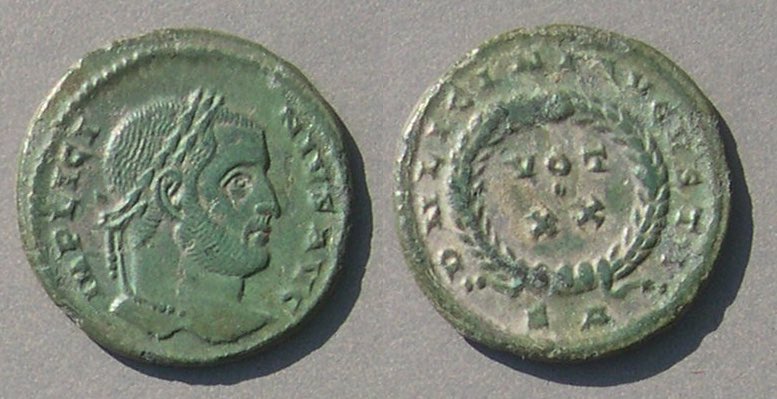
DN LIC LICINI AVGVSTI , VOT XX in wreath |
Vota. |
| F307 |
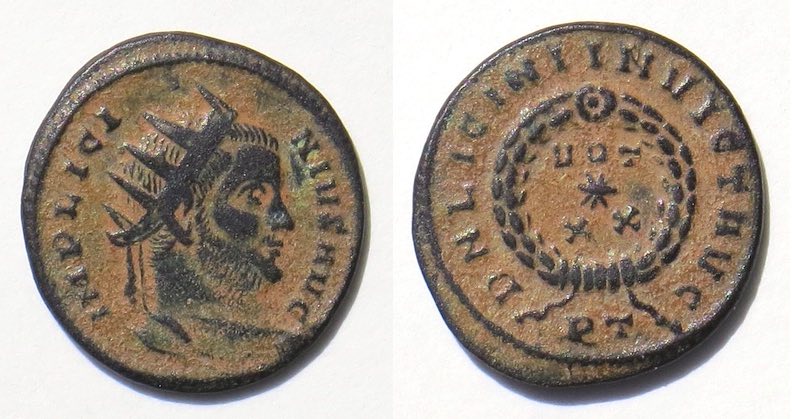
DN LICINI INVICT AVG (Ticinum only)
VOT XX in wreath |
Vota. |
| F308 |
DOMINI N LICINI AVG
VOT XX in wreath |
Vota. |
| F190 |
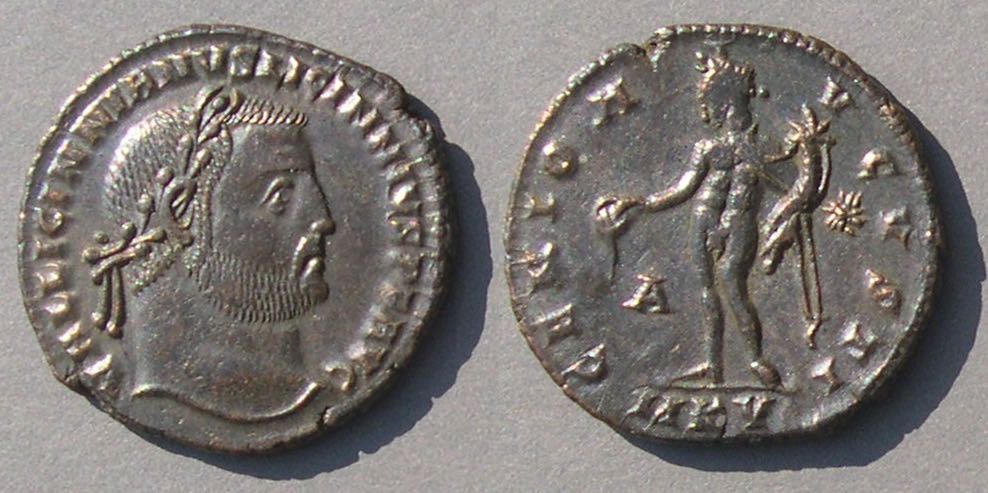
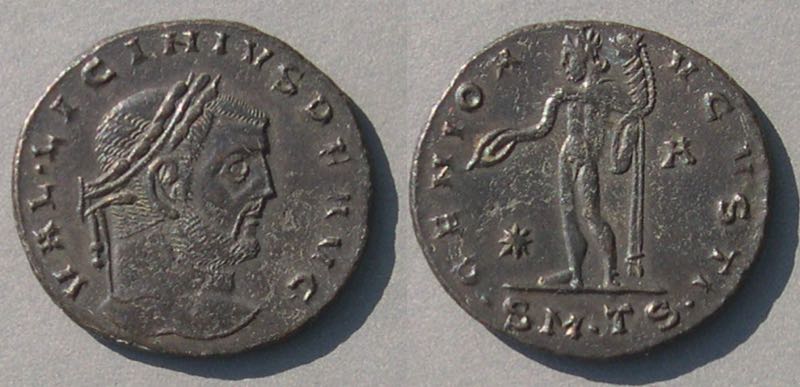
GENIO AVGVSTI, Genius holding patera |
C |
| F190A |
GENIO AVGVSTI, Genius holding head of Sol |
C |
| F190B |
GENIO AVGVSTI, Genius holding head of Serapis |
C |
| F190C |
GENIO AVGVSTI, Genius holding Victory on globe |
C |
| F191-F192 |
GENIO AVGVSTI CMH, Genius holding patera |
C |
| F195 |
GENIO EXERCITVS, Genius standing |
S |
| F197 |
GENIO IMPERATORIS, Genius standing |
S |
| F198, F253 |
GENIO POP ROM [CMH] |
C |
| F199 |
GENIO POPVLI ROMANI, Genius standing (Rome only) |
S |
| F199v |
GENIO POPVLI ROMANI, Genius holds head of Serapis (Alexandria only) |
R |
| F201 |
HERCVLI VICTORI, Hercules leaning on club right |
|
| F254 |
IOVI CONSERVATORI, Jupiter holds Victory, eagle at feet (sometimes also a captive) |
|
| F254v |
IOVI CONSERVATORI, Jupiter standing left w thunderbolt and scepter |
Also for L2. |
| F278C |
IOVI CONSERVATORI, Jupiter striding right hurling thunderbolt |
Also for L2. |
| F279 |
IOVI CONSERVATORI, Jupiter holding Victory and scepter with eagle on top, at feet eagle and captive, XIIΓ in right field (for the denomination) The bust is radiate for Licinius. |
Also for L2 with helmeted bust |
| F248 (billon) |
IOVI CONSERVATORI AVG [only one "G"], Jupiter rides flying eagle (Trier only) Struck c. 312 |
R |
| F248 (AE) |
IOVI CONSERVATORI AVG [only one "G"], Jupiter rides flying eagle (Trier only) AE. Struck 319 |
S |
| F202 |
IOVI CONSERVATORI AVGG, Jupiter holds Victory, eagle at feet left |
For L2 with CAESS |
| F202B |
IOVI CONSERVATORI AVGG, Jupiter holds Victory, captive at feet left |
For L2 with CAESS |
| F202C |
IOVI CONSERVATORI AVGG, Jupiter holds globe and scepter (no Victory, eagle, or captive) |
For L2 with CAESS |
| F202NN |
IOVI CONSERVATORI AVGG NN Jupiter holds Victory, captive at feet left |
For L2 with CAESS |
| F314 |
LICINI AVGVSTI around
VOT/IS /XX (Siscia only ) or VO/TIS/XX (Arles only) (no wreath) |
Vota. |
| F204 |
MARTI CONSERVATORI, Mars standing or advancing |
|
| F280 |
PAX PERPETVA, Pax leans on column |
Also L2. |
| F282 |
PROVIDENTIAE AVGG, campgate |
For L2 with CAESS |
| F256 |
PROVIDENTIAE AVGG two figures moving the mint from Ostia to Arles (Arles only) |
RR |
| F315 |
ROMA AETERNAE, XV on shield held by Roma (Rome only) |
Vota. |
| F284 |
SAECVLI FELICITAS, shield with AVG on cippus |
RR |
| F240 |
SECVRITAS AVGG (London only) |
RR |
| F208v |
SOLI [or SOLE] INVICTO, Sol standing in long robe, holding head of Serapis (Antioch only) |
|
| F208 |
SOLI INVICTO COMITI, Sol standing |
|
| F241 |
SPQR OPTIMO PRINCIPI, three standards |
S |
| F259 |
TRB P CONS IIII PP PROCONSVL, emperor standing with globe and scepter (Arles only) |
RR |
| F287 |
VICTORIA AVGG NN (Thessalonica only) |
S. CAESS for L2. |
| F316-318 |
VICT[ORIA] LAET[AE] PRINC PERP
VOT PR on shield held by two Victories |
|
| F244 |
VICTORIA MAXIMINI AVG, Victory w wreath and palm (Cyzicus only. RIC VI Cyz 107 "R3") |
RR |
| F288 |
VIRT EXERCIT, "camp plan" like X's superimposed (Thessalonica only) RIC Thessalonica 68. |
R |
| F289-290 |
VIRTVS AVGG, city gate |
|
| F291 |
VIRTVS EXERCIT, trophy with two captives |
Also for L2. Rare |
| F320 |
VIRTVS EXERCIT, VOT XX on standard between two captives |
Vota. This issue has VOT X (F319) for the Caesars. |
| F212 |
VIRTVTI EXERCITVS, Virtus with spear and trophy |
|
| F245 |
VIRTVTI EXERCITVS, Virtus drags captive |
|
| F323 |
VOT XV, in weath (Rome only) |
Vota. |
| F322 |
VOT X / ET XV F / RP, in wreath. (Rome only. RIC Rome 201f, "320") |
Vota. Also for L2. For the 2 Augusti and the 3 Caesars. R or RR for all. |
| F324 |
VOT/XV/FEL/XX in wreath (Rome only. RIC Rome 213f ,"320") |
Vota. RR |
| F326 |
VOT XX MVLT XXX in wreath (Thessalonica only) |
Vota. S |
| F264 |
VOTIS V MVLTIS X in wreath (not in RIC, but I have seen at least a dozen. Likely Antioch only) |
Vota. R |
| F265 (fraction) |
FVNDAT PACIS, Mars advances (Trier and Rome only) |
R |
| F266 (fraction) |
GLORIA PERPET two Victories advancing right (Trier and Rome only) |
RR |
| F269 (fraction) |
SAPIENT PRINCIP, altar with owl (Trier and Rome only) |
RR |
| F221 (fraction) |
VOT X MVL XX, in wreath (Trier only) |
Vota. RR |
Table key:
L2 = Licinius II
Vota = a type with a vota number or numbers
S = scarce (i.e. often available, but much less common than his common types)
R = rare. RR = very rare. RRR = almost never offered.
Skip to Licinius: DN, GENIO, IOVI, LICINI, ROMAE, VICTORIA, VOT. Licinius II: CAESARVM, IOVI, PROVIDENTIAE, VICTORIA, VOT.
Table 2: Licinius and Licinius II (317-324)
(very rare "double effigy" types)
Failmezger
#(image link) |
Types (images below)
in alphabetical order of reverse legend
after the rare "double effigy" types |
Licinius |
Licinius II |
F276
(no image) |
Two busts, vis-a-vis (Licinius with Licinius II)
DD NN IOVII LICINII INVICT AVG ET CAES
IOM ET VICT CONSER DD NN AVG ET CAES, Victory crowns Jupiter (Cyzicus only, RIC Cyz 13) |
joint issue,
RR |
joint issue,
RR |
F275
(no image) |
Two busts, vis-a-vis (Licinius with Licinius II)
DD NN IOVII LICINII INVICT AVG ET CAES
IOM ET FORT CONSER DD NN AVG ET CAES, Victory crowns Jupiter (Nicomedia only, RIC Niko 38) |
joint issue,
RR |
joint issue,
RR |
F275B
(no image) |
Two busts, vis-a-vis (Constantine and Licinius)
DD NN CONSTANTINVS ET LICINIVS AVGG
IOM ET FORT CONSER DD NN AVGG Victory crowns Jupiter (Nicomedia only, RIC Niko 39) |
RR |
-- |
F275C
(no image) |
Two busts, vis-a-vis (Licinius II and Constantine II)
DD NN LICINIVS ET CONSTANTINVS NOB CAESS
IOM ET FORT CONSER DD NN NOBB CAESS Victory crowns Jupiter (Nicomedia only, RIC Niko 40) |
-- |
RR |
| F277 |
Two busts, vis-a-vis (Licinius and Licinius II)
DD NN IOVII LICINII INVICT
IOM ET VIRTVTI DD NN AVG ET CAES, Jupiter standing left, trophy to left, two captives below. (Antioch only). RIC Heraclea 50 with attribution corrected to Antioch by Bastien, NC 1973, #5. |
joint issue,
RR |
joint issue,
RR |
Table 3: Licinius II (317-324)
Failmezger
#(image link) |
Types (images below)
in alphabetical order of reverse legend |
Notes |
| F299 |
BEATA TRANQVILLITAS
VOT[IS] XX, globe on altar |
Vota. RR. This is really a type of Constantine and his sons. Not for L1. |
| F300 |
CAESARVM NOSTRORVM
VOT V in wreath |
Vota. Common |
| F302 |
CAESARVM NOSTRORVM
VOTIS V (large V, no wreath) |
Vota. |
| F302A |
CAESARVM NOSTRORVM
VO/TIS/V or VOT/IS/V |
Vota. RR |
| F273 |
CONCORDIA AVGG NN, Concordia stands (Aquileia only) |
R. RIC Aq 12-13, "s, r4" but only one officina each. |
| F312 |
DOMINORVM NOSTRORVM CAESS
VOT V in wreath |
Vota. |
| F278A |
IOVI CONSERVATORI, Jupiter standing left holding thunderbolt and scepter |
Also for L1 |
| F278B |
IOVI CONSERVATORI, Jupiter right hurling thunderbolt |
Also for L1 |
| F278 |
IOVI CONSERVATORI, Jupiter holding Victory, eagle at feet (sometimes also a captive) |
Also for L1 |
| F279 |
IOVI CONSERVATORI, Jupiter holding Victory, eagle and captive, XIIΓ in right field (for the denomination) The bust is helmeted for Licinius II. |
Also for L1, but radiate. |
| F278 |
IOVI CONSERVATORI CAESS, Jupiter holding Victory (sometimes a captive at feet left) xxx eagle? |
CAESS for L2 and AVGG for L1. |
| F278v |
IOVI CONSERVATORI CAESS, Jupiter holding globe and scepter. |
CAESS for L2 and AVGG for L1. |
| F280 |
PAX PERPETVA, Pax leans on column |
Also L1 |
| F281 |
PRINCIPI IVVENTVTIS, Prince or Mars |
|
| F282 |
PROVIDENTIAE CAESS, campgate |
L2 has CAESS. For L1 with AVGG |
| F283 |
PROVIDENTIAE CAESS, Jupiter holding Victory (Nicomedia only). Palm branch at left |
Not for L1, even with AVGG. |
| F315 |
ROMA AETERNAE
XV on shield held by Roma (Rome only) |
Vota. Also for L1. |
| F284 |
SAECVLI FELICITAS, shield with AVG on cippus |
Also L1. RR |
| F287 |
VICTORIA CAESS NN (Thessalonica only) |
Scarce. L2 with CAESS. L1 has AVGG. |
| F316-318 |
VICT[ORIA] LAET[AE] PRINC PERP
VOT PR on shield held by two Victories |
Vota. Also for L1. |
| F288 |
VIRT EXERCIT, "camp plan" like an X (Thessalonica only) RIC Thess 70 for L2 |
Also for L1. |
| F289 |
VIRTVS AVGG, city gate |
The Augusti at this time were Constantine and Licinius. VIRTVS CAESS was not in this issue. |
| F291 |
VIRTVS EXERCIT, trophy with two captives |
Also for L1. Rare. |
| F319 |
VIRTVS EXERCIT
VOT X on standard between two captives |
Vota. Not for L1, who has VOT XX instead. |
| F320 |
VIRTVS EXERCIT
VOT XX on standard between two captives |
Vota. Also for L1. |
| F292 |
VIRTVS MILITVM DD NN, Mars walking right with spear and trophy (Thessalonica only) |
RR, RIC Thess 22, only one officina "r3". Only L2. |
| F321 |
VOT V MVLT X CAESS TS Є in wreath (Thessaloncia only) |
Vota. C. F326 is the corresponding issue for L1 |
| F322 |
VOT X / ET XV F / RP, in wreath. (Rome only) |
RR. Vota. Also for L1. |
| F324 |
VOT XV FEL XX, in wreath (Rome only) |
Vota. Also for L1. RR |
| F325 |
VOT XX in wreath (Rome only, RIC Rome 212. r4) |
Vota. Also for Constantine, but not listed for L1, athough it seems it should be. |
| F293 (fraction) |
PRINCIPI IVVENTVTIS, Prince or Mars |
RRR |
Numismatic notes: When Licinius was using VOT XX, Licinius II was using VOT V. Vota types had previously celebrated only multiples of 10--previously VOT X was the minimum. These VOT V coins (shared with Crispus and Constantine II) are the first to make vows for 5 years of reign. Also, the coins with XV for 15 are the first to make vows for 15 years. There were only two rare VOTA types for Licinius I before issues including Licinius II, F221 and F264.
Skip down to Licinius: DN, GENIO, IOVI, LICINI, ROMAE, VICTORIA, VOT. Licinius II: CAESARVM, IOVI, PROVIDENTIAE, VICTORIA, VOT.
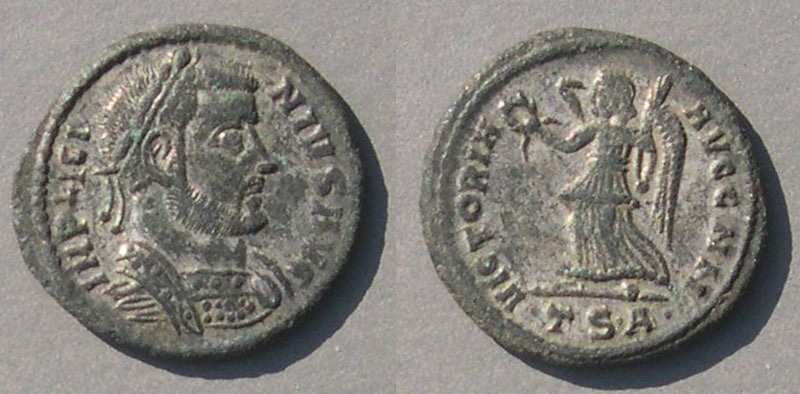
Images. Licinius. Table 1. 308-324. (Several early issues spell his name with two Ns--LICINNIANVS.)
F185. [no photo] BONO GENIO PII IMPERATORIS, Genius standing. Only at Alexandria. Shared with Maximinus II and Constantine as Augusti, c. 311-312.

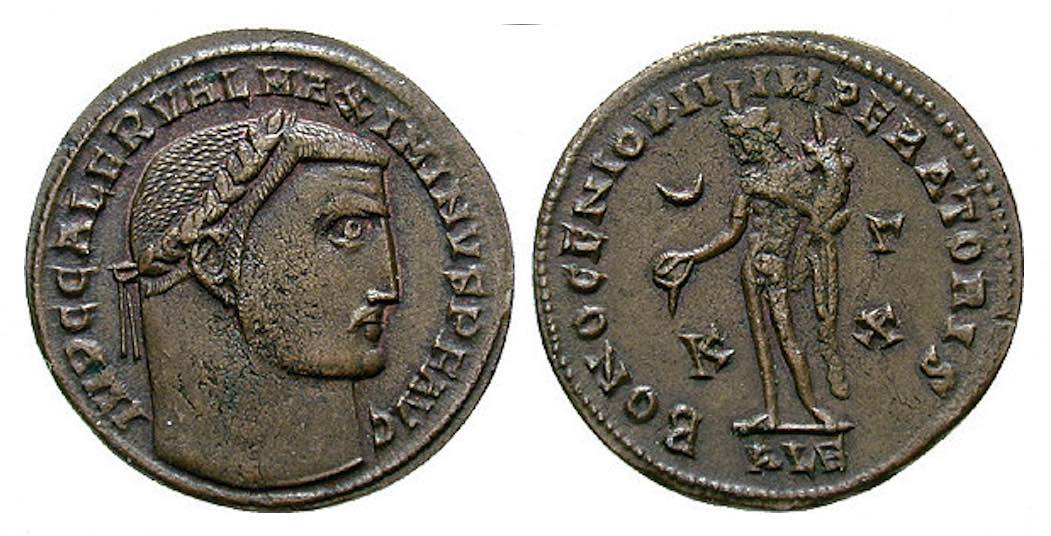 The reverse type, but for Maximinus II.
BONO GENIO PII IMPERATORIS
This example: Maximinus II
24 mm. 5.97 grams.
RIC VI Alexandria 144b, page 683. "c. 311-312"
F190 variety. GENIO AVGVSTI, Genius standing left, holding patera over altar
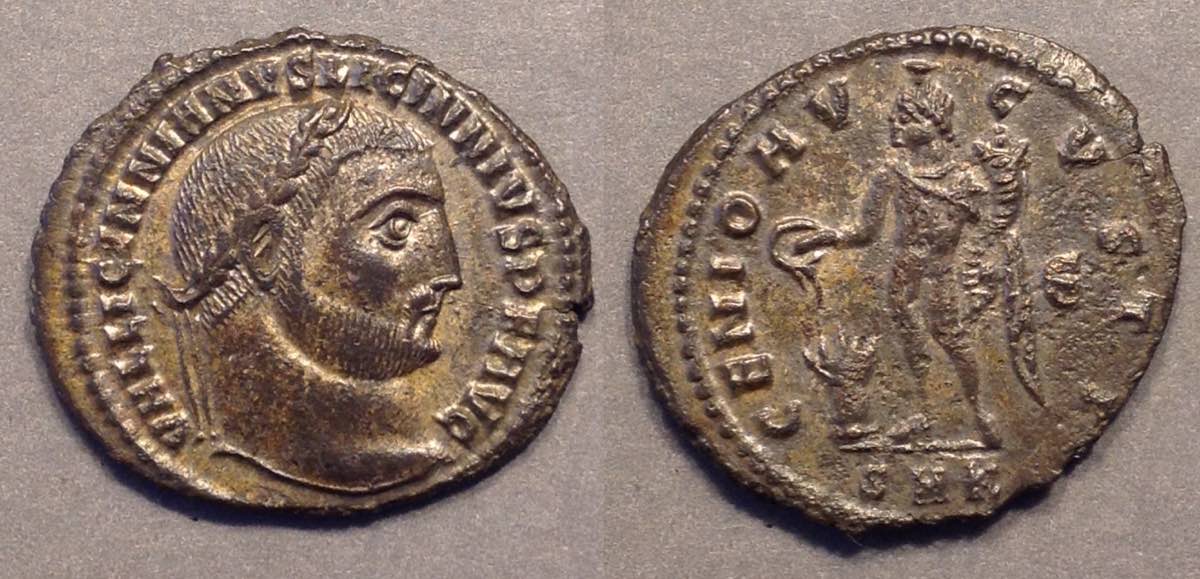 Licinius
GENIO AVGVSTI, Genius standing left, holding patera over altar
This example: 22-20 mm. 4.04 grams.
VAL LICINNIANVS LICINNIVS PF AVG
Another long early legend.
RIC VI Cyzicus 100 "c. 312-313", page 593.
Sear IV 15158
F190 with Sol. GENIO AVGVSTI, Genius standing left holding head of Sol
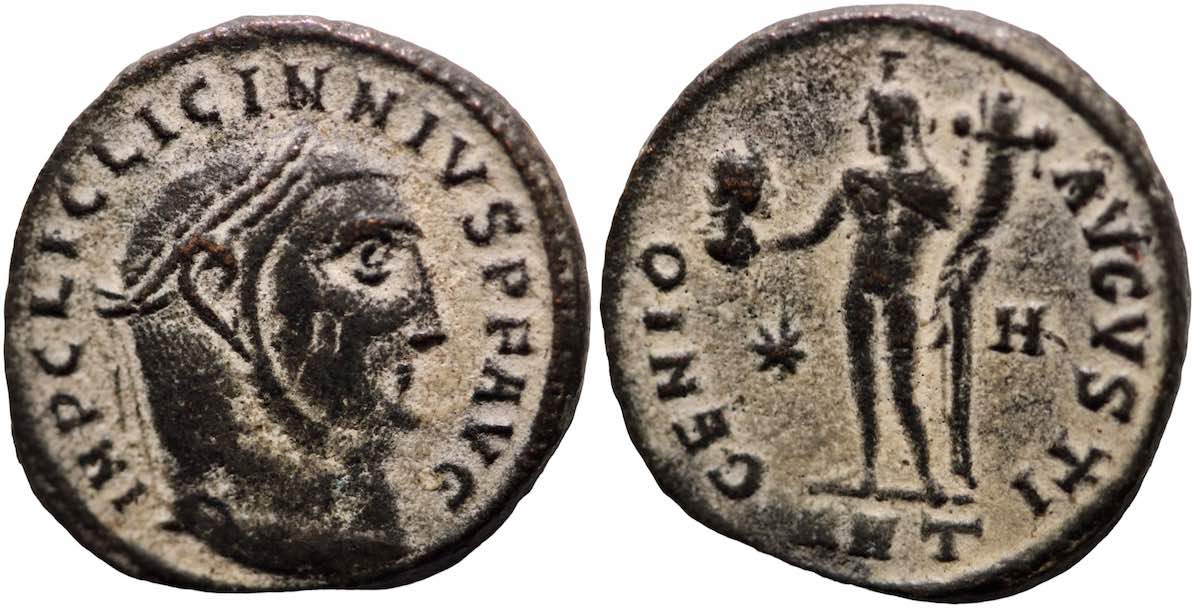 Licinius
GENIO AVGVSTI, Genius standing left holding head of Sol
This example: 21 mm. 4.52 grams.
IMP C LIC LICINNIVS PF AVG (with "NN")
RIC Antioch 164a, page 643. "312"
F190 with Serapis. GENIO AVGVSTI, Genius standing left holding head of Serapis
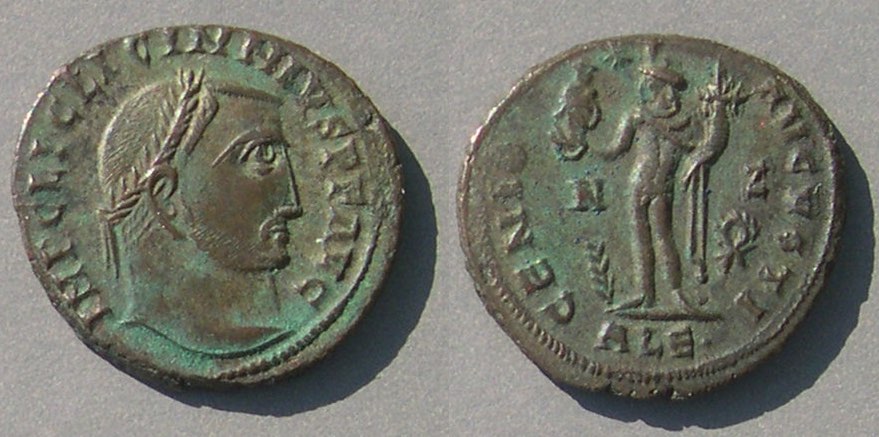 Licinius
GENIO AVGVSTI, Genius standing left holding head of Serapis
This example: 22-21 mm. 5.58 grams.
RIC VI Alexandria 162a, page 685. "313"
Sear IV 15167
IMP C LIC LICINNIVS PF AVG (with "NN")
F190 with Victory. GENIO AVGVSTI, Genius standing left holding Victory on globe
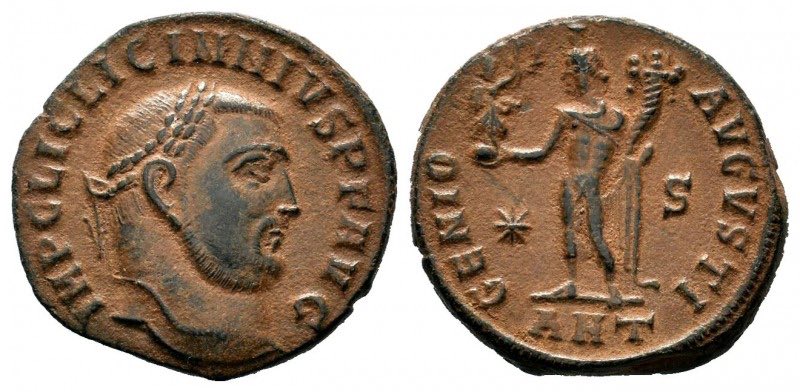 Licinius
GENIO AVGVSTI, Genius standing left holding Victory on globe
This example: 21-20 mm. 4.69 grams.
RIC VI Antioch 162a, page 642. "311-312"
IMP C LIC LICINNIVS PF AVG (with "NN")
F192. GENIO AVGVSTI CMH, Genius standing left holding patera (only Nicomedia and Cyzicus)
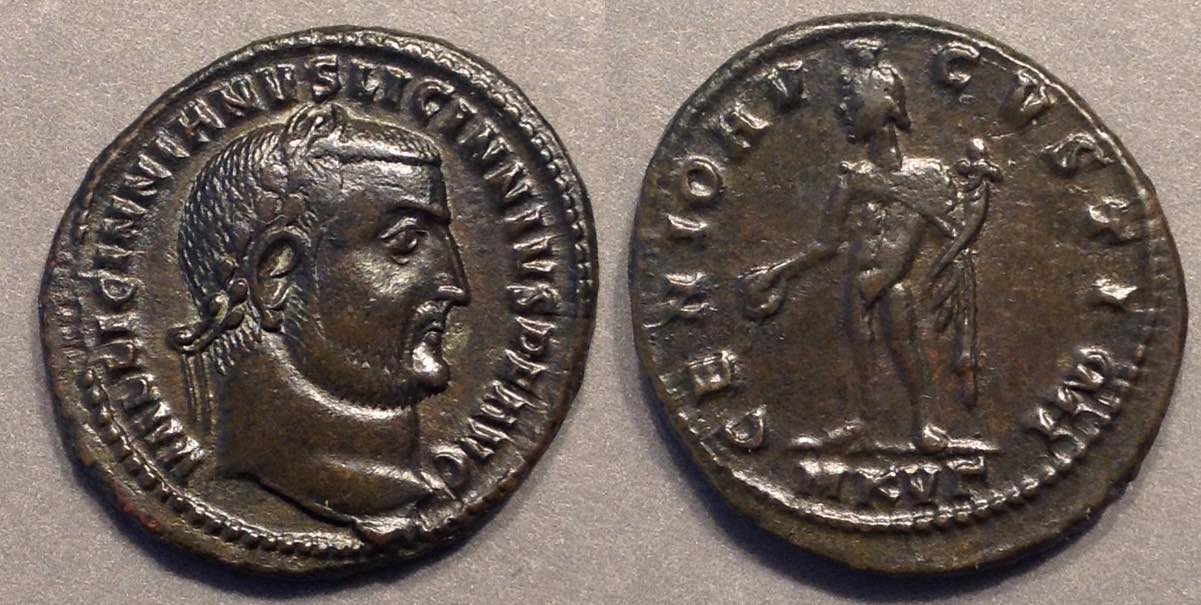 Licinius
Obverse legend: VAL LICINNIANVS LICINNIVS PF AVG
Note the double Ns which were replaced by N in later issues.
GENIO AVGVSTI CMH, Genius standing left holding patera
This example: 22 mm. 6.34 grams.
RIC VI Cyzicus 76 "c mid 311" page 591 "S"
Sear IV 15159
The meaning of the elided "CMH" 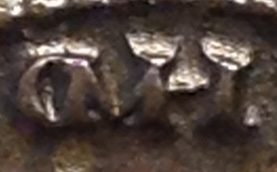 is unclear. Some think it may mean "C" for "100" and "MH" for "48" in some combination. This type with "CMH" struck only at Nicomedia and Cyzicus.
F195. GENIO EXERCITVS, Genius standing holding patera over altar (Antioch only)
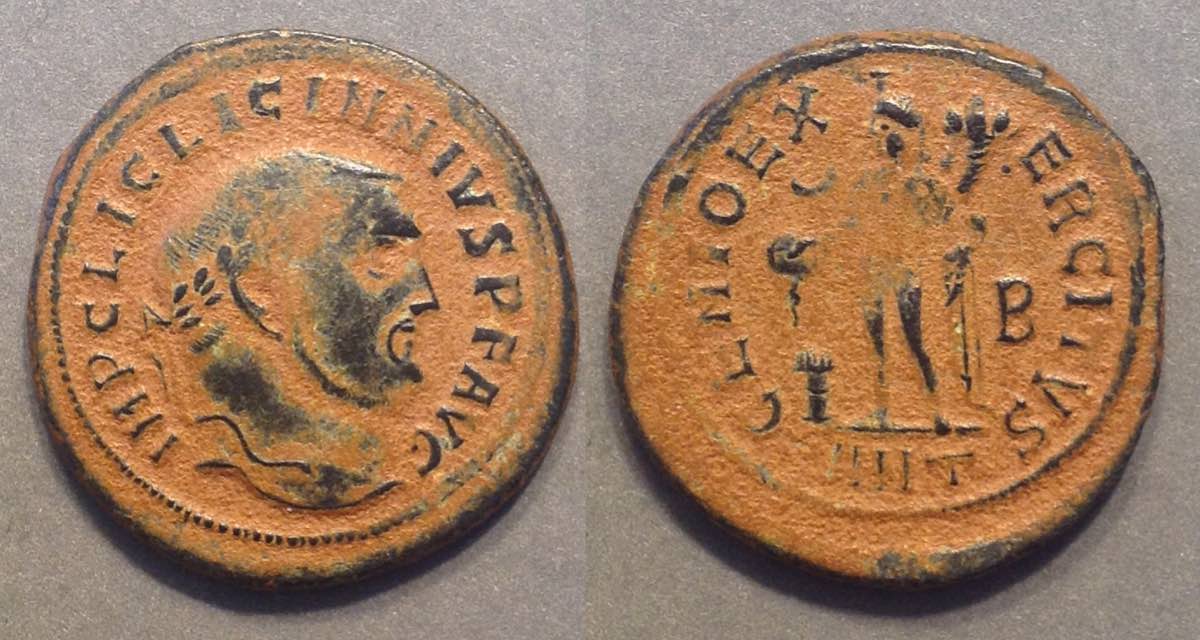 Licinius
GENIO EXERCITVS, Genius standing holding patera over altar
This Example: 23 mm. 6.29 grams.
IMP C LIC LICINNIVS PF AVG (with "NN")
RIC VI Antioch 147b, "310-311", page 638.
Sear IV 15170
This type only at Antioch for Galerius, Licinius, Maximinus II, and Constantine.
F197. GENIO IMPERATORIS, Genius standing holding patera
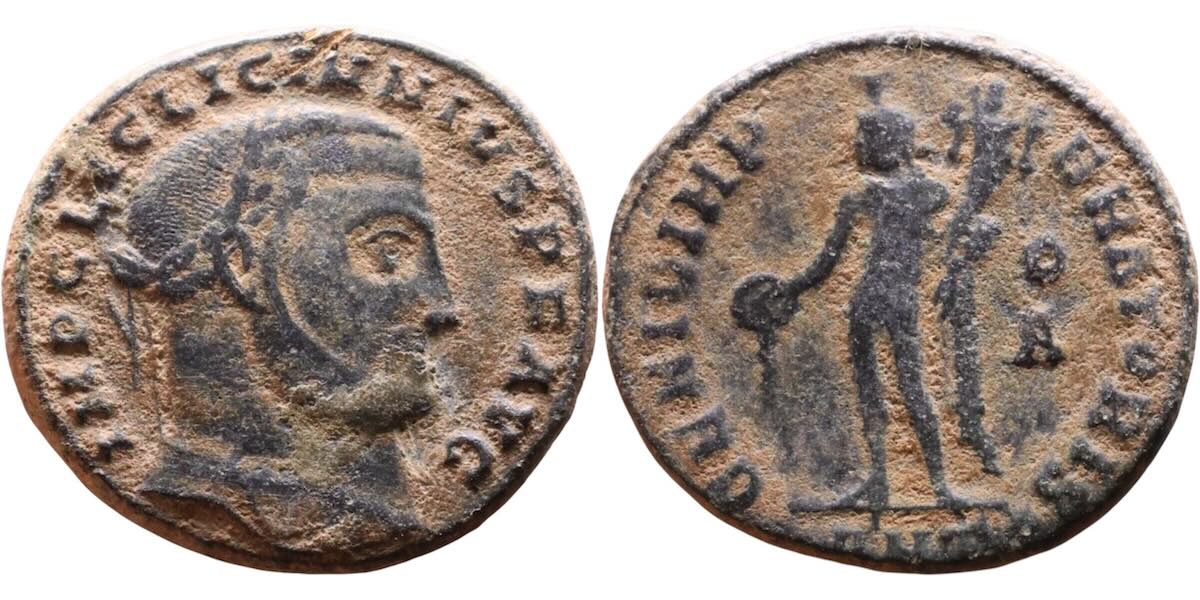 Licinius
GENIO IMPERATORIS, Genius standing holding patera
This example: 24-23 mm. 6.90 grams.
IMP C LIC LICINNIVS PF AVG (with "NN")
RIC VI Antioch 112b "early to later 309", page 632.
This issue with these fieldmarks was shared by Galerius, Licinius, and Maximian (his third reign!) It is unclear why Galerius, who had arranged the Conference at Carnuntum which determined that Maximian should return to retired status, would mint for Maximian with the titles of an active Augustus.
F197. GENIO IMPERATORIS, Genius standing holding patera
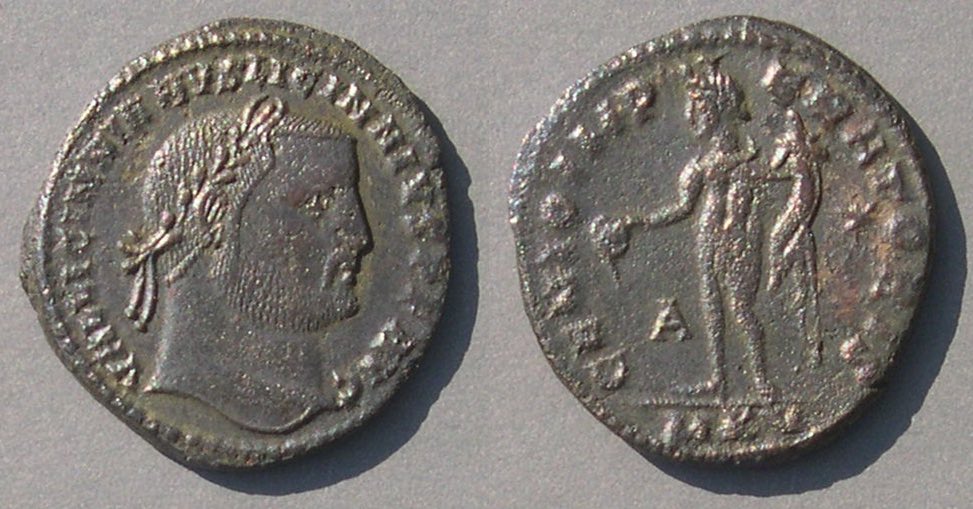 Licinius
GENIO IMPERATORIS, Genius standing holding patera
This example: 25-24 mm. 6.36 grams.
RIC VI Cyzicus 57, page 588. "c. 309-310"
VAL LICINNIANVS LICINNIVS PF AVG
Another coin with the long early legend with his named spelled with two Ns where later coins use one.
F197, variety with altar. GENIO IMPERATORIS, Genius standing holding patera over altar
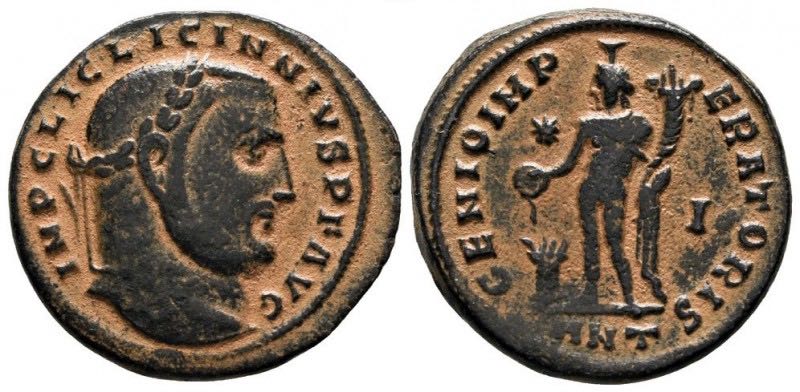 Licinius
GENIO IMPERATORIS, Genius standing holding patera over altar
This example: 24-22 mm. 6.21 grams.
IMP C LIC LICINNIVS PF AVG (with "NN")
RIC VI Antioch 133b, page 636. "310"
F198. GENIO POP ROM, Genius standing holding patera
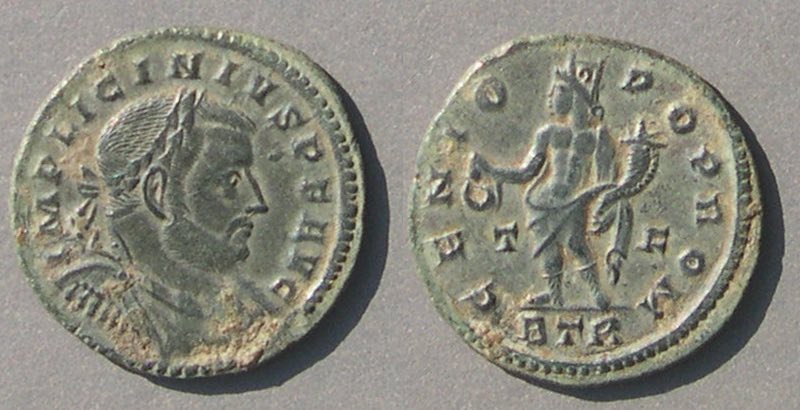 Licinius
GENIO POP ROM, Genius standing holding patera
This example: 20 mm. 2.89 grams.
IMP LICINIVS PF AVG
RIC VII Trier 120, page 133. "316"
F198 (a second example). GENIO POP ROM, Genius standing holding patera
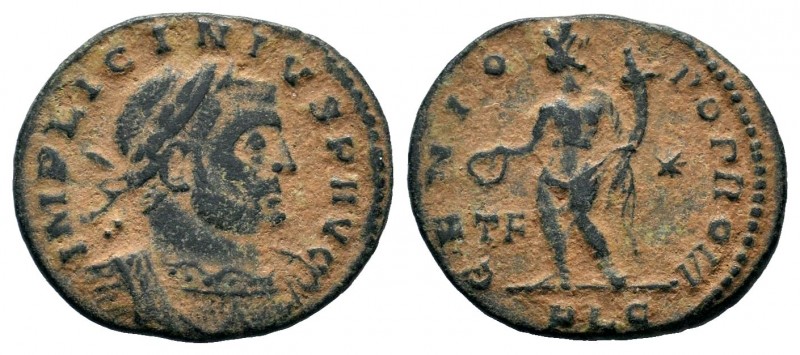 Licinius
GENIO POP ROM, Genius standing holding patera
This example: 21-18 mm. 2.73 grams.
IMP LICINIVS PF AVG
RIC VII Lyons 46, page 125. "315-316"
Sear IV 15195.
F199. GENIO POPVLI ROMANI, Genius standing holding patera
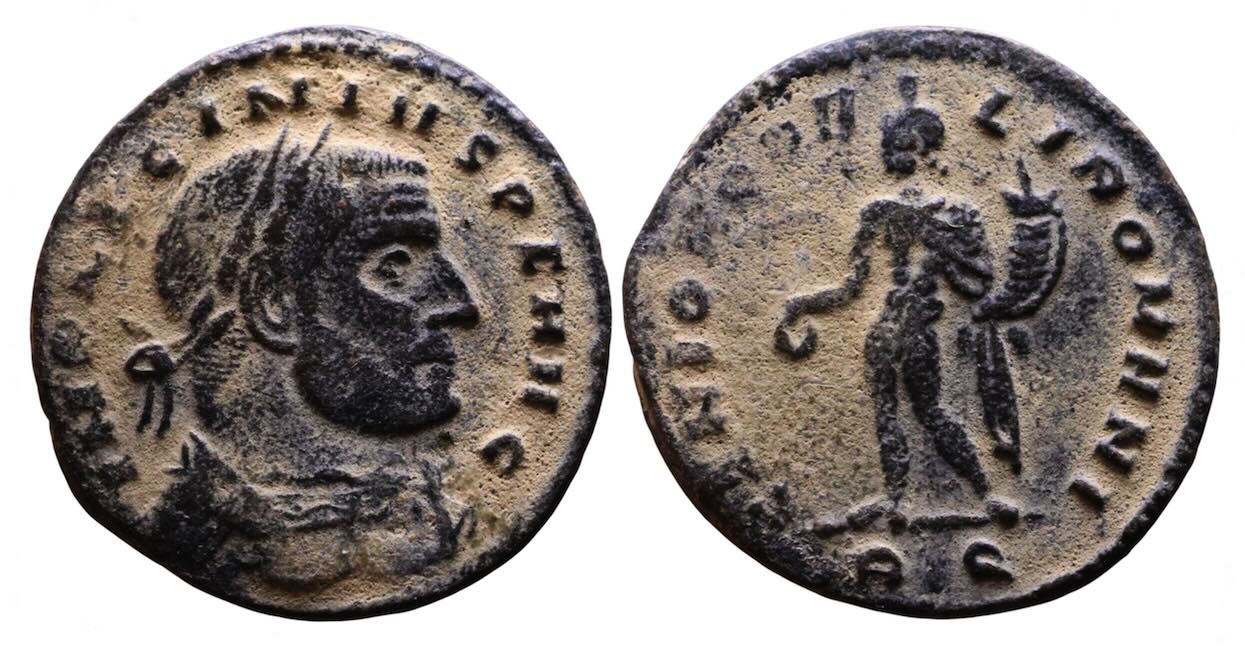 Licinius
GENIO POPVLI ROMANI, Genius standing holding patera
This example: 21 mm. 2.72 grams.
IMP C LICINIVS PF AVG
RIC VII Rome 295c "312-3"
A late occurance of the GENIO POPVLI ROMANI legend.
F199 with Serapis. GENIO POPVLI ROMANI, Genius standing holding head of Serapis (Alexandria only)
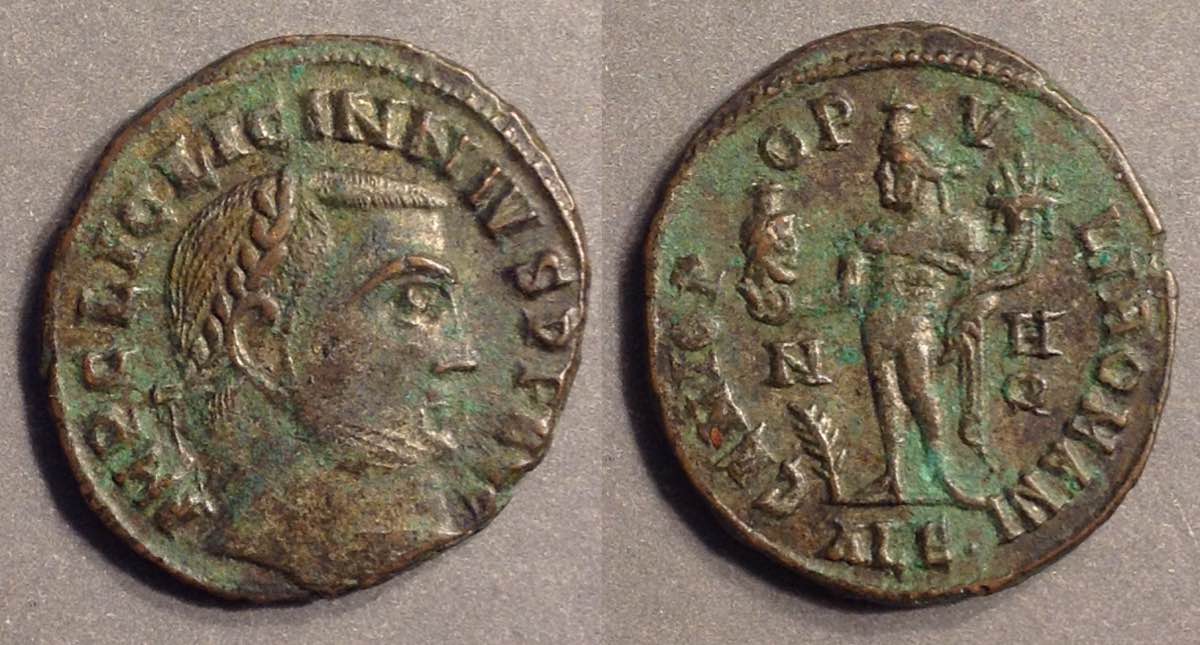 Licinius
GENIO POPVLI ROMANI, Genius standing holding head of Serapis (Alexandria only)
This example: 22-20 mm. 5.40 grams.
RIC VII Alexandria 5, page 703. "313-314"
Sear IV 15199
F201. HERCVLI VICTORI, Hercules leaning right on club
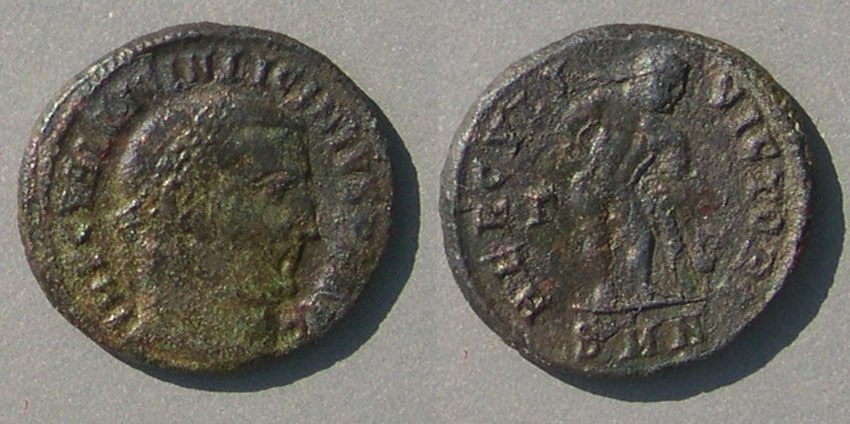 Licinius
HERCVLI VICTORI, Hercules leaning right on club
This example: 22-20 mm. 4.98 grams.
RIC VI Nicomedia unlisted, but would be 68a. (68b is for Maximinus II with no 68a.) "c. May 311-313"
IMP C VAL LICIN LICINIVS PF AVG
IOVI
F254. IOVI CONSERVATORI, Jupiter holds Victory and staff eagle at feet
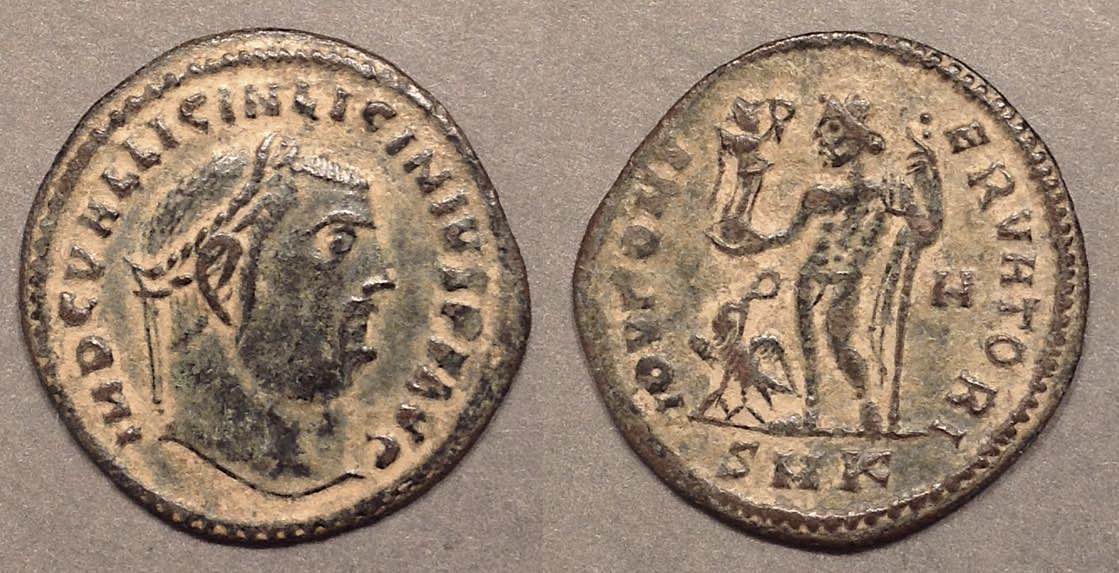 Licinius
IOVI CONSERVATORI. Jupiter holds Victory and staff, eagle at feet
This example: 23-22 mm. 2.58 grams.
RIC VI Cyzicus 105a, page 584. "c. 312-313"
F254v. IOVI CONSERVATORI, Jupiter holds thunderbolt and staff
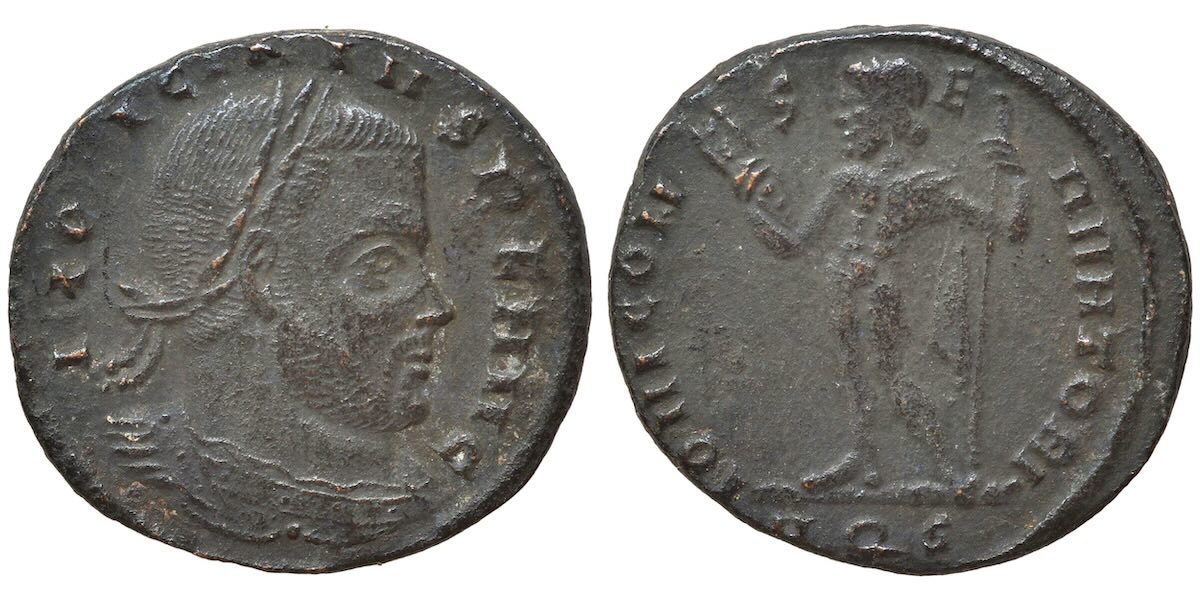 Licinius
Jupiter holds thunderbolt and staff
This example: 19-18 mm. 2.99 grams.
IMP LICINIVS PF AVG
RIC VII Aquileia 7 "317"
F279. IOVI CONSERVATORI, Jupiter holds Victory with eagle, XIIΓ in right field (for the denomination "12 1/2"). Obverse bust is radiate for the Augusti and helmeted for the Caesars.
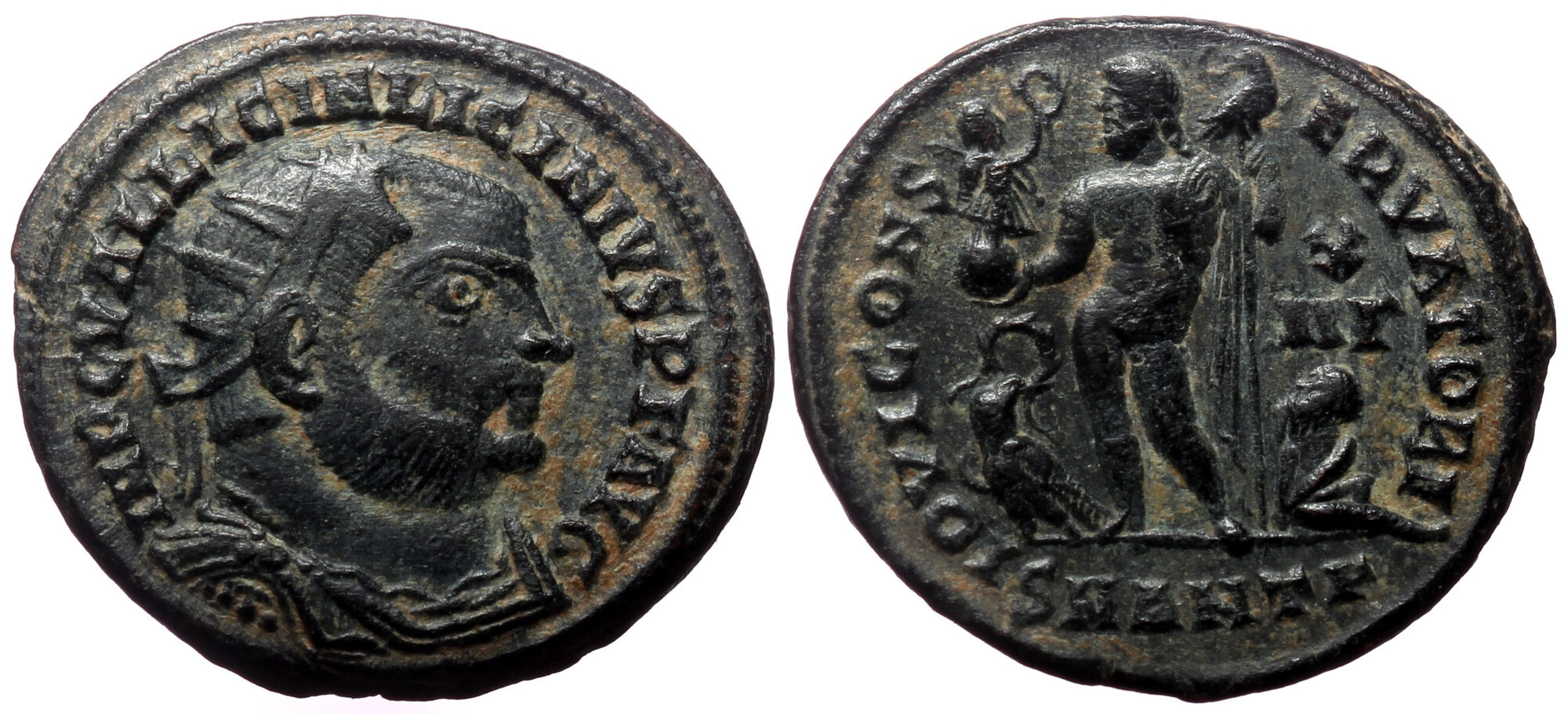 Licinius
IOVI CONSERVATORI, Jupiter holds Victory, eagle and captive, XIIΓ in right field (for the denomination).
Obverse bust is radiate.
This example: 20-19 mm. 4.00 grams.
RIC Antioch 35, struck "321-323", page 682
Sear IV 15225
Another example, but from Alexandria, is next.
F279 (a second example). IOVI CONSERVATORI, Jupiter holds Victory, eagle and captive at feet, XIIΓ in right field (for the denomination). Obverse bust is radiate.
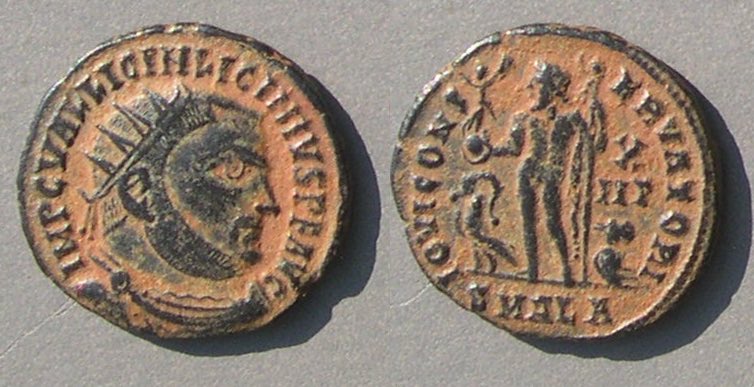 Licinius
Radiate bust, as always for Licinius and Constantine for this denomination. The Caesars are not radiate.
IOVI CONSERVATORI, Jupiter holds Victory, eagle and captive at feet, XIIΓ in right field
This example: 19-18 mm. 2.97 grams.
RIC VII Alexandria 28, page 709. "321-322"
Sear IV 15226
F248. (Base silver agrenteus) IOVI CONSERVATORI AVG, Jupiter rides eagle flying right. Struck c. 312. Mintmark PTR (Not STR)
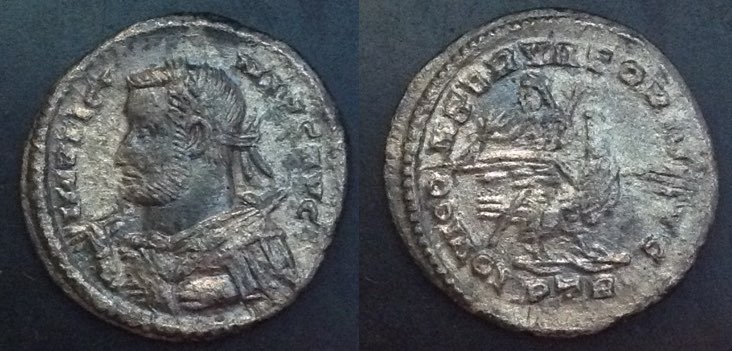 Licinius
IOVI CONSERVATORI AVG, Jupiter rides eagle flying right
(Trier only)
This example: 18 mm. 2.85 grams.
RIC VI Trier 825 "R3" "base silver" "309-May 313"
Sear IV 15144
This is really a different denomination from the AE above. It is from a base-silver issue shared with Constantine and Maximinus II that is now called a "base silver argenteus." It is a debased successor of the good-silver argenteus of the coin reform of 294.
F248. IOVI CONSERVATORI AVG [only one "G"], Jupiter rides eagle flying right, Struck c. 319. Mintmark STR.
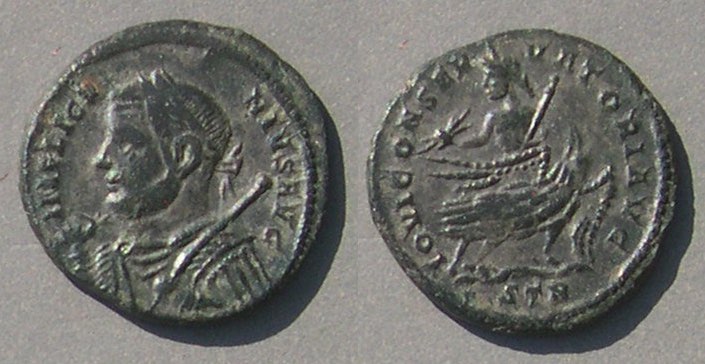 Licinius
IOVI CONSERVATORI AVG [Only one "G"], Jupiter rides eagle flying right
(Trier only)
This example: 18 mm.
IMP LICINIVS AVG
Note the mintmark is "STR", not "PTR".
RIC VII Trier 212 , page 224. "319 AD" "r3"
This type is easy to mistake for the earlier base-silver argenteus above.
F202. IOVI CONSERVATORI AVGG, Jupiter holds Victory with eagle at feet.
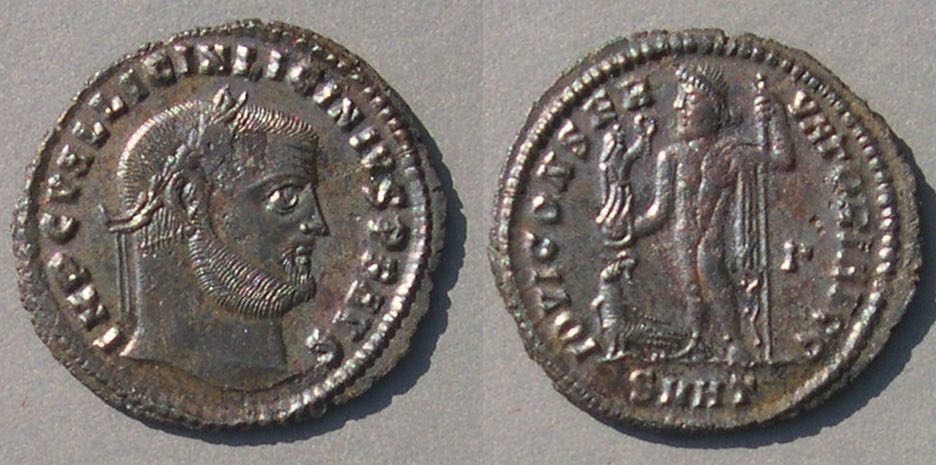 Licinius
IOVI CONSERVATORI AVGG, Jupiter holds Victory with eagle at feet.
This example: 24 mm. (large) 3.65 grams.
IMP C VAL LICIN LICINIVS PF AVG (long legend)
RIC VI Heraclea 73, page 514. "early 313"
Sear IV 15240
F202 (a second example). IOVI CONSERVATORI AVGG, Jupiter holds Victory with eagle at feet.
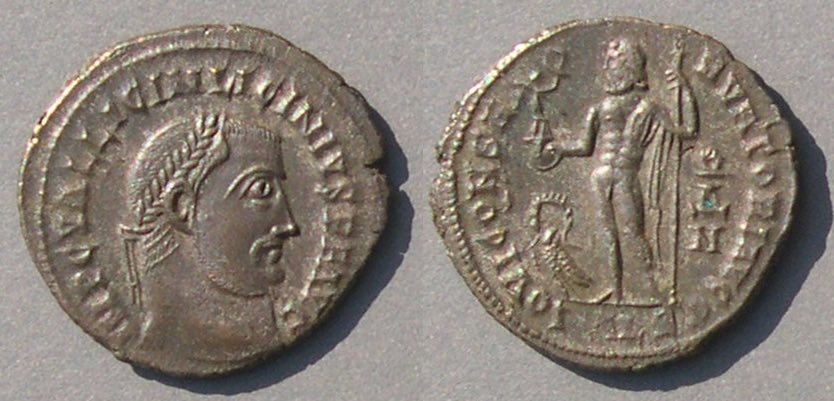 Licinius
IOVI CONSERVATORI AVGG, Jupiter holds Victory with eagle at feet.
This example: 21-20 mm. 3.36 grams. (Smaller than the above example)
IMP C VAL LICIN LICINIVS PF AVG (long legend)
RIC VII Alexandria 10a, page 705. "315"
Sear IV 15246
Coin sizes were decreasing rapidly. The larger one above is from 313 and this smaller one from 315.
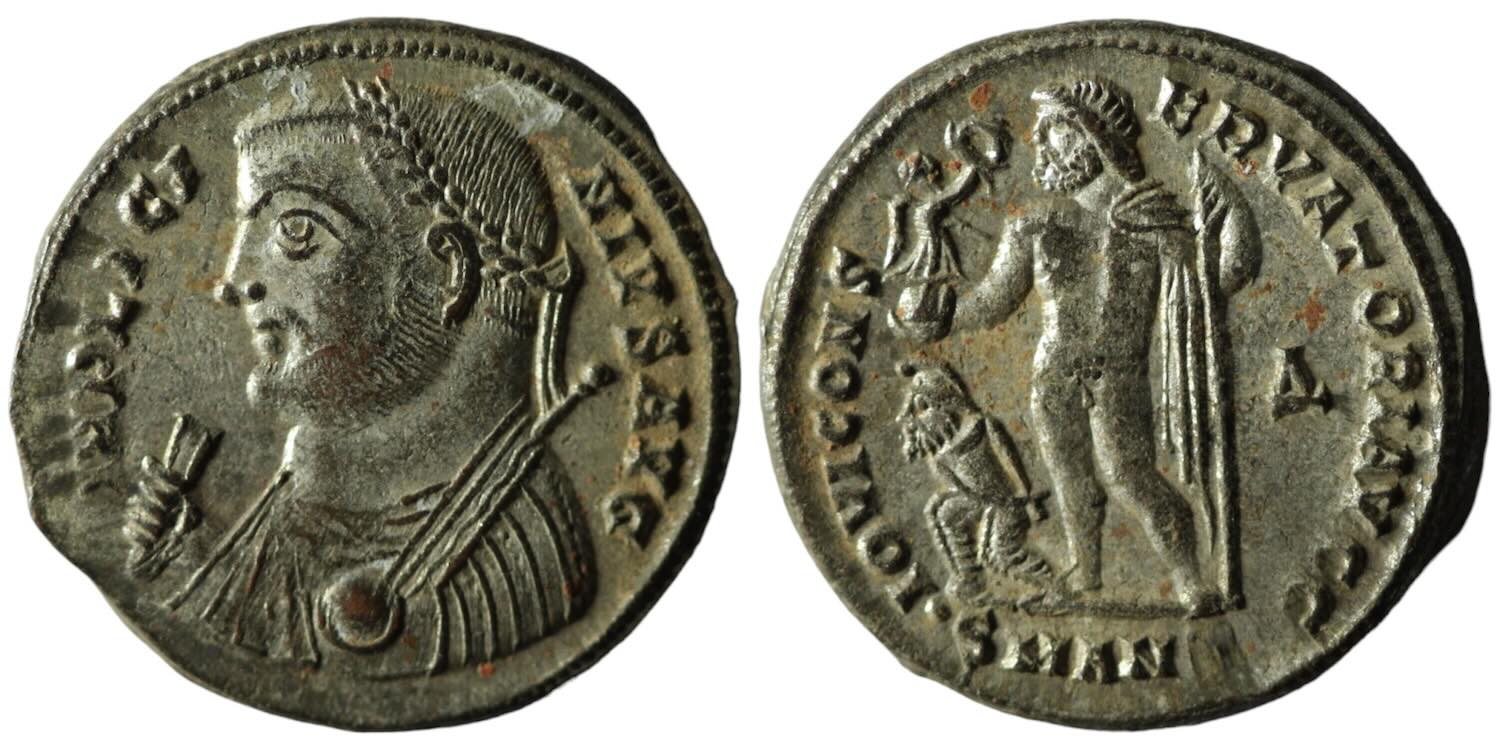 Licinius
IOVI CONSERVATORI AVGG, Jupiter holds Victory with captive at feet
This example: 19 mm. 3.85 grams.
IMP LICINIVS AVG
RIC VII Antioch 27 "317-320"
Sear IV 15239
F278. IOVI CONSERVATORI AVGG, Jupiter standing holding globe and scepter (no Victory, eagle, or captive). AVGG for Constantine and Licinius. CAESS for Crispus, Licinius II, and Constantine II.
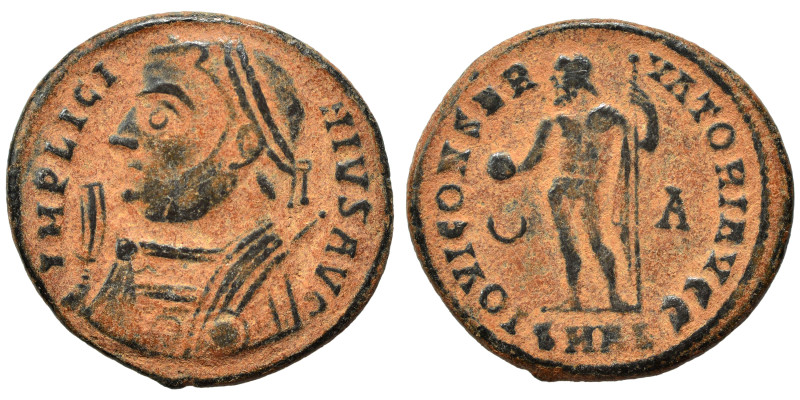 Licinius
IOVI CONSERVATORI AVGG, Jupiter standing holding globe and scepter (no Victory, eagle, or captive)
This example: 18 mm. 3.22 grams.
IMP LICINIVS AVG
RIC VII Alexandria 23, page 707. "317-320"
F202. IOVI CONSERVATORI AVGG NN, Jupiter holds Victory with eagle at feet.
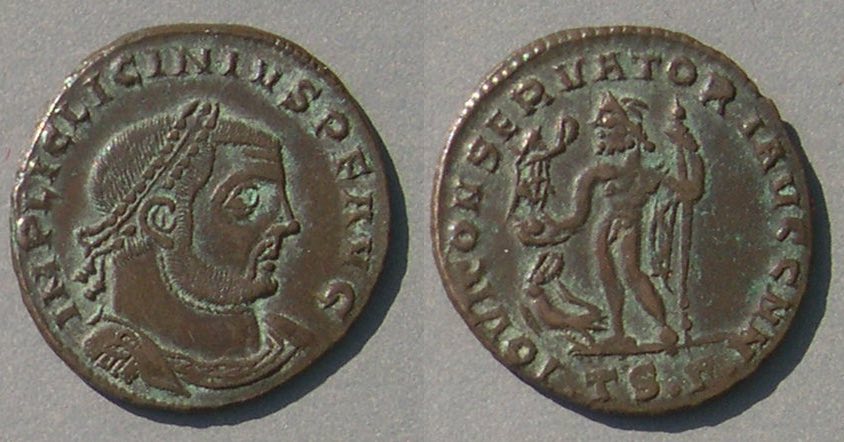 Licinius
IOVI CONSERVATORI AVGG NN, Jupiter holds Victory with eagle at feet.
This example: 22 mm. 3.71 grams.
IMP LIC LICINIVS PF AVG
RIC VI Thessalonica 59, page 519. "c. 312-313"
Sear IV 15249
Skip to Licinius: DN, GENIO, IOVI, LICINI, ROMAE, VICTORIA, VOT. Licinius II: CAESARVM, IOVI, PROVIDENTIAE, VICTORIA, VOT.
F314. LICINI AVGVSTI around VO/ TIS/ XX (Arles only) or VOT/ IS/ XX (Siscia only) with no wreath.
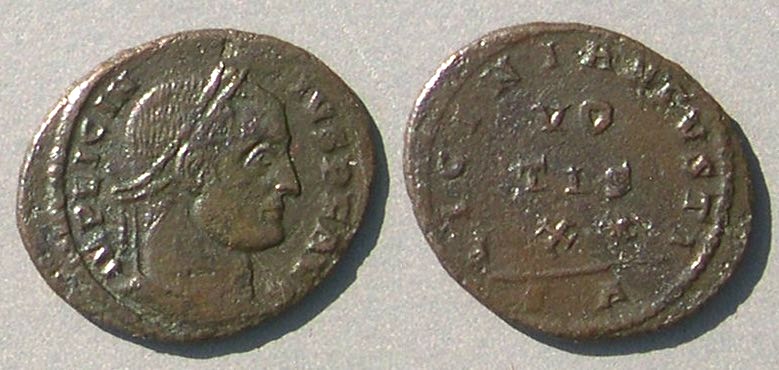 Licinius
LICINI AVGVSTI around.
VO/ TIS/ XX (no wreath).
This example: 21-17 mm. 2.82 grams.
IMP LICINIVS PF AVG
RIC Arles 219 "S" "320-3121", page 258 (only this one mint and officina for the "VO" first line)
Sear 15253
F204. MARTI CONSERVATORI, Mars standing right with reversed spear and shield
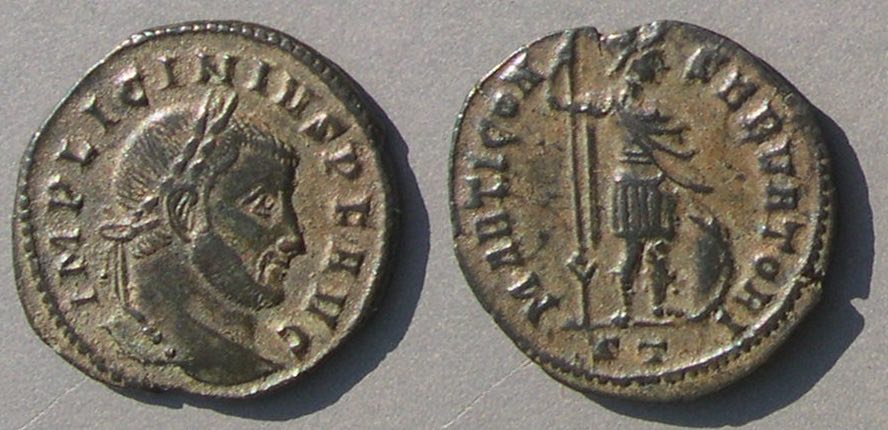 Licinius
MARTI CONSERVATORI, Mars standing right with reversed spear and shield
This example: 23-21.4 mm. 4.29 grams.
IMP LICINIVS PF AVG
RIC Ticinum 123b, page 298. "312-313"
Sear 15258
F282. PROVIDENTIAE AVGG, city gate. [AVGG is for Constantine and Licinius. CAESS is for Crispus, Licinius II, and Constantine II.]
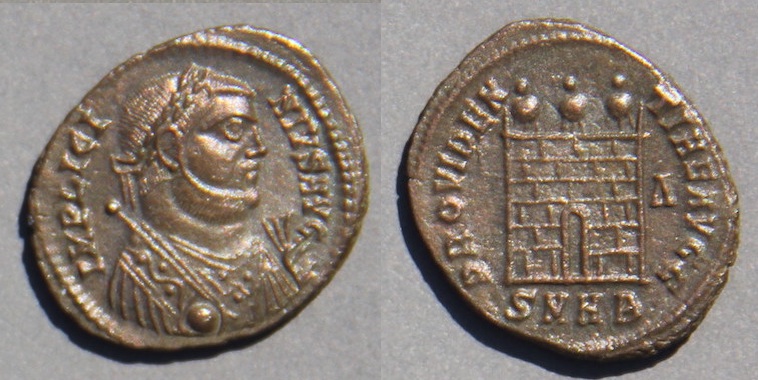 Licinius
PROVIDENTIAE AVGG, city gate
This example: 20-18 mm. 2.84 grams.
IMP LICINIVS AVG
RIC Heraclea 48, page 547. "318-320"
Sear 15268
F315. ROMAE AETERNAE, XV on shield held by Roma seated right. Issued for Constantine, Licinius, Crispus, Licinius II, and Constantine II.
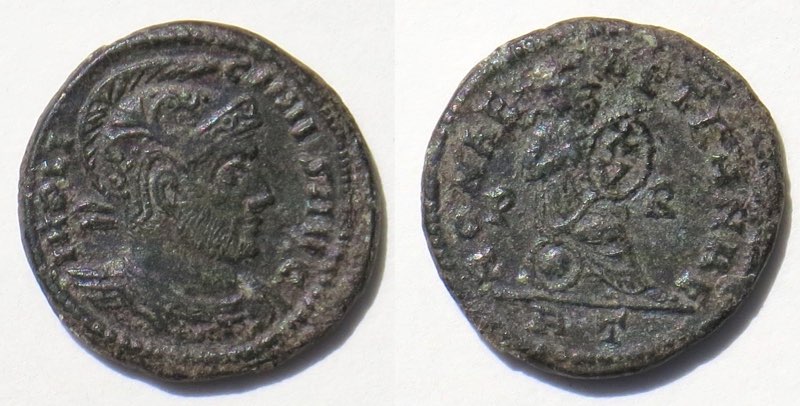 Licinius
ROMAE AETERNAE, XV on shield held by Roma seated right.
This example: 19 mm. 3.42 grams.
IMP LICINIVS AVG
RIC Rome 151 (but unlisted with officina T), "318-319" page 315.
Sear IV 15354, no photo.
F208v. SOLI [or SOLE] INVICTO, Sol standing left in long robe, raising right hand and holding head of Serapis in left (Antioch only)
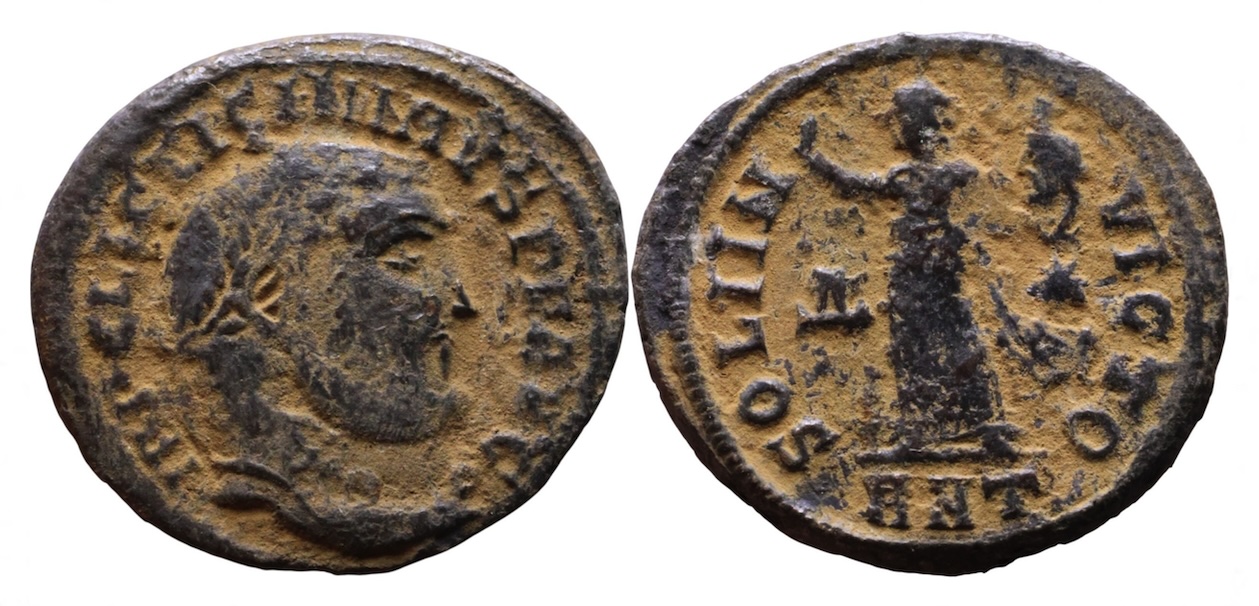
Licinius
SOLI INVICTO
Sol standing left in long robe, raising right hand and holding head of Serapis in left
This example: 22-20 mm. 4.19 grams.
IMP C LIC LICINNIVS (two Ns)
RIC Antioch 167a, page 644. "312"
Sear 15272
F208. SOLI INVICTO COMITI, Sol standing raising right hand [Issued by Constantine, this is one of the most common ancient-coin reverse types, with most examples of the type in the name of Constantine. The lack of coins in the name of Licinius II shows this type was from before 317.]
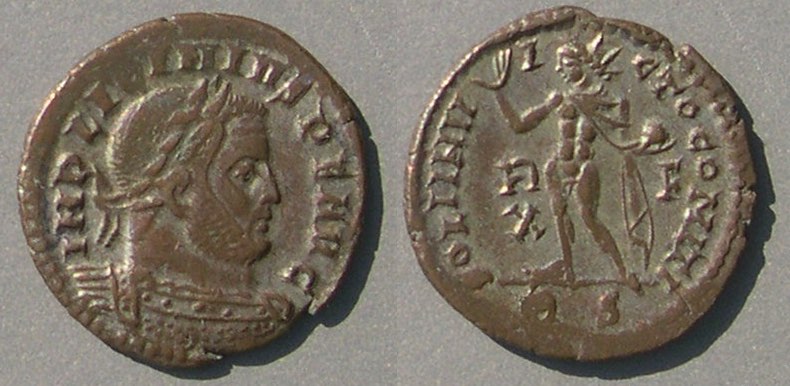 Licinius
SOLI INVICTO COMITI, Sol standing raising right hand
This example: 20 mm. 2.97 grams.
IMP LICINIVS PF AVG
RIC Rome 30, page 299. "314-315"
Sear 15320
This example is remarkable for still having some silvering.
F208 (a second example). SOLI INVICTO COMITI, Sol standing raising right hand
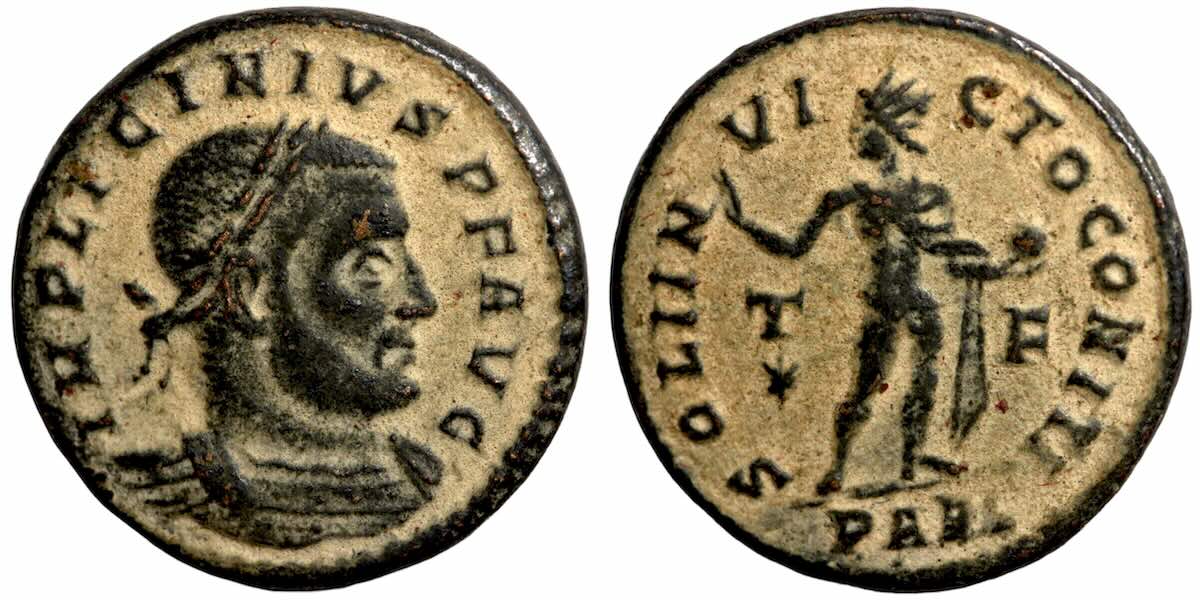 Licinius
SOLI INVICTO COMITI, Sol standing raising right hand
This example: 20 mm. 3.44 grams.
Repatinated
IMP LICINIVS PF AVG
A second example, very similar to the above example. Only the direction of the feet and legs is different--hardly worth noting.
RIC Arles 88, page 241. "early 316"
Sear 15286
F208 variety. SOLI INVICTO COMITI, Sol standing raising right hand. Cross in left field.
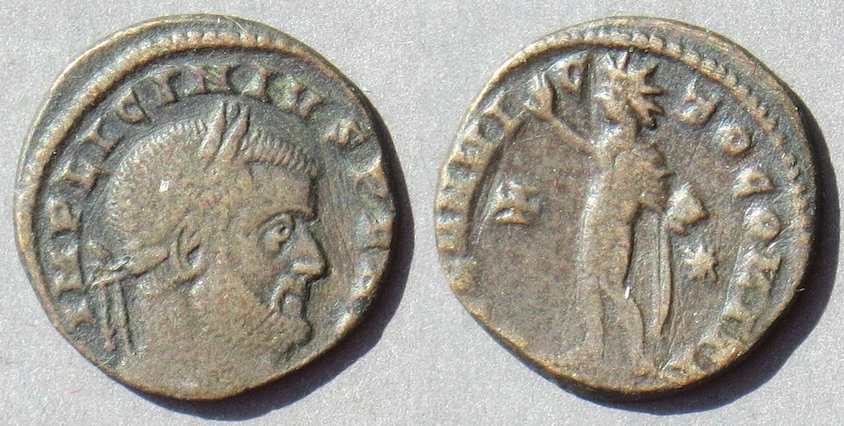 Licinius
SOLI INVICTO COMITI, Sol standing raising right hand. Cross in left field.
This example: 18-17 mm. 2.92 grams.
IMP LICINIVS PF AVG
RIC VII Ticinum 46, page 366. "316"
This variety with a cross really belongs to Constantine, for whom it is scarce. For Licinius, it is very rare.
F241. SPQR OPTIMO PRINCIPI, legionary eagle between two standards.
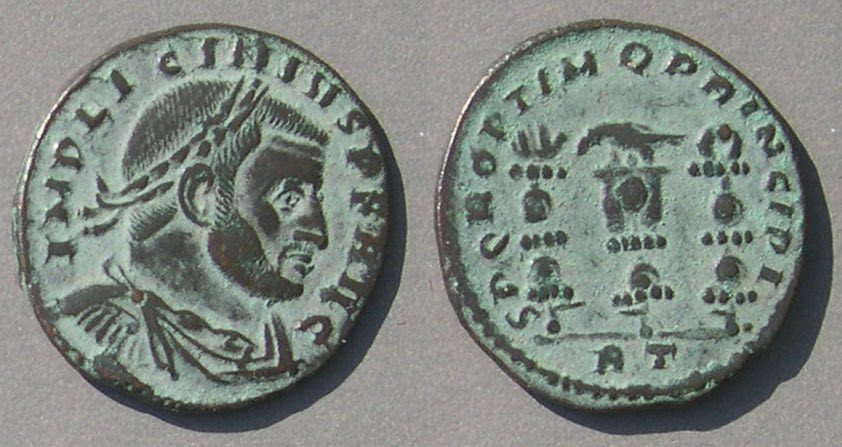 Licinius
SPQR OPTIMO PRINCIPI, legionary eagle between two standards.
This example. 22 mm. 4.41 grams.
IMP LICINIVS PF AVG
RIC VI Rome 350c, page 390. "312 (end) - 313"
Sear IV 15307
This type was issued by Constantine.
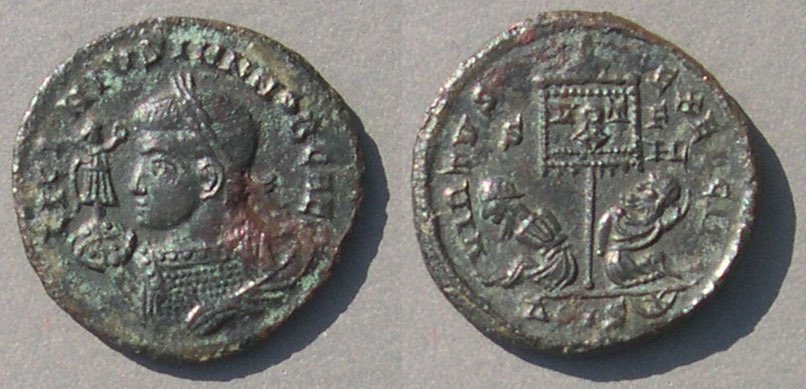
F320. VIRTVS EXERCIT around standard with VOT XX between two captives,
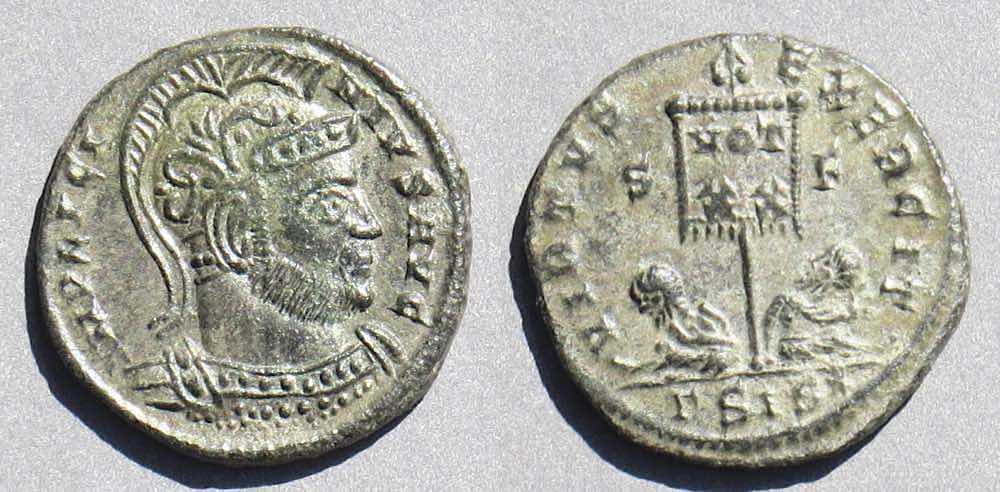 Licinius
VIRTVS EXERCIT around
VOT
XX
on standard between two captives
This example: 18 mm. 2.85 grams.
IMP LICINIVS AVG
RIC Siscia 110, page 438. "320"
F320v. As above, but with symbol to the left of the banner, perhaps Iota-Chi.
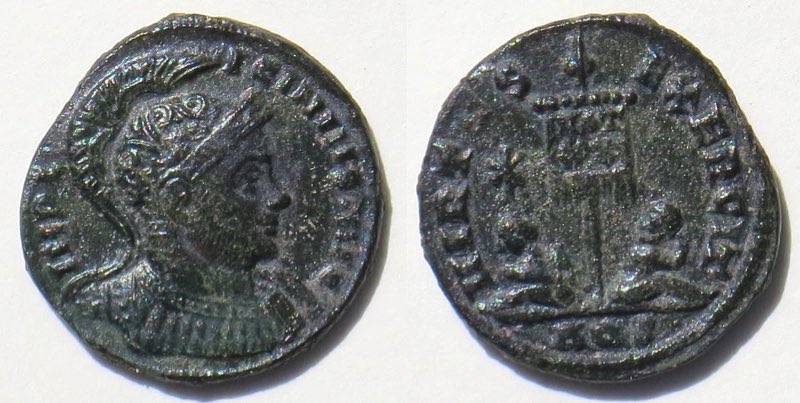 Licinius
VIRTVS EXERCIT around
VOT
XX
on standard between two captives,
[Some scholars thought the symbol was a Christian chi-rho, but it never has the loop of the rho, so it might be a star or, if Christian, an Iota-Chi (for Ihsus CHristus).]
This example: 18 mm. 2.62 grams.
IMP LICINIVS AVG
RIC Aquileia 59 "r4" (only this officina, S) "320" page 401.
Sear IV 15374
F212. VIRTVTI EXERCITVS, Virtus right with spear and trophy over shoulder
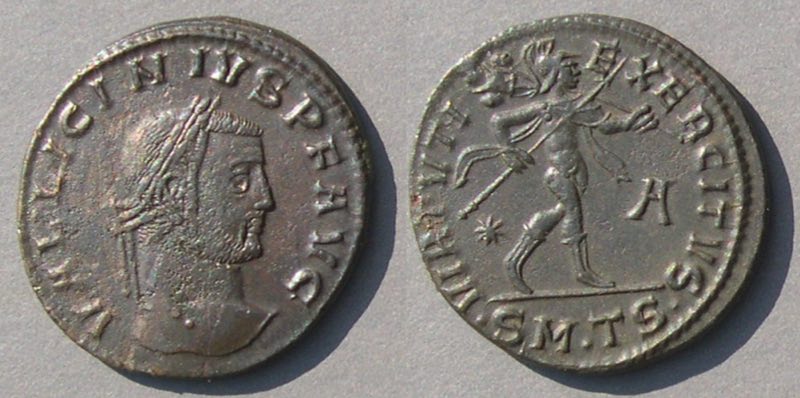 Licinius
VIRTVTI EXERCITVS, Virtus right with spear and trophy over shoulder
This example. 26-25 mm. 6.51 grams.
VAL LICINIVS PF AVG
RIC VI Thessalonica 37b, page 515. "Dec. 308-May 310"
This is the first issue and largest size for Licinius.
F324. VOT /XV FEL /XX RQ in wreath. (Rome only). This issue has two arrangements of the lettering (see the next two coins). Issued for Constantine, Licinius, Crispus, Licinius II, and Constantine II. It is very rare for Constantine and Licinius and extremely rare for the others.
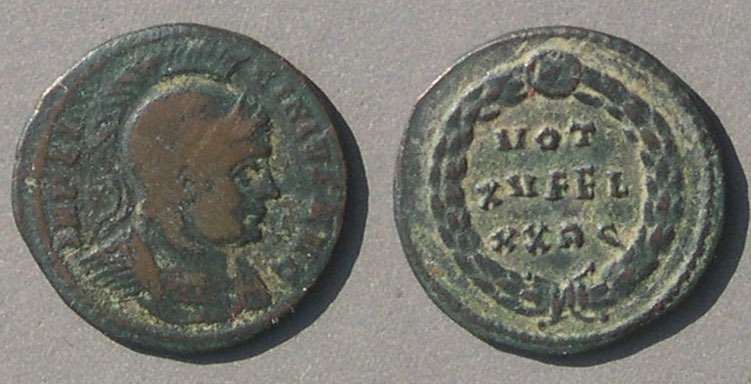 Licinius
VOT
XV FEL
XX RQ in wreath (Rome only)
This example: 18-17 mm. 2.48 grams.
IMP LICINIVS AVG
RIC Rome 221 "r5" (2 officina, each r5), page 319. "320"
Sear 15381 variety.
Struck in Rome under Constantine, this issue has two arrangements of the lettering. See the next coin.
F324, minor variety. VOT /XV / FEL /XX RQ in wreath. (Rome only).
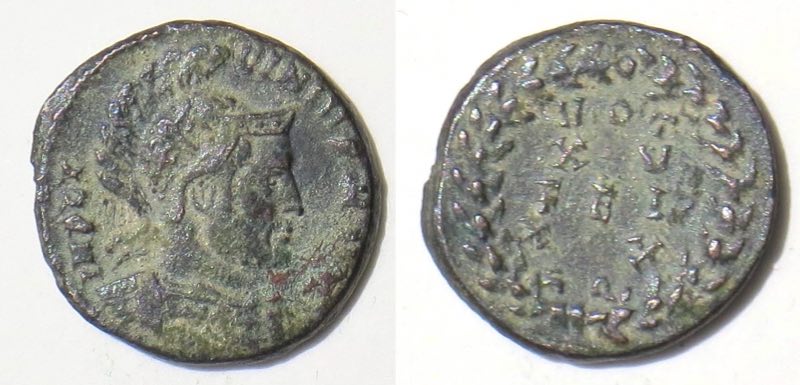 Licinius
VOT
X V
FEL
X X
RQ in wreath
This Example: 18-17mm. 3.02 grams.
IMP LICINIVS AVG
RIC VII Rome unlisted officina, but would be Rome 215 with officina Q. (Only officina P is listed and it is "r5"), page 318. "320"
Sear IV 15381.
Struck in Rome under Constantine, this issue has two arrangements of the lettering. See the previous coin.
F326. VOT XX/MVLT/XXX/TSA in wreath. (Thessalonica only) [VOT XX for Constantine and Licinius]
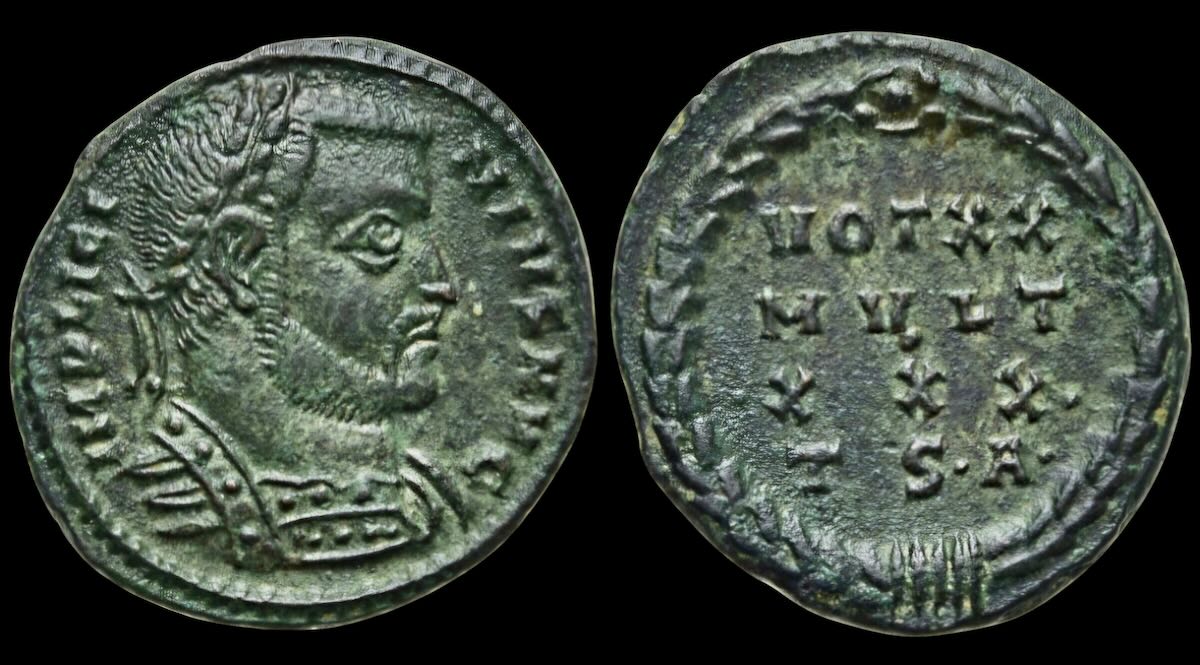 Licinius
VOT XX
MVLT
XXX
TSA
in wreath.
This example: 19.5 mm. 2.80 grams.
IMP LICINIVS AVG
RIC VII Thessalonica 33 "r3", only one officina, only this one mint. page 504. "318-319"
Fractions. Constantine struck a few scarce and rare types of smaller denominations ("fractions") at Trier and Rome. As co-ruler, coins for Licinius were included, but in very small numbers. All are rare or very rare.
F265. (fraction) FVNDAT PACIS, Mars advancing right with trophy over shoulder and dragging captive
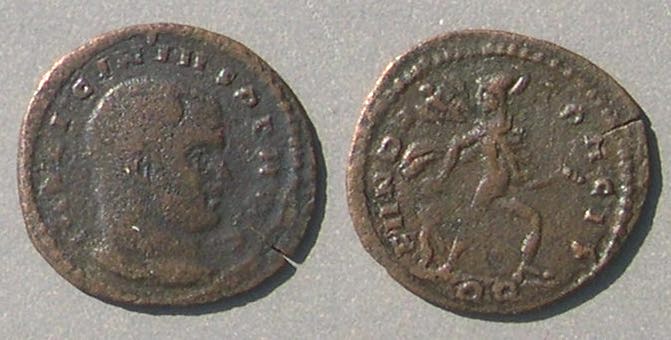 Licinius
FVNDAT PACIS, Mars advancing right with trophy over shoulder and dragging captive
(Trier and Rome only)
A half-follis.
This example: 17 -16 mm. 1.22 grams.
IMP LICINIVS PF AVG
RIC VII Rome 13, page 297. Only two officina, both r4. Struck "313."
F266. (fraction) GLORIA PERPET two Victories advancing right (Trier and Rome only). Very rare, no photo.
F268. (fraction) SAPIENT PRINCIP, altar with owl (Trier and Rome only). Very rare, no photo.
F221. (fraction) VOT X MVL XX, in wreath (Trier only). Very rare, no photo.
Skip to Licinius: DN, GENIO, IOVI, LICINI, ROMAE, VICTORIA, VOT. Licinius II: CAESARVM, IOVI, PROVIDENTIAE, VICTORIA, VOT.
Licinius and Licinius II, 317-324. Table 2.
F277. Busts of Licinius and Licinius II, vis-a-vis. Obverse legend: DD NN IOVII LICINII INVICT
IOM ET VIRTVTI DD NN AVG ET CAES, Jupiter standing left, trophy to left, two captives below. (Antioch only). RIC Heraclea 50 with attribution corrected to Antioch by Bastien, NC 1973. Struck late 317-early 318.
Licinius
Busts of Licinius and Licinius II, vis-a-vis.
DD NN IOVII LICINII INVICT
IOM ET VIRTVTI DD NN AVG ET CAES, Jupiter standing left, trophy to left, two captives below. (Antioch only).
This example: 22 mm. 4.14 grams.
RIC Heraclea (in error) 50, corrected by Bastien NC 1973 to Antioch, late 317-early 318.
F275, 275B, 275C, and 276. "Double effigy" types. In 317 when the three Caesar were created, three mints of Licinius issued very rare types, slightly larger than all the other types (22 mm instead of 18-20 mm), with busts vis-a-vis on the obverse. There are three recorded bust combinations:
Licinius and Licinius II (above)
Constantine and Licinius
Licinius II and Constantine II
and, given the rarity of each, it may be that other combinations will eventually be found, especially since Crispus was senior to Constantine II. Bastien (NC, 1973) discusses the "double-effigy" types. Only the one type above is illustrated here.
Licinius II images, 317-324. Table 3.
F299. BEATA TRANQVILLITAS around altar with VOT[IS] XX and globe on top [no image]. 321AD. This is very common type for Constantine, Crispus, and Constantine II issued only from mints of Constantine (London, Lyons, and Trier). A few extremely rare examples for Licinius and Licinius II have been recorded from Trier.
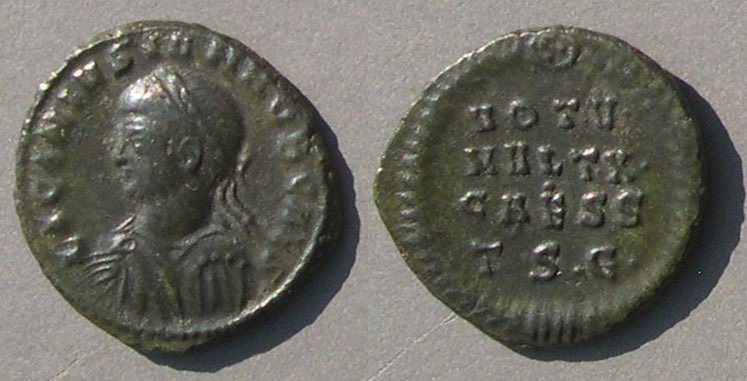
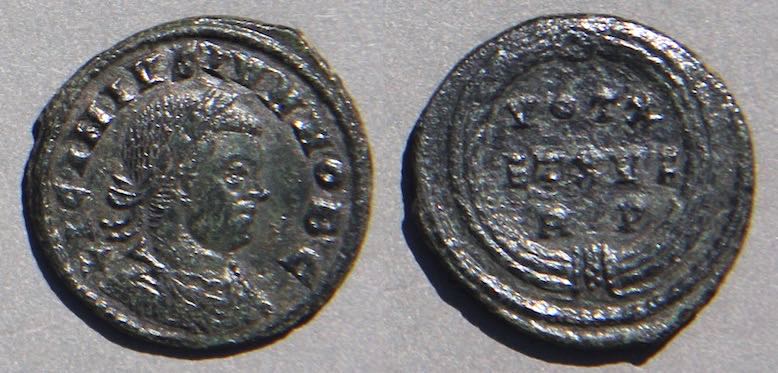
F300. CAESARVM NOSTRORVM around VOT/V in wreath.
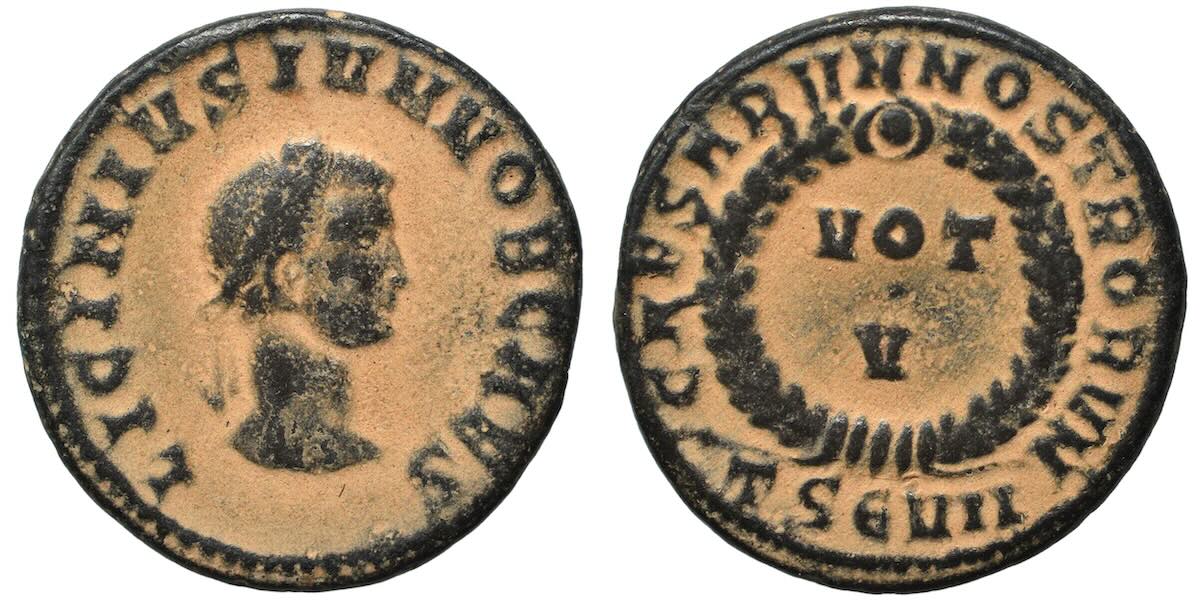 Licinius II
CAESARVM NOSTRORVM around
VOT/V in wreath.
This example:18.7-18.4 mm. 3.12 grams.
LICINIVS IVN NOB CAES
RIC Thessaloncia 99, page 510. "r3" "320" (only one officina)
F302. CAESARVM NOSTRORVM around VOT/IS/V (no wreath). [VOTIS V for Crispus, Licinius II and Constantine II]
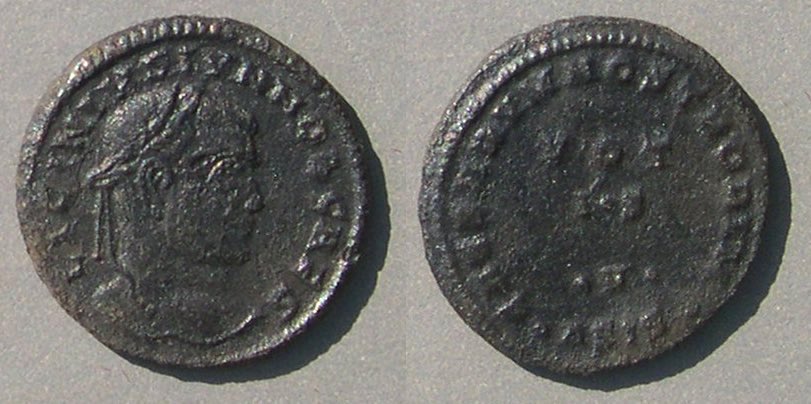 Licinius II
CAESARVM NOSTRORVM around
VOT/IS/V (no wreath)
This example: 20 mm. 3.50 grams.
LICINIVS IVN NOB CAES
RIC Siscia 143 "r3" "320", page 442.
F302v. CAESARVM NOSTRORVM around VO / TIS / V (no wreath)
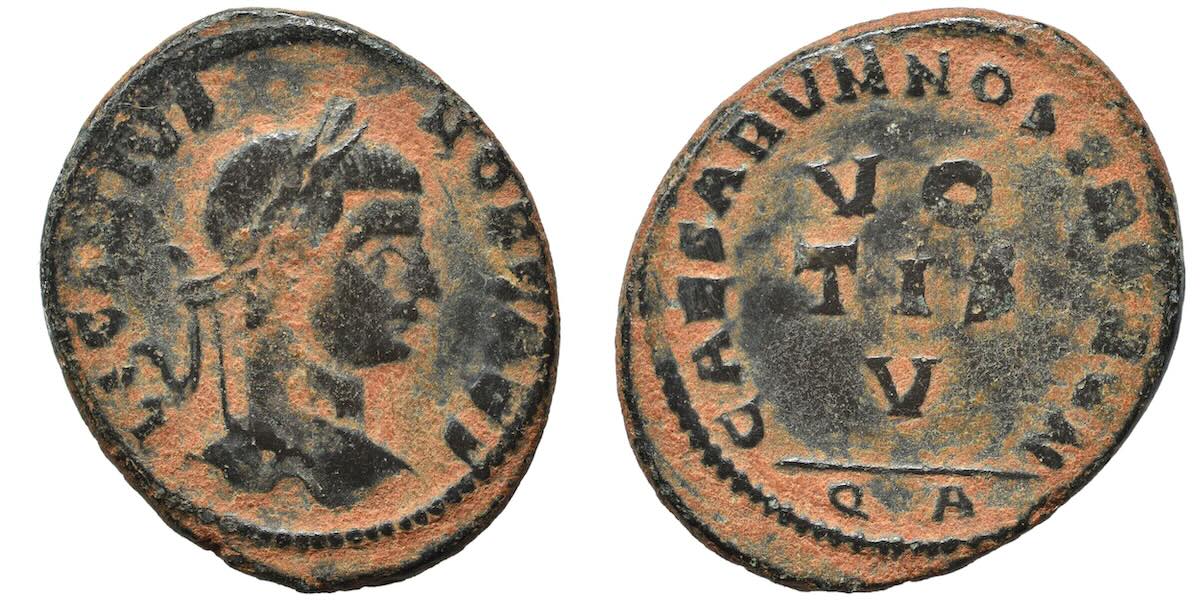 Licinius II
CAESARVM NOSTRORVM around
VO / TIS / V (no wreath)
This example: 21-18 mm. 3.32 grams.
LICINIVS NOB CAES
RIC VII Arles 221 "r3" "320-321"
F273. CONCORDIA AVGG NN, Concordia standing standing with long cadeuceus and holding cornucopia (Aquilia only. RIC Aq 12, 13 "s" and "r4", "317")
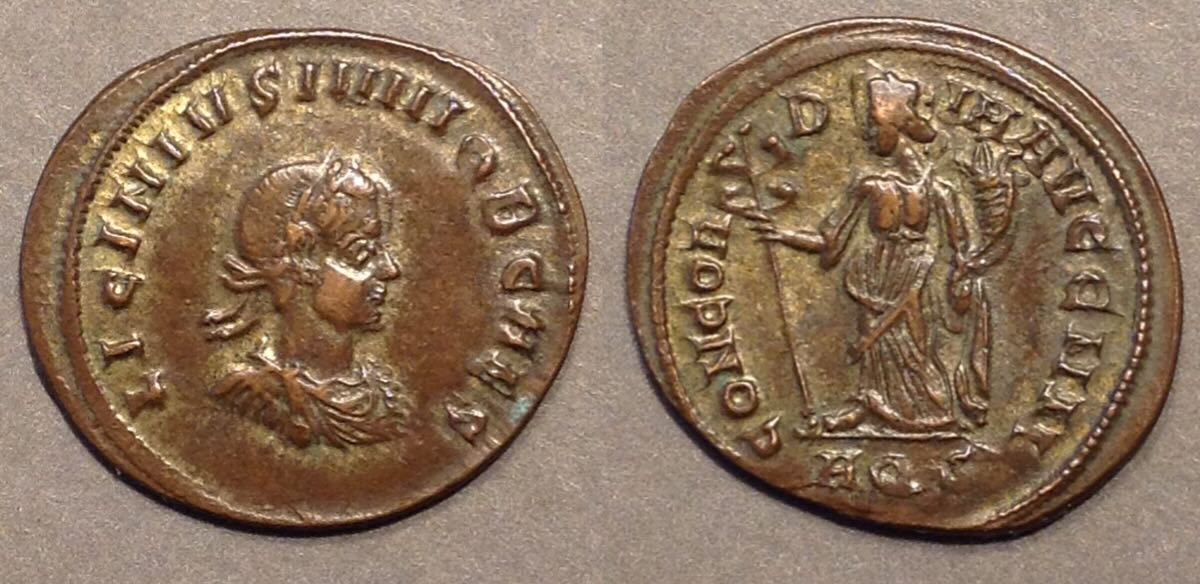 Licinius II
CONCORDIA AVGG NN
Concordia standing standing with long cadeuceus and holding cornucopia
This example: 23-20 mm. 2.98 grams.
LICINIVS IVN NOB CAES
RIC Aquileia 12, page 394, photo plate 11. "317"
The type is shared with Licinius, for whom it is RIC Aq 11, "r5" with only one officina, and not shared with anyone else. A rare reverse type.
The reverse legend is also on some solidi.
279 IOVI CONSERVATORI, Jupiter holds Victory with eagle, XIIΓ in right field (for the denomination). The augusti are radiate [Licinius above], the Caesars helmeted.
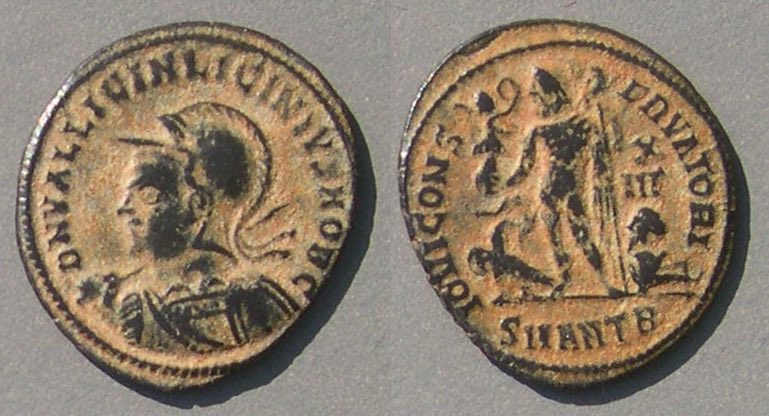 Licinius II
IOVI CONSERVATORI, Jupiter holds Victory with eagle, XIIΓ in right field (for the denomination).
Obverse bust of Licinius II is helmeted.
This example: 21-19 mm. 2.92 grams.
DN VAL LICIN LICINIVS NOB C
RIC Antioch 36B "321-323" page 682.
F278A. IOVI CONSERVATORI, Jupiter standing left holding thunderbolt and long staff
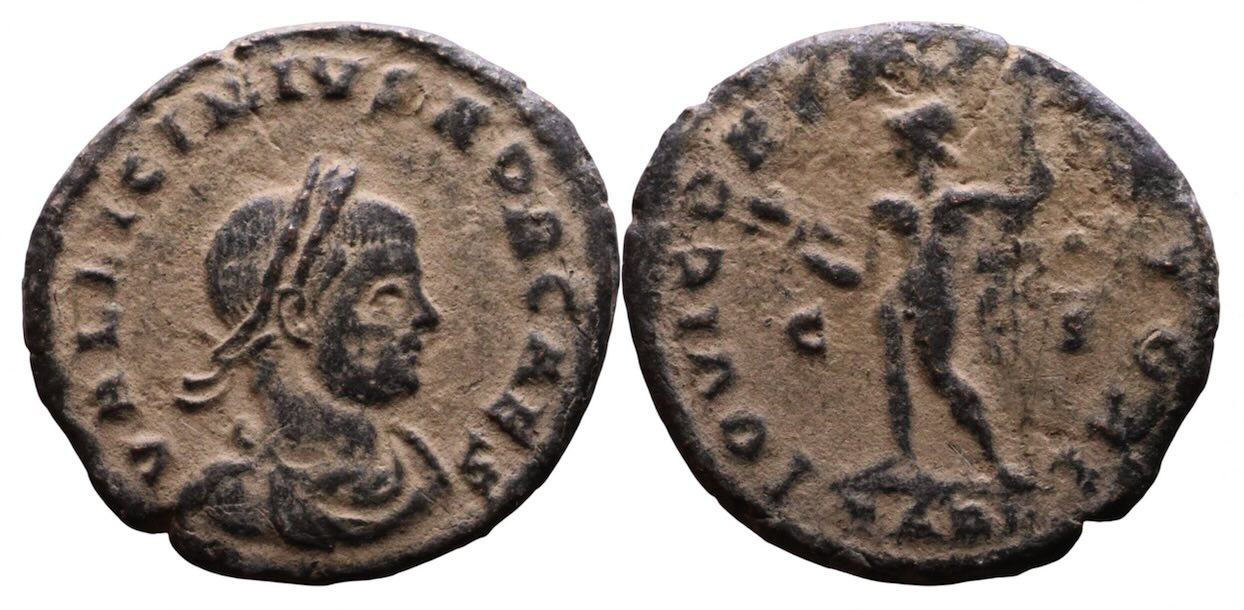 Licinius II
IOVI CONSERVATORI, Jupiter standing left holding thunderbolt and long staff
This example: 20 mm. 2.82 grams.
VAL LICINIVS NOB CAES
RIC Arles 142, page 248. "317-318"
F278A, variety. IOVI CONSERVATORI, Jupiter standing left holding thunderbolt and long staff
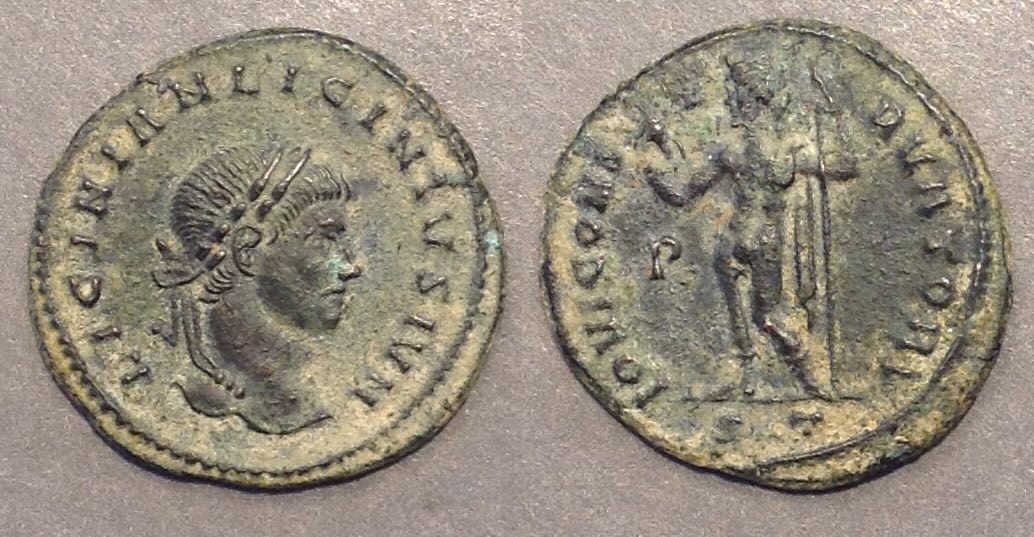 Licinius II
IOVI CONSERVATORI, Jupiter standing left holding thunderbolt and long staff
This example: 20 mm. 3.65 grams.
LICINIAN LICINIVS IVN
RIC Ticinum 91, page 371. "317-8"
This type is without any imperial title. Look at the obverse legend. It has his name, but no title like "CAES" or even "PRINCIPS". This obverse legend is only from Ticinum and extremely rare. I think this is the only Roman imperial type without an imperial title.
F278B. IOVI CONSERVATORI, Jupiter right hurling thunderbolt
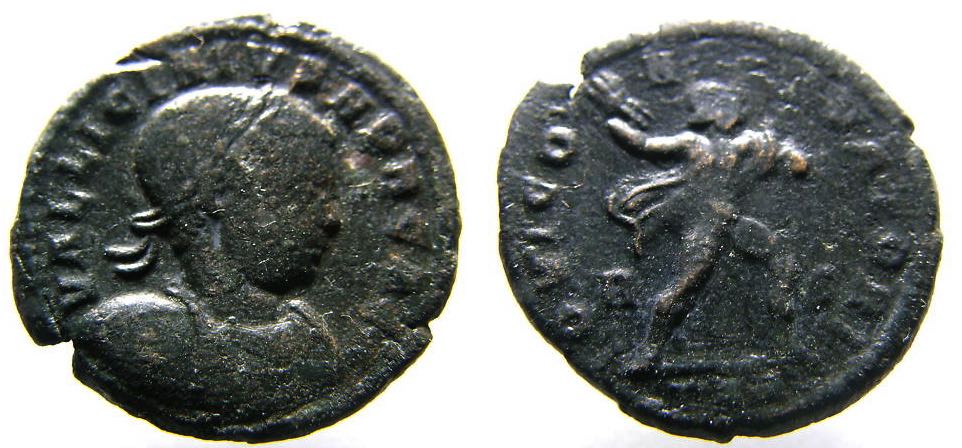 Licinius II
IOVI CONSERVATORI, Jupiter right hurling thunderbolt
This example: 21 mm. 3.60 grams.
VAL LICINIVS NOB CAES
RIC Arles 128, struck 317, page 246
F278. IOVI CONSERVATORI CAESS, Jupiter standing holding Victory and scepter (no eagle or captive). [CAESS for Crispus, Licinius II, and Constantine II. AVGG for Constantine and Licinius.]
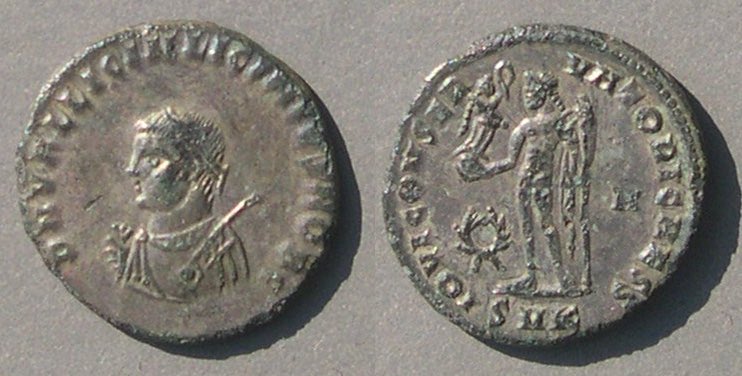 Licinius II
IOVI CONSERVATORI CAESS, Jupiter standing holding Victory and scepter (no eagle or captive)
This example: 18 mm. 2.53 grams.
DN VAL LICIN LICINIVS NOB C
RIC Antioch 39 "317-320" page 680.
F278v. IOVI CONSERVATORI CAESS, Jupiter standing holding Victory and scepter, captive at feet left (no eagle). [CAESS for Crispus, Licinius II, and Constantine II. AVGG for Constantine and Licinius.]
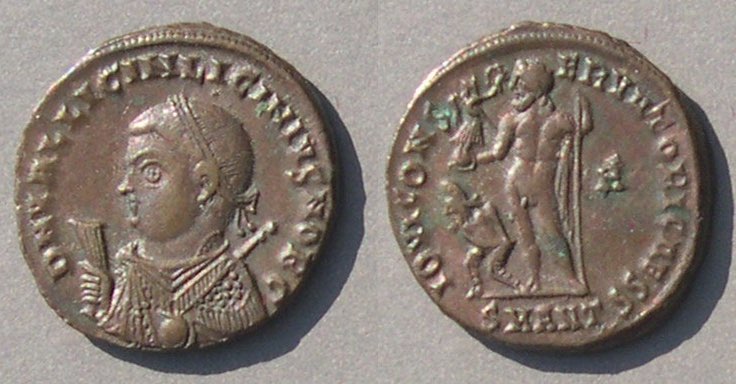 Licinius II
IOVI CONSERVATORI CAESS, Jupiter standing holding Victory and scepter, captive feet left (no eagle)
This example: 18 mm. 3.47 grams.
DN VAL LICIN LICINIVS NOB C
RIC Antioch 39 "317-320" page 680.
F278v. IOVI CONSERVATORI CAESS, Jupiter holding globe and scepter [with AVGG for the Augusti]
[no image]
F283. PROVIDENTIAE CAESS, Jupiter holding Victory
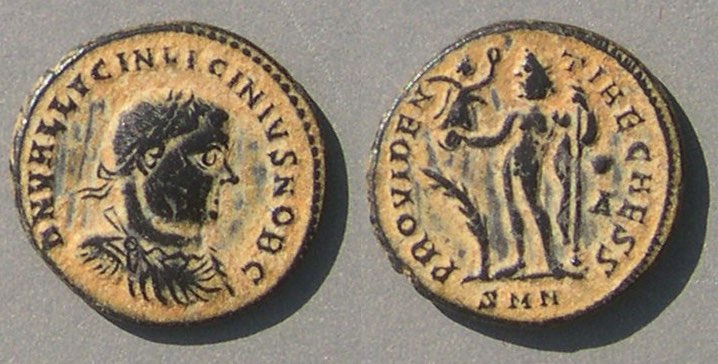 Licinius II
PROVIDENTIAE CAESS, Jupiter holding Victory
This example: 18 mm. .92 grams.
RIC Nicomedia 34. "317-320", page 605.
F282. PROVIDENTIAE CAESS, city gate. [CAESS it for Crispus, Licinius II, and Constantine II. AVGG for Constantine and Licinius.]
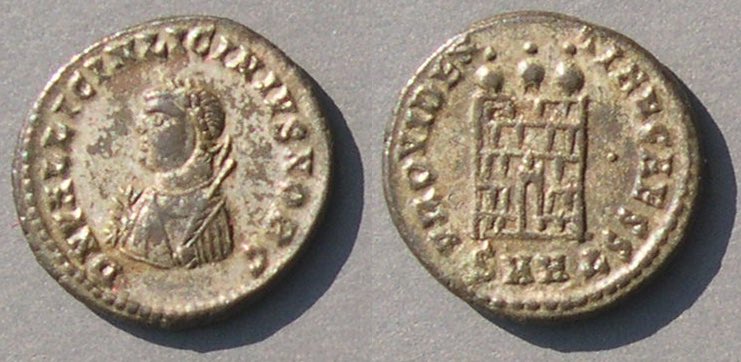 Licinius II
PROVIDENTIAE CAESS, city gate
This example: 18 mm. 3.22 grams.
RIC Heraclea 36 "318-320" page 546
F315, ROMAE AETERNAE, XV on shield held by Roma seated right. Issued for Constantine, Licinius, Crispus, Licinius II, and Constantine II.
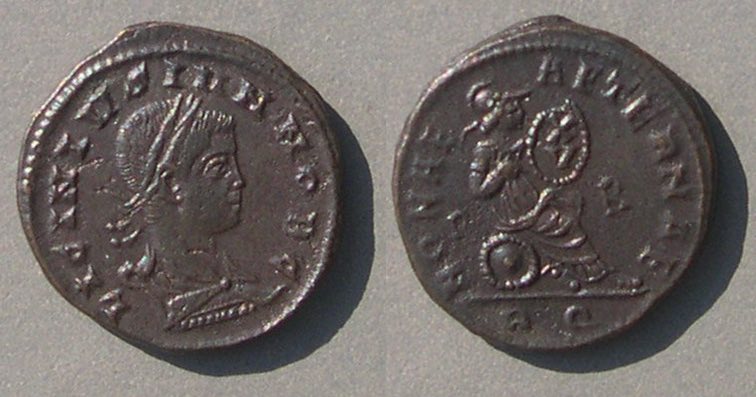 Licinius II
XV on shield held by Roma seated right.
This example: 18 mm. 3.94 grams.
LICINIVS IVN NOB C
RIC Rome 154 "r3" (with two other officina at r3 and r4) "318-319" page 315.
Sear IV 15354, no photo.
F284. SAECVLI FELICITAS, shield with AVG on cippus [no photo]
F287. VICTORIA CAESS NN, Victory left (Thessalonica only). Issued only for Crispus, Licinius II, and Constantine II. (There is an AVGG version for Constantine and Licinius.)
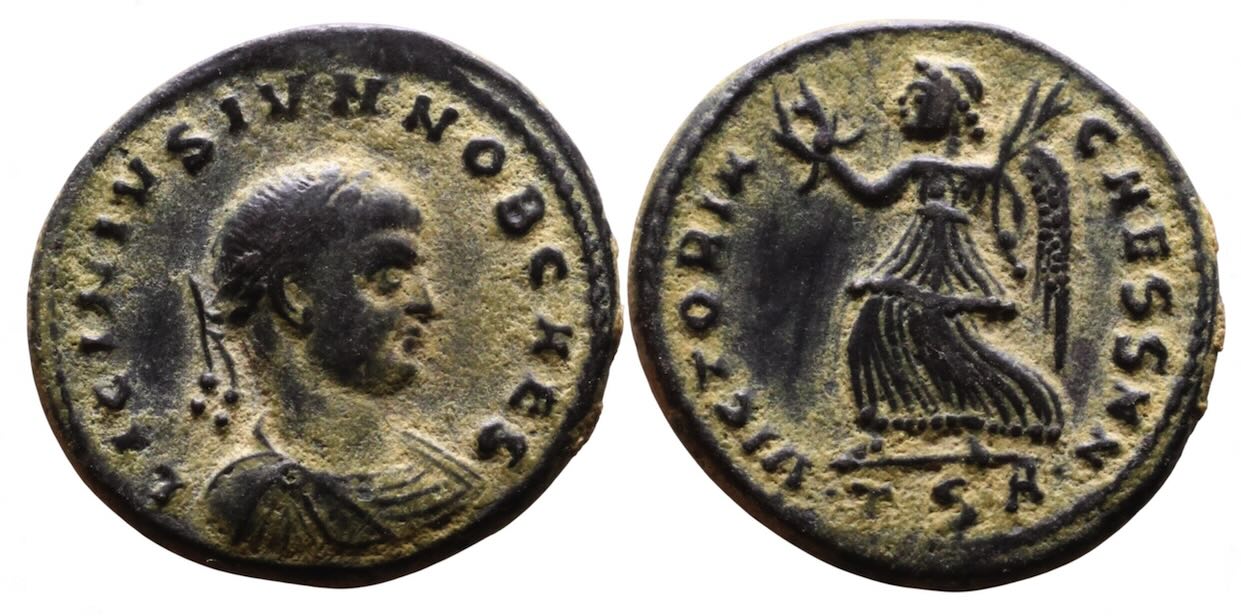 Licinius II
VICTORIA CAESS NN, Victory left
This example: 19 mm. 3.36 grams.
LICINIVS IVN NOB CAES
RIC Thessalonica 63 "r3" (only one mint, one issue, one officina, with a second "r5" with a different obverse legend), page 506
Sear IV 15454
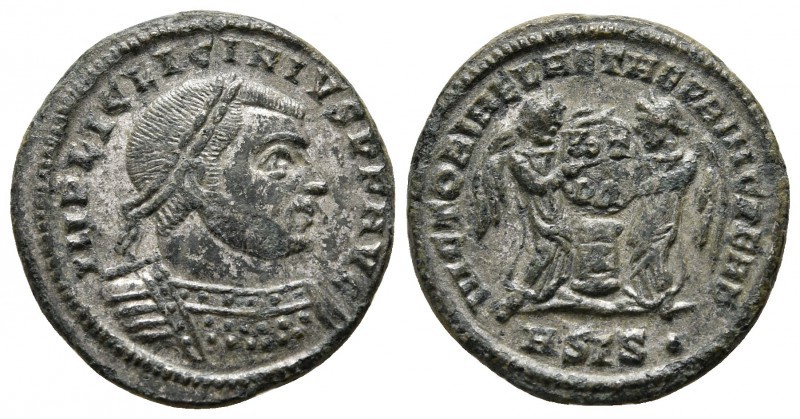
F316. VICTORIAE LAETAE PRINC PERP around VOT PR on shield held by two Victories above cippus.
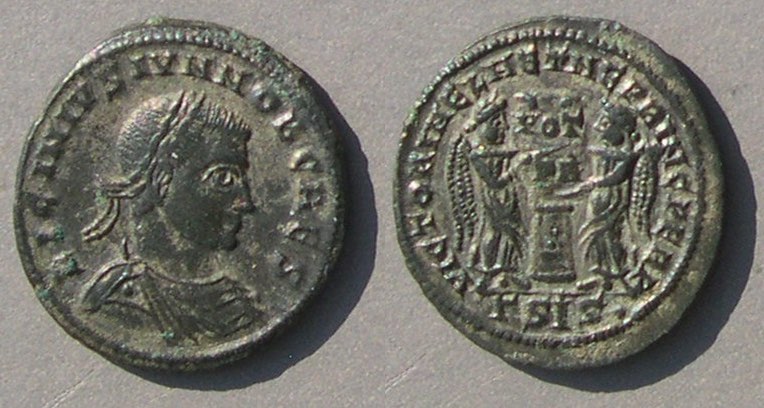 Licinius II
VOT PR on shield held by two Victories above cippus
VICTORIAE LAETAE PRINC PERP
This example: 20-19 mm. 3.41 grams.
LICINIVS IVN NOB CAES
RIC Siscia 70 "319" page 433.
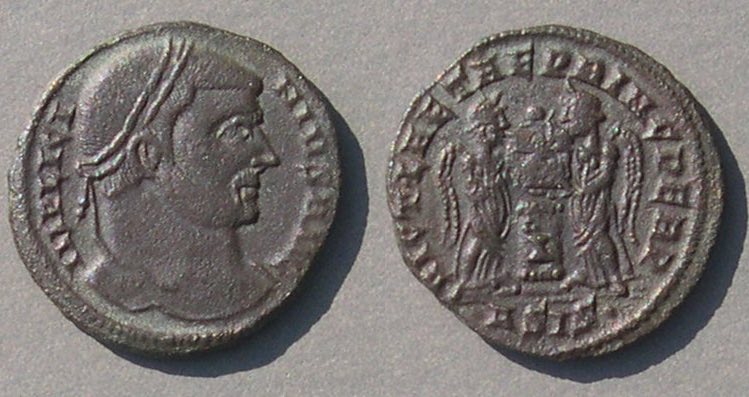
F316 variety with "VICT" instead of "VICTORIAE". VICT LAETAE PRINC PERP around VOT PR on shield held by two Victories above cippus.
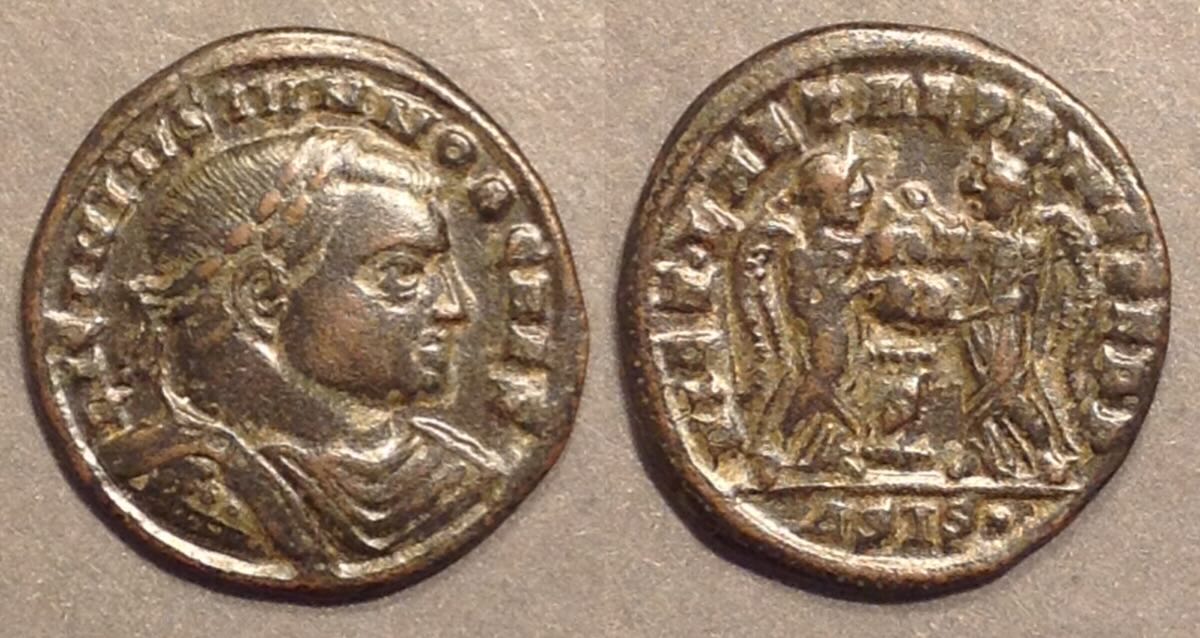 Licinius II
VOT PR on shield held by two Victories above cippus
VICT LAETAE PRINC PERP
This example: 18 mm. 2.52 grams.
LICINIVS IVN NOB CAES
RIC Siscia 105 variety "319-320" page 436. There are many minor varieties, each individually very rare, but in total (if you don't care about dots in the mintmark) only scarce.
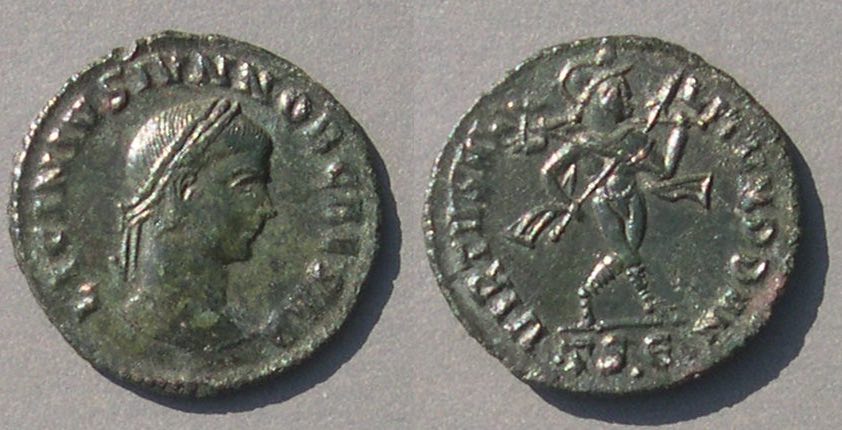
F291. VIRTVS EXERCIT, trophy with captives either side.
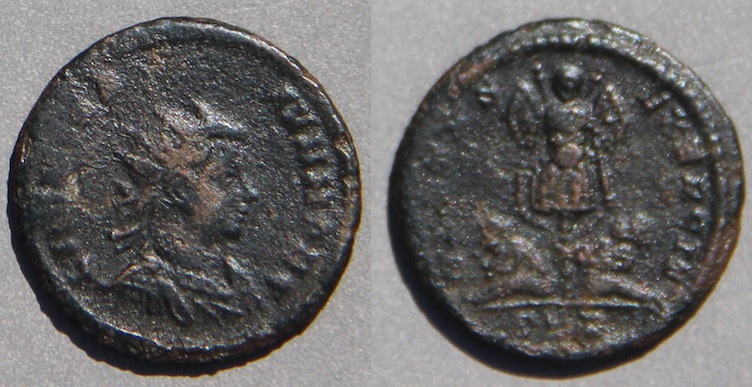 Licinius II
VIRTVS EXERCIT, trophy with captives either side.
This example: 19 mm. 3.23 grams.
LICINIVS IVN NOB C
RIC Trier 264 "320" page 187.
Radiate!
Skip to Licinius: DN, GENIO, IOVI, LICINI, ROMAE, VICTORIA, VOT. Licinius II: CAESARVM, IOVI, PROVIDENTIAE, VICTORIA, VOT.
What's in the tables? The tables list a reverse type set for Licinius I and Licinius II in AE. The primary references are RIC VII (up to 313) and RIC VIII (after 313), but many types are issued from many mints and with several obverses and would not have a unique RIC ID number, so I have chosen to use Failmezger numbers (given as "Fxyz") because his ID numbers are for reverse types which is what I am lisiting. What this page contributes is the list of the reverse types of these emperors in AE, illustrations of many types and of some varieties.
Rarity: C = common,
S = scarce (readily available, but with far fewer examples than the "common" types)
R= rare RR = very rare RRR = extremely rare. Attested but almost never seen.
Types and Varieties. You may, of course, distinguish types from varieties in any way you like. For purposes of this page the type is determined by the reverse legend and central design, not including field marks or mintmarks. Even with the same reverse, collectors rightly regard coins with different obverse busts as different types, but here they considered one type because this page concentrates on reverse types only.
The line between type and variety can be fine. Are two similar coins with the same design and legend different types if they are from different mints? What if their field marks are different denoting that they are from different issues? Yes, for some collectors, but, for purposes of this page, they are regarded as different varieties of the same type. Are two similar coins with Jupiter standing with the same legend different types if on one he is holding the head of Sol and on the other he is holding the head of Serapis? Are they the same type if one has an eagle at Jupiter's feet and the other doesn't? For purposes of this page I regard them as different types because important elements of the designs are different. I am not claiming that this definition of the word type is somehow right and better than alternatives. I am just explaining how this particular page uses the term type for reverses.
Imitations. Ancient coins were frequently counterfeited in ancient times. For AE3 of this time period, often the reason was simply to increase the supply of small change. Under the Republic and empire there was a profit motive for counterfeiting denarii, but not for these AE3s. Very many imitation AEs of Constantine are known, including many from the Balkans and along the Danube. In contrast, very few imitations of coins of Licinius have appeared. Here are three:
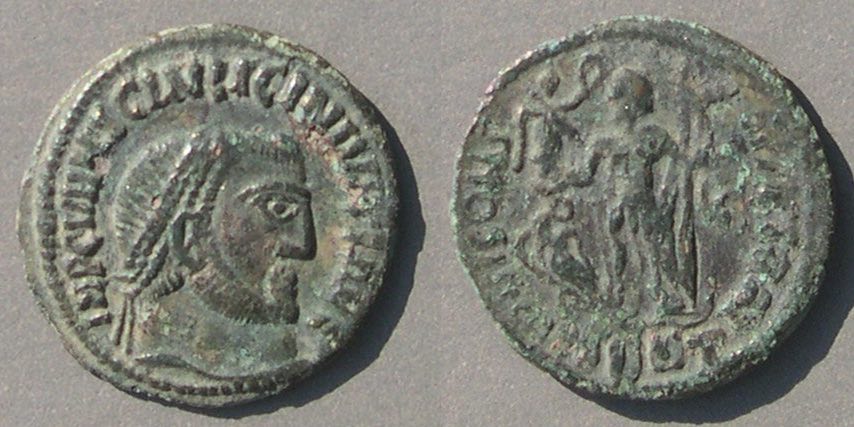
Licinius
IOVI CONSERVATORI design
This piece: 22 mm. 3.68 grams.
IMP C VAL LICIN LICINIVS PF AVG
Obverse lettering bold.
Mintmark uncertain. Prototype possibly RIC VII Heraclea 64.
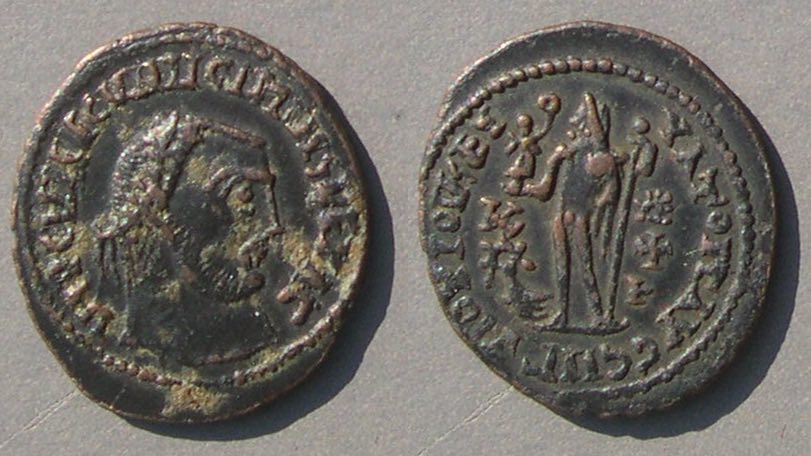 Licinius
IOVI CONSERVATORI AVGG design
Crude lettering. The letters look something like
IMP C VAL ECVA LICINVS PF AVG
for IMP C VAL LICIN LICINIVS PF AVG
Reverse blundered lettering something like:
IOVI IOVSEY YATOIIAVGG
This piece: 23-20 mm. 3.32 grams.
The many fieldmarks make it possible to identify the prototype.
RIC VII Alexandria 18, page 706. "316-317"
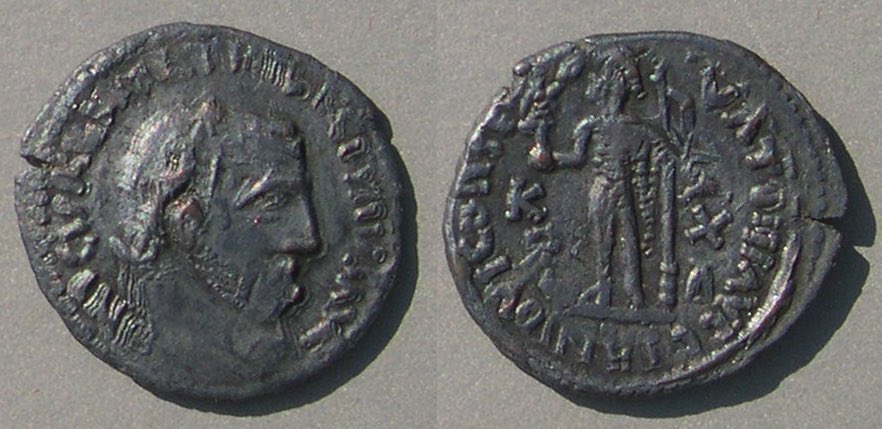 Licinius
IOVI CONSERVATORI AVGG design
This piece: 22-21 mm. 3.43 grams.
Crude lettering, badly blurred. The letters, with imagination and foreknowledge, might make something like
IMP CVKxSxxTxxLIxxNIxxVS AVx (all uncertain)
The fieldmarks are a big part of the identification of this peice as an imitation of Licinius. The lettering alone is not clear.
The many fieldmarks make it possible to identify the prototype.
RIC VII Alexandria 18, page 706. "316-317"
References.
Failmezger, Victor "Tory". Roman Bronze Coins: From Paganism to Christianity, 294-364 AD. 2002.
Roman Imperial Coinage, volumes VI (through the death of Maximinus II in 313) and VII (313-337 AD)
Sear, David. Roman Coins and their values, volume IV (AD 284-337). 2011
Go back up to Licinius: DN, GENIO, IOVI, LICINI, ROMAE, VICTORIA, VOT.
Licinius II: CAESARVM, IOVI, PROVIDENTIAE, VICTORIA, VOT.
Go to a similar page for coins of the Roman emperor Crispus, Constantine II, Constans, or Constantius II.
Return to the top of this page.
Go to the main Table of Contents of this whole educational site.
 Licinius
 Licinius
  Licinius
 Licinius
 Licinius
 Licinius
 Licinius
 Licinius II
 Licinius II
 Licinius II
 Licinius II