Fun with overstrikes (Byzantine coins)
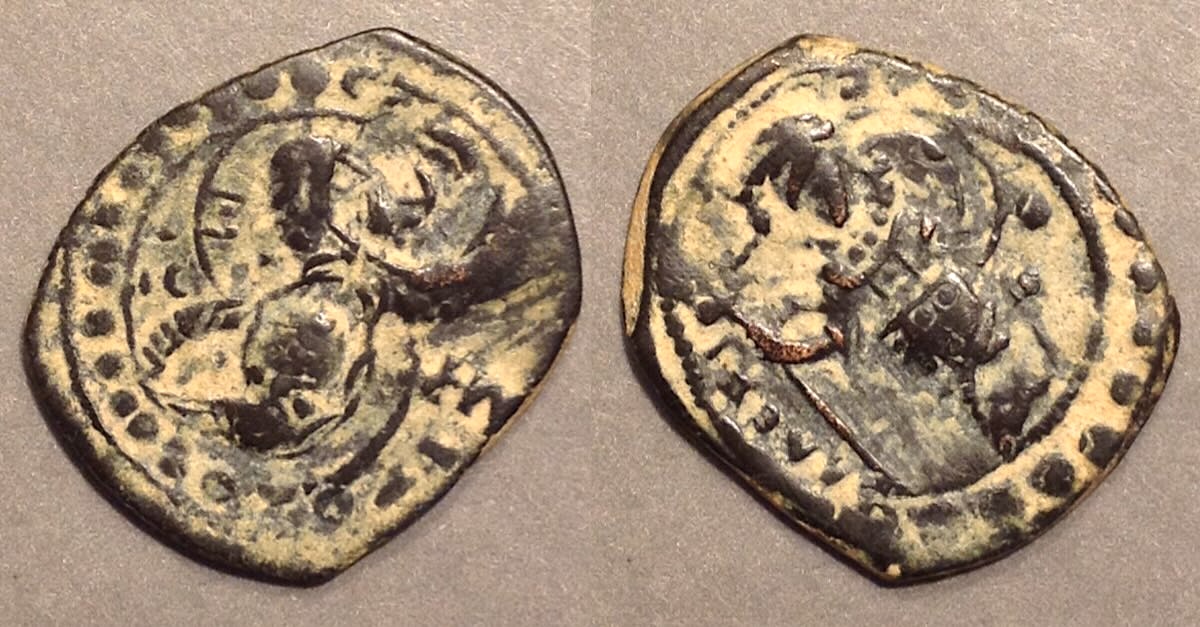
Byzantine copper coins were often struck using older coins as flans. When both types are identifiable, which is pretty often, we can tell which type should be dated earlier. Often an overstruck coin is a garbled mess, but sometimes we get lucky and the overtype is still fairly clear and the undertype is, nevertheless, identifiable. Here are two examples.
Alexius over Alexius. Alexius I , 1081-1181, was the Byzantine emperor during the First Crusade and we have many interesting stories about his reign. Numismatically his reign is special because in 1092 he initiated a coin reform that replaced all the previous denominations. Even before the reform he issued folles with his name after issuing anonymous folles without his name. Next is a "named" follis of Alexius overstruck on an anonymous Class K follis, also attributed to Alexius.
 Alexius I, 1081-1118
26-22 mm. 6.27 grams.
Sear 1909
Bust of Virgin facing, infant Christ on her lap
MP [ΘV] either side
/Emperor standing front, holding labaum
AΛЄΧΙ to left [ΔЄCΠOT TωK is not visible on the right]
The large beads around the rim of the Class K undertype are easily visible on both sides.
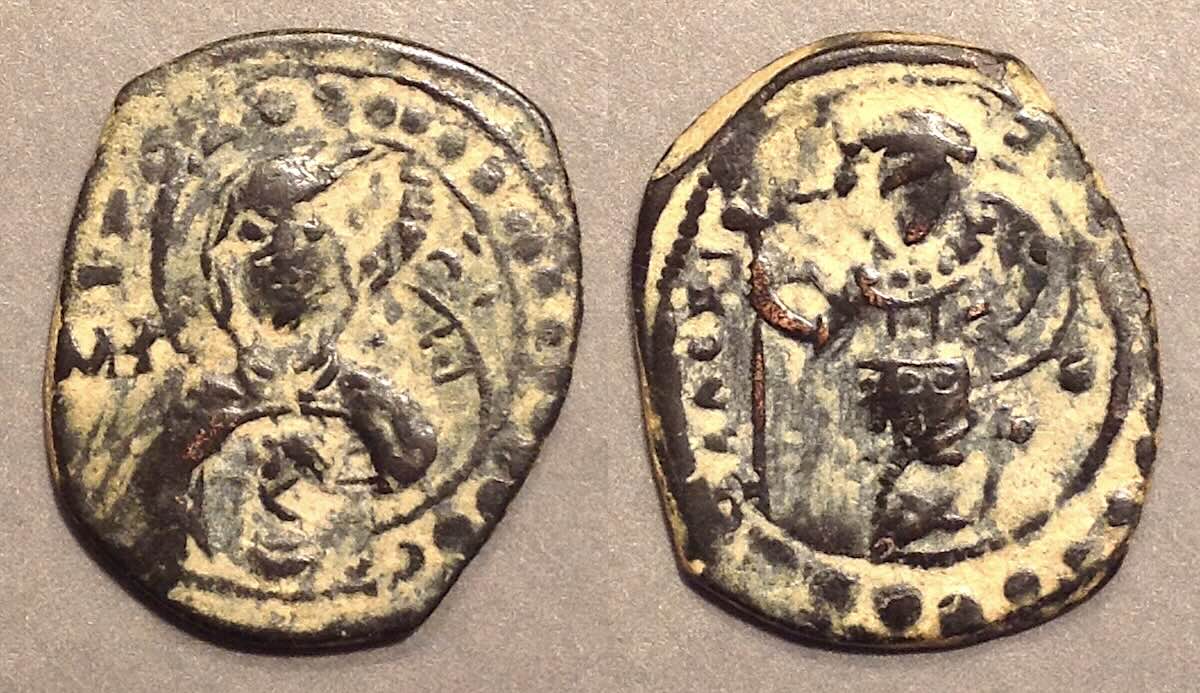
Anonymous follis, Class K
Attributed to Alexius I
25-22 mm. 6.92 grams.
Sear 1901
Notice the distinctive beading which is visible on the undertype above.
Compare this type to the next image of the first coin, rotated to show the undertype right-side up.
On the obverse the head of Christ and "IC" to its left is visible.
On the reverse the head of the Virgin, and maybe parts of her hands "orans" (raised in blessing) are there.
The large beads, unique to Class K, are clear on both sides.
The undertype is easily identified.
The coin is Sear 1909 over Sear 1901.
Romanus IV, 1068-1071, Class G, over Constantine X, 1057-1059. Romanus IV is famous for losing the disasterous Battle of Manzikert in 1071.
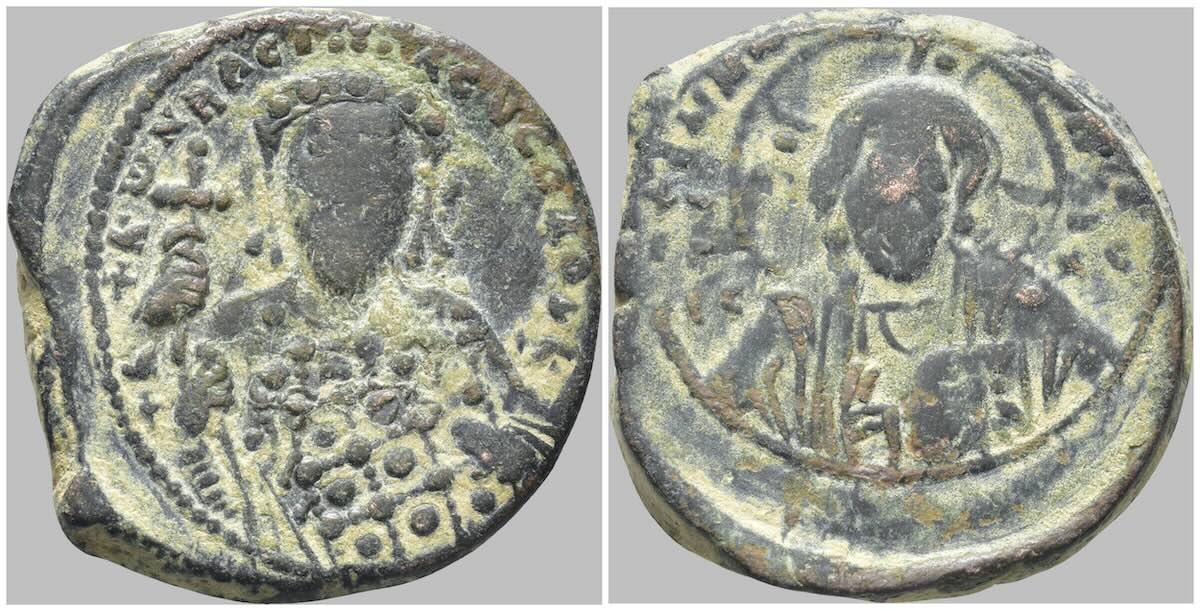 This type is the undertype of the overstrike, next.
Constantine X, Ducas, 1057-1059
27-26 mm. 10.78 grams.
Sear 1854
Bust of emperor facing, holding cross
+KωΝ RACI- ΛЄVC O ΔOVK ["R"in "RACI" is an epigraphic form of "B"]
Constantine Basileus (Emperor) the Ducas
The obverse is double-struck with the top 60% of one strike clear and well-centered
over a strike of the same die tilted and lower down so the hand holding the cross appears twice and the loros is at an angle.
/Facing bust of Christ.
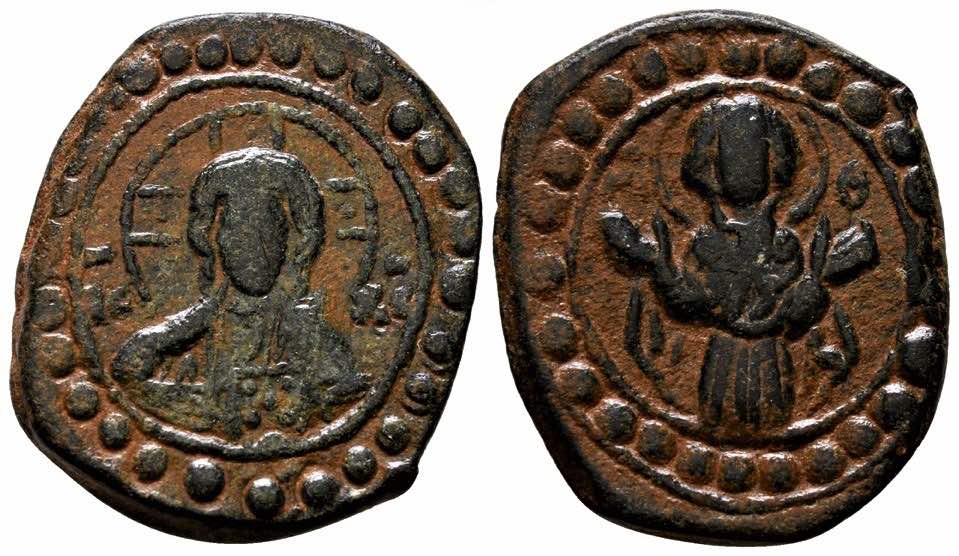
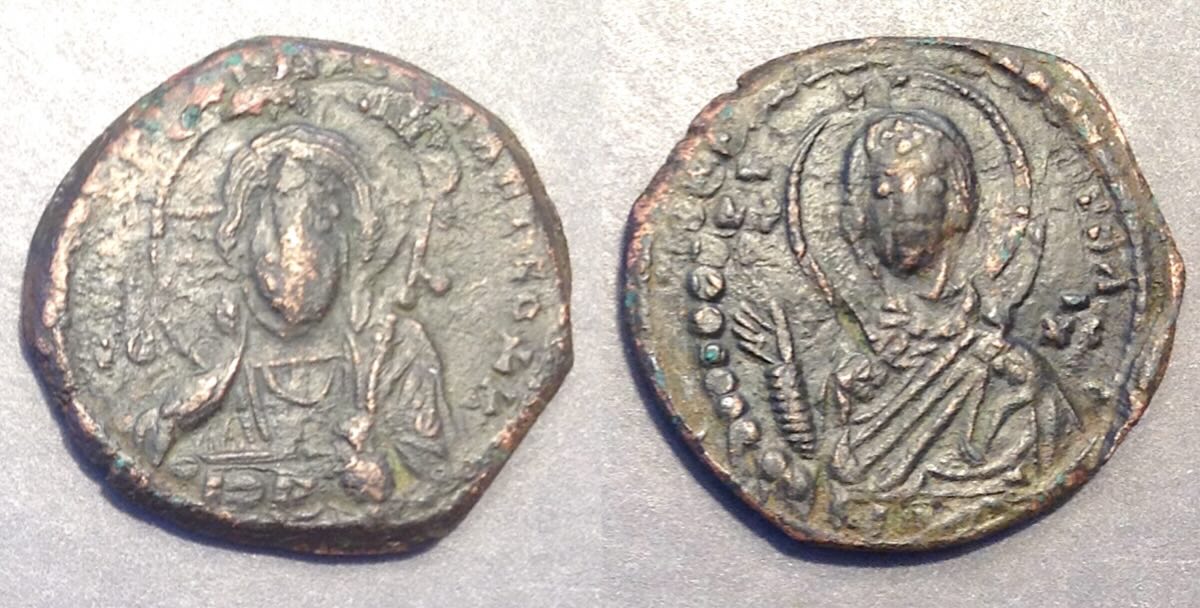 This is a fairly clear Class G anonymous follis, attributed to Romanus IV (1068-1071).
27 mm. 8.09 grams.
Sear 1867
Bust of Christ/Bust of Virgin Mary.
The undertype has almost been obliterated, but not quite.
On the obverse from 12:00 to 4:00 there is lettering which does not belong to the Class G type (illustrated next).
On the reverse the "MP" (Mother of God) at 10:00 belongs to Mary, but the "XC" (Christ) at 4:00 belongs to a Bust-of-Christ type.
The obverse undertype lettering matches up with the obverse lettering of the Constantine X coin above with the tip of the crown barely visible at 1:00.
The Virgin normally has two hands "orans" symmetrically, but this coin show only her right hand and the clear "XC" shows that her left hand is not struck up.
The next coin shows a better Class G strike.
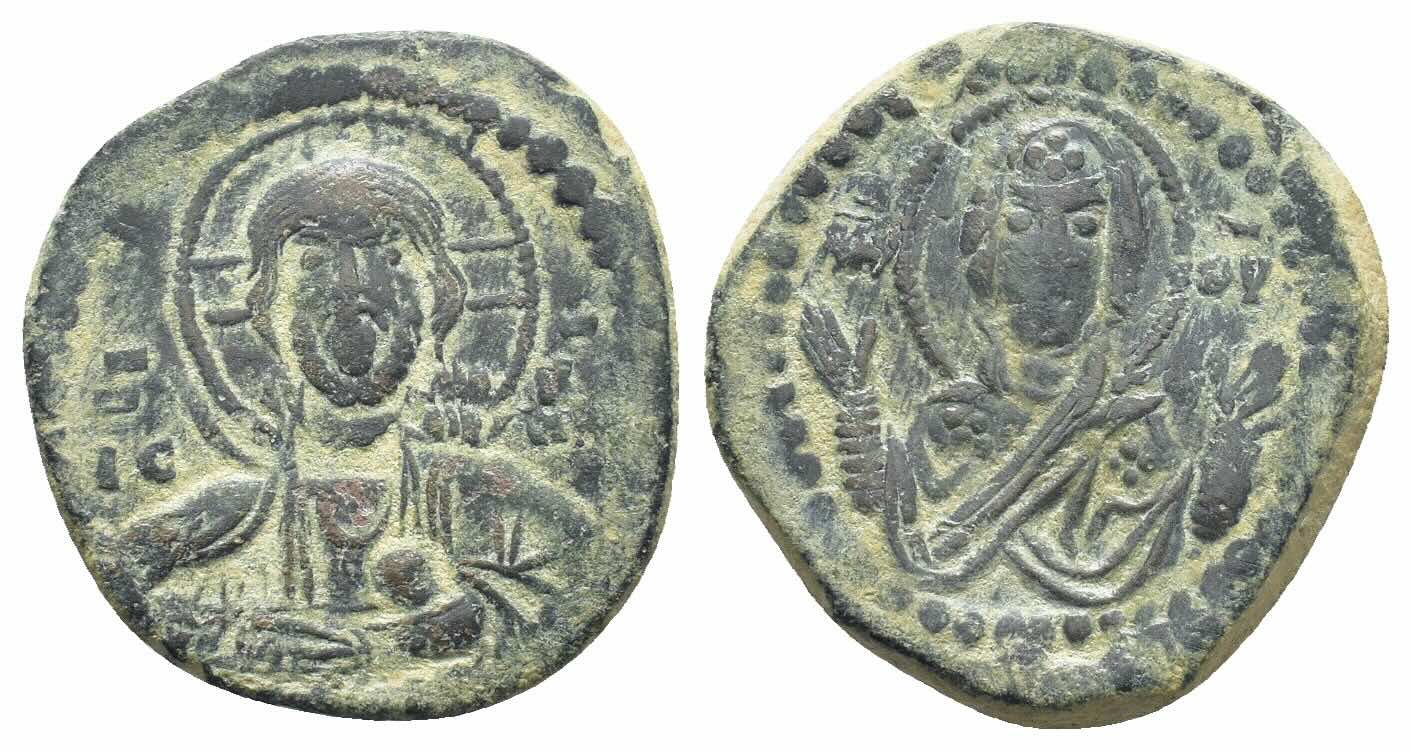 Class G, Sear 1867
27-26 mm. 8.54 grams.
Sear 1867
Bust of Christ/Bust of Virgin Mary.
A better strike than above, not obviously overstruck.
The left hand of the Virgin is raised. How is it that her shoulder on the coin above is so clearly outlined with no hand visible?
These coins show that Class G, Sear 1867, was after Sear 1854 of Constantine X.
Go to the page on anonymous folles.
Go to the main Table of Contents for this entire educational site.